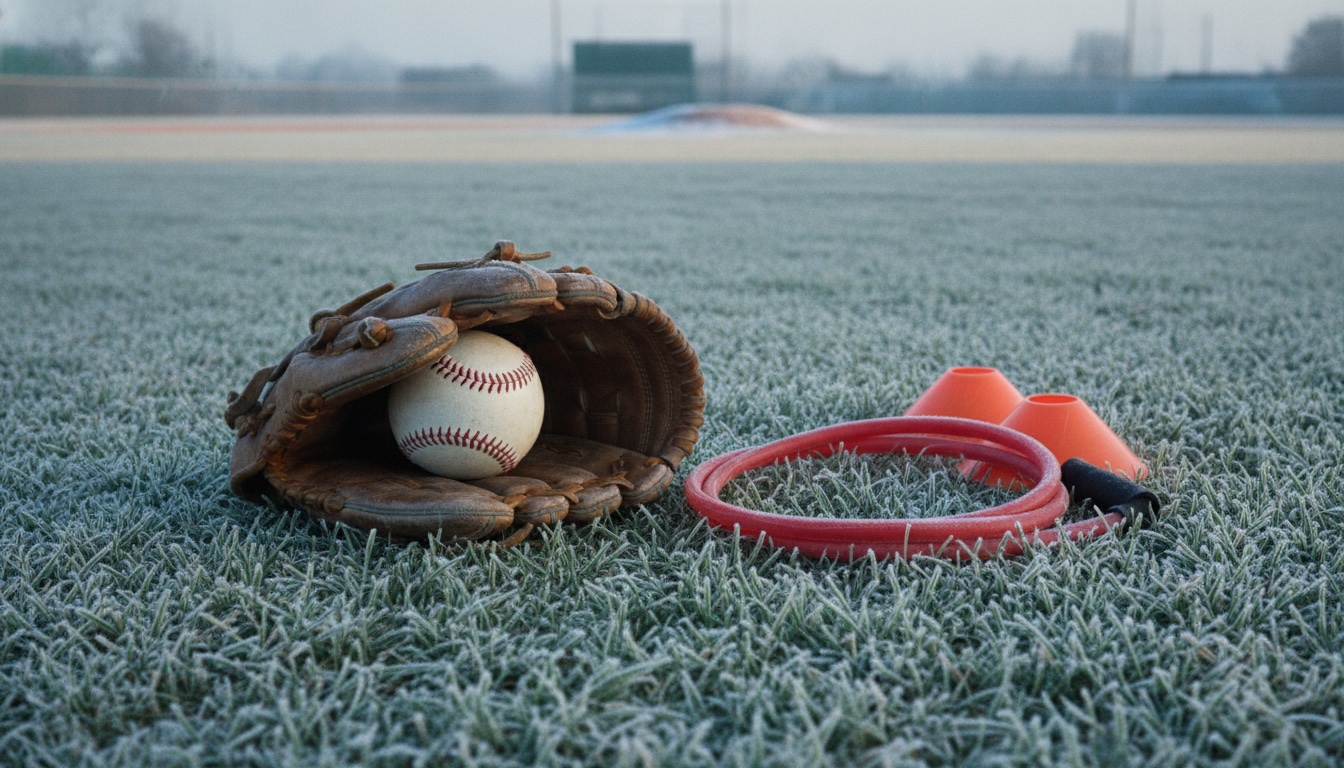
The last out of fall ball had just been made, and one of my 12-year-olds jogged in from center field already asking when winter workouts started. “Two weeks,” I told him. He looked disappointed like rest was a punishment. That is the first mindset we have to flip, because the kids who come back in March with the biggest jumps are not the ones who threw in the backyard every Saturday in November. They are the ones who let their arms rest and spent those months getting genuinely stronger and more athletic.
A complete youth baseball offseason breaks into three phases: active rest (October through November), base building (December through January), and baseball skills re-entry (February). Players under 10 should spend most of the offseason in free movement and multi-sport play. Players 11 and up can layer in structured strength and arm-care work, but only after a minimum 6-week throwing break.
Why the Offseason Window Matters More Than Fall Ball
Most youth programs pile straight into fall ball without giving kids a real break. Sports medicine research is consistent here: players who do not take at least 2 to 3 continuous months off from throwing significantly increase their risk of overuse injuries, the kind that can end a career before high school.
But injury prevention is not the only reason. During the season, you are managing fatigue. The offseason is when real fitness gets built, and it is the window coaches cannot replicate in March when the schedule takes over. Visit our baseball coaching hub for how we think about player development across the full calendar year.
Phase 1: Active Rest (October through November)
The most important thing you can do right now is stop throwing. Not forever, but for a minimum of 6 weeks, and the full 8 weeks for pitchers who threw heavy innings this fall.
Active rest does not mean the couch. It means removing baseball from the equation and letting the body recover through movement that is not overhead throwing. For athletes 10U and under, this phase is essentially the whole offseason: free play, another sport, swimming, wrestling, pickup basketball. Multi-sport participation at young ages builds the movement vocabulary that makes better baseball players later. I have seen it enough times to be a believer. The 11-year-old who spent his winters playing soccer and basketball reads a bounced ball better at shortstop than the kid who took grounders every weekend.
For 11U to 14U athletes, structure this phase simply:
- Weeks 1 and 2: Nothing baseball. Full decompression.
- Weeks 3 through 6: Light general movement, bodyweight work, running, or another sport in-season. No throwing.
Phase 2: Base Building (December through January)
By December, the arm has had its break, and now we build the physical tools that actually make a player better without a baseball in hand.
Strength and Power
The biggest gap we see in youth baseball players is weak legs and an underdeveloped core. A throw’s power originates from the lower half and hips, not the arm. Every squat and lunge your player does in December translates directly to velocity and arm health in March.
For 11U to 14U athletes, we run a 3-days-per-week training block:
- Lower body: goblet squats, reverse lunges, single-leg RDL
- Core: deadbug, Pallof press, side plank
- Upper body pulling (not pressing during arm rest): dumbbell rows, face pulls, band pull-aparts
Our youth baseball strength and conditioning program for ages 12 to 15 has the full progressive layout with sets, reps, and loading guidelines.
Mobility
I had a high school pitcher come to us after back-to-back arm injuries. When we assessed him, his lead-leg hip external rotation was terrible. He could not generate rotation from the ground up, so his arm was doing all the work. Six weeks of targeted hip and thoracic work changed his mechanics entirely, and he stayed healthy the next two seasons.
Mobility priorities for December through January:
- Hip flexors and hamstrings (major limiting factors in young pitchers)
- Thoracic rotation
- Ankle mobility (underrated and almost never addressed at the youth level)
Arm Care Introduction (January, Pitchers Only)
At week 8 of arm rest, pitchers can begin light band work for the rotator cuff and scapular control. This is not throwing. It is movement prep. A basic set of resistance bands is all you need. Our athletes use resistance bands for youth athletes at theranchsports.com, 10% off with no sales tax, and they hold up well through a full winter block.
Phase 3: Baseball Skills Re-Entry (February)
By February, the arm is recovered, the body is stronger, and it is time to reconnect with baseball. We call this the ramp phase: 2 to 4 weeks of progressive skill work before tryouts or spring practice begins.
Throwing
Start easy and short. Week 1: catch play at 30 to 40 feet, 10 minutes, zero intent. Week 2: extend to 60 to 80 feet, still easy. Week 3: flat-ground throwing at 70% effort. Pitchers get back on the mound in week 4 at controlled effort. Our long toss program for youth pitchers maps out a full 4-week build from first toss to bullpen.
Hitting
February hitting is about reconnection, not overhaul. For younger hitters, we keep tee work to the fundamentals: tee height, contact point, one swing cue per rep. That simple framework is exactly right for February. Keep each tee session focused on one thing. Trying to rebuild a swing before spring is one of the fastest ways to wreck a kid’s confidence heading into tryouts.
Fielding
Add 10 ground balls per player and 10 fly balls for outfielders in your ramp-week practices. For outfielders, drop-step footwork is the real gap in how kids are taught to read fly balls. They miss not because of the glove, but because the first step goes sideways instead of back. Add 4 to 5 drop-step reps per outfielder to your ramp week and you will see the difference immediately.
For baserunning, we use a four-decision framework: secondary lead, tag-up, ball in the dirt, and the turn at first. Five reps of each situation in a 15-minute block before the season opens sharpens those reads faster than anything else I have found.
Weekly Training Blocks by Age Group
One More Thing About February
The point of a real offseason is not to keep kids busy. It is to send them into spring practice genuinely more capable than they were in October. When an athlete walks into tryouts having rested their arm, built their legs, and developed their athleticism, coaches feel it and kids feel it.
For players who want to go deeper on the explosiveness side of Phase 2, our plyometric training program for youth baseball players pairs well with the strength block above and is a strong add-on for December through January.
Download this as a free PDF — get the free PDF here
Get "Youth Baseball Offseason Training Plan: Month by Month" as a free PDF
Instant download, plus free coaching resources in your inbox. No spam.
✓ You're in — here's your download
↓ Download the PDFBookmark it for the field — and check your inbox for more free coaching resources.