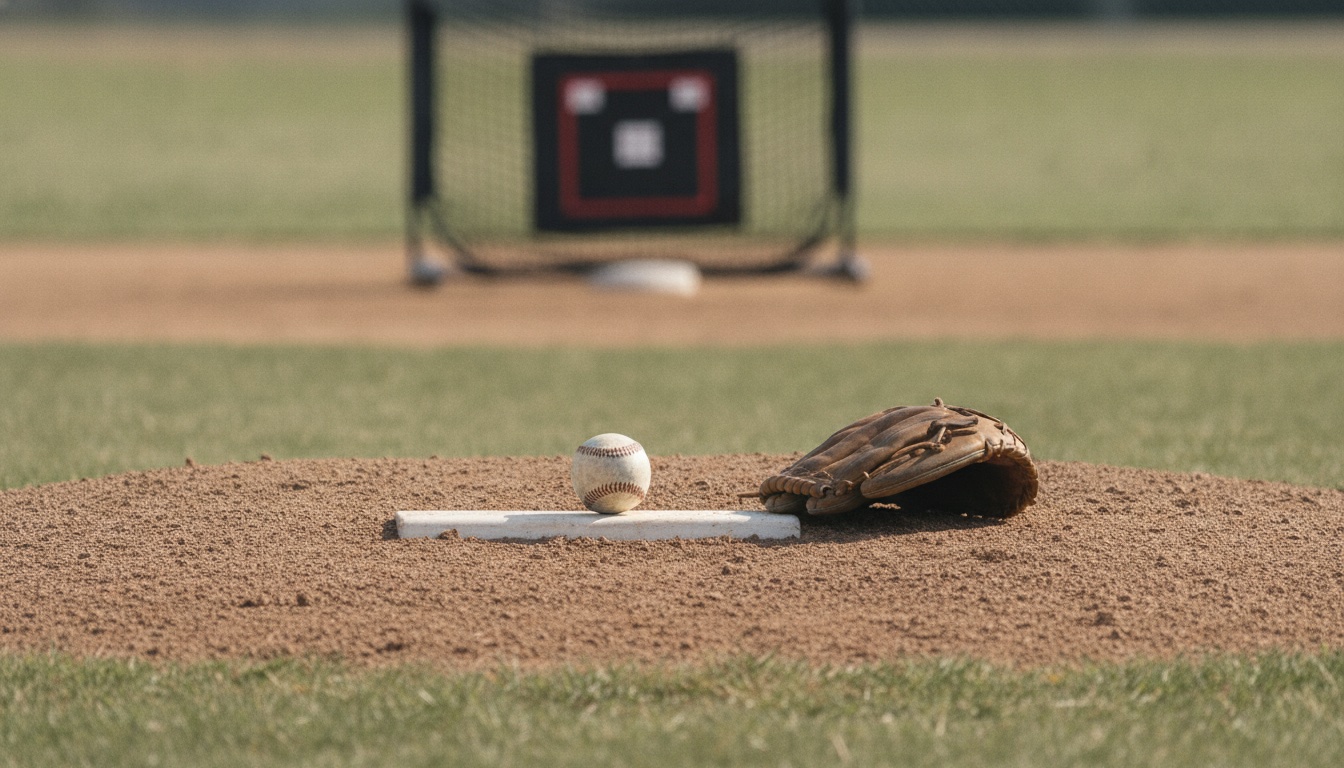
I had a 12-year-old on the mound last spring who could throw 64 mph — which, for a 12U club game, gets every radar gun in the dugout humming. He also walked five batters in two innings and threw 48 pitches before we pulled him. Two rows over in the stands, I heard a parent say: “He has a rocket — he just needs to figure out where it is going.”
That sentence captures exactly the wrong way to think about youth pitching development.
The short answer: At the youth development level, command is the more trainable skill and the higher-value investment — not because velocity does not matter, but because a pitcher who cannot find the zone is not developing any usable pitch. The mechanics that produce command are the same mechanics that eventually produce velocity. Build the delivery, earn the strike zone, then load the gun. That is the sequence that works.
That said, framing it as velocity versus command is a mistake coaches make when reacting to parent pressure instead of player development. The goal is always both, and they are far less separate than they feel when you are watching a radar gun in a dugout.
Why “Velocity vs. Command” Is the Wrong Question
Every serious resource on pitching development arrives at the same conclusion: these two qualities share a foundation. A clean arm path, proper hip-to-shoulder separation, a stable landing foot, and a repeatable release point all produce command. Those same mechanics, when the body matures and adds strength, produce velocity. They are expressions of the same underlying delivery.
The either/or framing usually comes from external pressure — a scout with a gun, a travel team tryout, a parent who just watched a 10-year-old down the road pump 60 mph. The developmental reality is that chasing velocity too early, without the mechanical base to support it, produces two outcomes: inconsistency and arm stress. You end up with a pitcher who throws hard sometimes and wild most of the time, and whose arm starts complaining by 13U because the mechanics that let them generate speed also create stress they cannot absorb.
As one pitching development community puts it: velocity gets you noticed, accuracy makes you relevant. We have seen that play out in our program more times than we can count.
The Case for Command-First at the Youth Level
For pitchers under 14 — and especially under 12 — command is the most teachable skill you have a window to develop.
Strikes get outs. Walks kill development time. A pitcher who walks three batters per inning is not developing anything. They are not reading hitter reactions, not learning to sequence pitches, not competing in a meaningful sense. The game teaches you nothing when you are never actually pitching to contact. I had a 10-year-old with a genuinely good arm who spent two seasons walking batters and barely making it through an inning. We pulled him from starting roles until we rebuilt his command, and the next season he was one of the most effective pitchers in the league. Same arm, different delivery consistency.
Mechanics that produce command also produce velocity — eventually. The hip-to-shoulder separation that creates a late pull through the zone is what puts command on a fastball at the knees. It is also what turns added strength into velocity once the athlete matures. You are not choosing between outcomes when you choose to work on mechanics.
Velocity ceilings are set by physical development, not early training. Most meaningful velocity gains come from physical maturity — height, weight, hip strength, rotational power. There is limited evidence that dedicated velocity training before age 14 produces lasting advantages; there is strong evidence that mechanical durability does.
The Case for Velocity Intent (and Why You Cannot Train It Out)
Here is what gets missed in command-first conversations: if you train a youth pitcher to locate pitches while pulling off the delivery or decelerating through the zone, you have built a habit that will actively limit their ceiling.
Velocity intent is the neurological pattern of throwing as hard as you can. If a pitcher learns to aim — to steer the ball at reduced effort — instead of accelerate through the delivery, command training becomes counter-productive. A pitcher who aims at a target with a 60% effort delivery will never throw 80 mph at 17, no matter how strong they get, because the motor pattern is wrong.
The real skill is learning to locate at full intent. That is the harder problem and the more important one. See our breakdown of proven methods to increase arm velocity in youth baseball for more on how to build that pattern correctly without sacrificing mechanics.
How to Diagnose Which Is Limiting YOUR Pitcher Right Now
This is where most coaching advice stops short. Everyone agrees “develop both” — but no one tells you how to decide which to prioritize for this pitcher, right now. That diagnostic is what turns generic advice into actual coaching.
We use a two-part assessment at the start of every fall bullpen:
Part 1 — Intent check. Watch five fastballs at full effort, no target pressure, no verbal cues. Just “throw it.” Look for arm speed, note release point consistency, watch ball carry and life. If velocity intent is clearly present — the ball has plane, carries late, the delivery looks athletic — the issue is almost certainly mechanical consistency. Verdict: work command.
Part 2 — Mechanics check. Now ask for five pitches to a specific target at full effort. Count how many land within six inches of the target and note the direction of misses. Consistent direction (always arm-side high, for example) means a mechanical fix is available. Random scatter means the delivery is not repeatable yet. Verdict: fix the delivery first, then work command.
If Part 1 shows low intent and Part 2 shows poor location, start with the delivery. Command training on a broken delivery locks in bad compensation patterns. For a full walkthrough of this assessment approach, our guide to assessing a youth pitcher before assigning drills lays out exactly what to look for.
Designing a Bullpen That Builds Both
The gap in most development plans is not philosophy — it is structure. No one explains what a productive bullpen session looks like when you want both command and velocity intent. Here is the Intent and Location block we run with 10U-14U pitchers:
How to Track Command Progress
Velocity has a built-in measurement tool. Command does not — and that is a big part of why it gets under-developed. Coaches can point to a radar number and feel like they are making progress. Command requires a different feedback system.
We track two metrics:
Zone percentage. What percentage of pitches land in the strike zone during bullpen sessions? A developing 10-year-old targeting fastball command should hit 60% or better in the bullpen and 55% or better in games. These are not hard cutoffs, but they give you a trend line over a season.
Miss direction. Consistent misses are mechanical. Random scatter is a delivery consistency problem. We mark four quadrants on a target — high/low, arm-side/glove-side — and chart where misses cluster over several bullpens. Consistent arm-side misses point to arm path. Consistent high misses point to the landing position. Truly random misses mean we go back to the delivery entirely. This gives us something to coach from without a biomechanics lab.
The Radar Gun Culture Problem
Here is the conversation that does not happen enough in coaches meetings: social pressure from radar guns is actively distorting development decisions at the youth level.
At travel showcases, guns come out at 10U. Parents text each other numbers. Coaches feel pressure to show velocity gains to justify roster spots. The kids feel it — they start pushing, steering, and tensing trying to hit a number. And tension is the enemy of arm speed.
I watch it happen every fall tryout cycle. A pitcher who was throwing loosely and efficiently suddenly gets stiff in the elbow trying to add three mph for the evaluators. The result is lower velocity, worse command, and increased arm stress — the exact opposite of what everyone was chasing. The most common youth pitching mistakes we see are almost all rooted in this pressure — young pitchers trying to look like something instead of learning to do something.
The conversation I have with every parent at the start of the season: if your pitcher builds a repeatable, athletic delivery and learns to throw strikes, the velocity will come. The body matures, hip strength develops, and a solid mechanical foundation translates all of that into miles per hour. Chase the number at 11 and you have bought the worst possible trade.
Age-Specific Development Guide
8U-10U: Zero velocity pressure. Every bullpen is about rhythm, balance, and finding the zone with a relaxed arm. Zone percentage is the only metric worth tracking, and only loosely.
10U-12U: Begin introducing half-zone targets in bullpens. Track zone percentage and miss direction, not MPH. Run the Intent and Location block above at least once per week. This is the window where consistent command work pays the biggest developmental dividend.
12U-14U: Use the two-part diagnostic assessment above. Some pitchers at this age are ready for spot-up command work; others still need delivery consistency work first. Read the pitcher, not the age.
14U and up: Velocity starts to matter for competitive visibility. By now, command should be developed enough that velocity training — structured long toss, lower-half power work, age-appropriate weighted implement training — can be added without sacrificing zone presence.
The Takeaway
Velocity versus command is a false choice. The real question is: what does this pitcher need most, right now, to take the next step in their development?
For most youth pitchers under 14, that answer is command at full intent — not aiming, not steering, but locating a legitimate fastball with a delivery that is repeatable and will not hurt them. Build that, and the velocity will follow. There is no shortcut in the other direction that actually works.
For more on developing complete pitchers and a full pitching curriculum, visit our baseball coaching hub.
Download this as a free PDF — get the free PDF here
Get "Youth Pitcher Velocity vs. Command: Which Matters More?" as a free PDF
Instant download, plus free coaching resources in your inbox. No spam.
✓ You're in — here's your download
↓ Download the PDFBookmark it for the field — and check your inbox for more free coaching resources.