A few years ago I had a 13-year-old shortstop show up to fall tryouts in August looking noticeably different — faster out of the box, quicker first step to his left, better carry on his throws across the diamond. His dad pulled me aside afterward and said his son had done about 45 minutes of strength work, three times a week all summer. That was it. No gimmicks, no heavy barbell, no expensive facility. Just a smart, progressive strength and conditioning program built for a kid his age.
The short answer: youth baseball players ages 12-15 need 2-3 strength sessions per week, focused on lower-body power, rotational core, and arm-health work — not max-effort lifting. The off-season is for building a strength base, the pre-season converts that base into baseball-specific power, and in-season sessions shrink to one per week to maintain gains without grinding the arm down. The three-phase program below covers all of that with specific exercises and coaching cues for each block. It fits within the broader youth athletic development framework we use across our entire program.
Why Ages 12-15 Is the Critical Window
Before high school cuts, select teams, and recruiting conversations begin, there is a development window most families treat as a holding pattern. That is a mistake.
Research from the NSCA and performance methodologies developed for elite youth training show that the 12-15 window is when athletes build the physical foundation that determines their ceiling as high school players. The nervous system is highly trainable. Rotational power and throwing velocity respond directly to purposeful strength work at this age — and those gains compound over time.
Our athletes who enter this program at 12 are, without exception, physically further ahead at 15 than equally-skilled peers who only played games. For most 12-13 year olds, bodyweight exercises and progressive resistance are the right starting point — genuinely effective at building the base before any external load is added.
The Five Baseball Qualities This Program Targets
Every scout evaluating a 14-15 year old watches for the same five tools: hitting ability, raw power, speed, arm strength, and fielding. Our strength program connects directly to all five:
- Lower body strength — first-step quickness, baserunning speed, and the drive mechanics behind both throwing velocity and bat speed
- Rotational core — exit velocity, pull-side power, hip-to-shoulder separation in the swing
- Shoulder and scapular stability — arm health across a full season and the ceiling on throwing velocity
- Hip mobility — range of motion in the fielding position, hip load in the swing and delivery
- Plyometric power — explosive first step, blocking angles in the field, sprint mechanics off the bases
Everything in this program earns its place by connecting to at least one of those five qualities. If an exercise does not, we do not use it.
The Three-Phase Year-Round Structure
Most articles give you a list of exercises. We are giving you a system, because exercises without a structure are just a random workout.
Phase 1 — Foundation (Off-Season, 8-10 weeks): Two to three sessions per week. Loads are light to bodyweight, and the goal is movement quality above everything. Players learn the hip hinge, the rotational brace, and basic pressing and pulling patterns before any resistance is added. Single-leg stability and posterior chain work — two areas most young players have never trained intentionally — get serious attention here.
Phase 2 — Power Ramp (Pre-Season, 4-6 weeks): Sessions stay at 2-3 per week but intensity increases. Med ball work replaces some bodyweight drills. Resistance goes up modestly. Plyometric components — broad jumps, lateral bounds — come in. The sessions start to feel baseball-specific, and the goal is converting the strength from Phase 1 into the kind of power that shows up in an April game.
Phase 3 — In-Season Maintenance (Season Length): This is the phase almost nobody covers, and it is where most youth programs fall apart. Players go to nothing in-season and lose 30-40% of their off-season gains by June. Or they try to maintain off-season volume and their arm health suffers.
The answer: one session per week during a normal week, no lifting the day before or day of a game, and a shorter session during tournament weekends. Keep lower body and core work. Pull back upper body pressing volume. The goal is not to get stronger in-season — it is to not get weaker.
I had a 14-year-old catcher two seasons ago who would not trust this. He kept grinding full off-season sessions through May. By tournament play in June he was calling it fatigue and his pop time to second had gone up a full tenth of a second. We pulled him to one short maintenance session per week for the last three weeks and he came back sharp by playoff time. In-season load management is a skill coaches and players both have to learn.
Phase 1: Foundation Block — Sample 3-Day Week
Use this for the first 8-10 weeks of the off-season (October through December for most programs). Each session runs 40-50 minutes including warmup.
Warmup (every session, 8 min): Hip circles, leg swings front-to-back and lateral, lateral band walks, arm circles progressing small to full range, easy jog or shuffle for 90 seconds.
Phase 2: Power Ramp — The Three Key Additions
Once Phase 1 is complete, these three movements rotate in. They replace one Foundation exercise per session — do not stack them on top of an already full workout.
In-Season: What a Maintenance Week Looks Like
Here is the weekly template we use with our 13-15 year old travel players for a normal two-game week — adjust game days to match your schedule:
Monday (full session, 35-40 min): Lower body and core from Phase 1 or 2. Upper body limited to one set of pulling and one set of pushing. Light band shoulder work only.
Tuesday (game day): Nothing. Rest and hydrate.
Wednesday (light session, 20 min): Glute bridges, dead bugs, hip mobility circuit, lateral band walks. No heavy lower body, no upper body load.
Thursday (game day): Nothing.
Friday: Optional movement only — light jog, foam rolling, arm circles. Not a training session.
Weekend: Rest or light activity.
Tournament weekend with three-plus games in two days: skip the Monday session entirely. A 15-minute mobility and activation routine before the first game Saturday morning is enough. Protect the arm and the legs first.
Resistance Bands: The Most Underused Tool in This Program
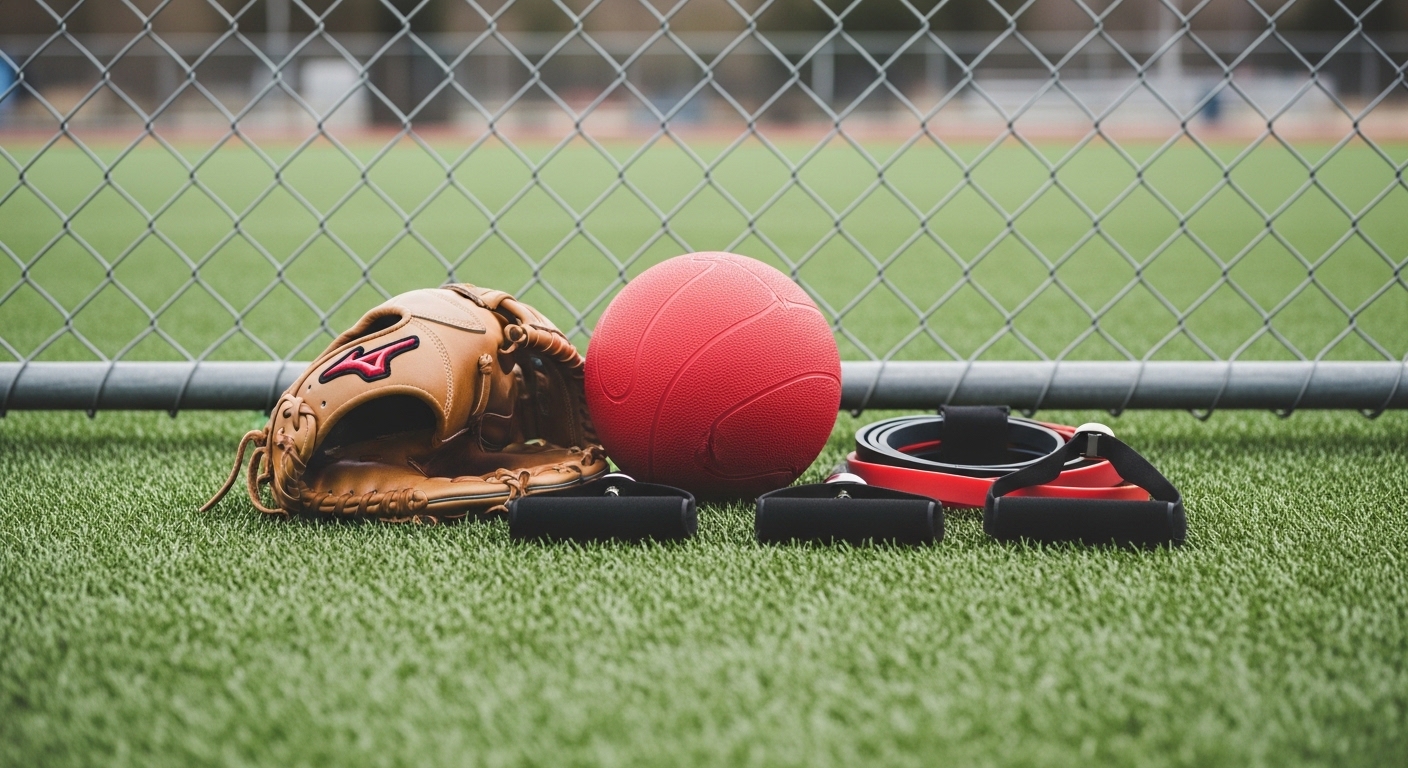
Bands belong in every phase. In Phase 1 they provide enough resistance to reinforce pulling patterns without joint stress. In-season they are the primary tool because they travel — hotel room, dugout warmup area, anywhere. We use them for pull-aparts, face pulls, lateral walks, and the half-kneeling rows in Phase 1.
Resistance band training for youth athletes is genuinely underused in youth baseball, and it is one of the first additions we recommend to any family starting this program. You can find a set at theranchsports.com that covers the right resistance levels for this age group, with 10% off and no sales tax on your order.
The Multi-Sport Connection
Our 12-15 year old athletes do not specialize in baseball year-round — we are deliberate about that. Several of our club players run cross country in the fall. Others play flag football or soccer. The lateral movement patterns, the aerobic base, the contact mechanics — they all feed into what this program builds.
Why multi-sport athletes develop into better baseball players is not just a philosophical argument — it is movement variety that prevents overuse injury and develops athleticism no amount of baseball reps alone can replicate. If your athlete is in a sport with heavy overhead demand (volleyball, swimming), reduce the pressing volume in this program for that season. If they are in a rotational sport (tennis, golf), cut the med ball sets in half and spend more time on landing mechanics instead.
Starting the Program
For athletes who have never done structured strength work: treat the first three weeks of Phase 1 as a movement quality audit with no added resistance. Just pattern the hip hinge, the squat, the pull, and the core braces. Add light resistance in week four once the patterns are consistent across sessions. This matters most for players who have only ever done baseball skill work — the first time most of them try a proper hip hinge, they discover they have never used their hamstrings intentionally.
If you are unsure whether your athlete is ready for any loaded work at all, our article on when kids can start weight training covers the readiness markers we look for before we add any resistance with a youth player.
The goal of this window is not to build the strongest 13-year-old in the gym. It is to arrive at 16 with a physical foundation — an athlete who moves powerfully, stays healthy across a full season, and has the tools to develop into a competitive high school and collegiate-level player. Every exercise in this program points toward that outcome.