I had a junior pitcher on our club team last spring who sat 84-85 mph in our first March tournament. By mid-May he was touching 80 on a good day. His mechanics looked the same on film. He was not overthrowing or showing any arm health issues. What changed was that the moment his high school season started, he stopped lifting entirely — because someone told him you do not want to be sore before a start.
That advice is not wrong. It is incomplete. The full answer is that timing your in-season training correctly means you are never sore before you pitch AND you hold your velocity from the first game all the way to the summer showcase circuit.
The answer: Two abbreviated strength sessions per week — one the day after a start and one three to four days before your next appearance — will prevent the late-season velocity drop many high school starters see by late May when they go cold between starts. You do not need your full offseason program during the season. You need a 30-minute routine focused on the posterior chain and hip rotation, which is the physical foundation your fastball is built on.
Why Most High School Pitchers Lose Velocity by June
Most high school pitchers fall into one of two traps: they try to keep running their full offseason velocity program and show up to games fatigued, or they drop all training and slowly lose the physical base they spent all winter building. Both paths land in the same place — less velocity by June.
The mechanism is straightforward. Pitching velocity is primarily driven by lower-body power and hip-to-shoulder separation, the kinetic chain that whips the arm through the release zone. That power comes from fast-twitch muscle fibers in the glutes, hamstrings, and posterior chain. Fast-twitch fibers degrade faster without training stimulus than slow-twitch fibers. When a pitcher throws two or three times a week but does zero lower-body work between outings, he is gradually trading his athlete’s legs for a thrower’s legs.
We track this on our teams every spring. The pitchers who maintain abbreviated strength sessions in-season consistently throw harder in May than the pitchers who train hard through February and then go completely cold. Velocity is an athletic output, not a mechanics trick. You cannot mechanic your way back to a number your legs can no longer produce. For the full picture on what drives arm speed in the first place, our piece on how to increase arm velocity in youth baseball covers the physical contributors that carry through to the high school level.
Your Weekly Structure: Starters vs. Relievers
This is where most in-season training guides fall apart. Starters and relievers live on completely different weekly schedules, and the training has to reflect that.
For starters on a 5-7 day rotation, you have a predictable window every week:
- Day 0 (game day): No lifting. Full focus on competing.
- Day 1 (day after a start): Bounce-back session at 60-70% effort. Light medicine ball rotational work, mobility, and band exercises. This session tells your body to start recovering actively rather than just sitting still. A pitcher who does 25 minutes of low-intensity movement the morning after a start bounces back faster than one who lies on the couch all day.
- Days 2-3: Your hardest training window of the week. Moderate lower-body strength work and any intent throwing. If you run a long toss program, this is its home. Our long toss program for youth pitchers covers the distance and intensity guidelines that apply equally well during the season.
- Day 4: Back off. No heavy lower body. Shoulder health exercises, core work, light band activation.
- Days 5-6: Rest or light movement. Do not lift the day before you pitch.
For relievers appearing multiple times per week, flexibility matters more than a fixed schedule. A solid default: one meaningful training session in the first 48 hours after your last appearance, and nothing more demanding than band work and mobility after that. If you throw Monday and again Thursday, Tuesday is your training day. If you pitch on back-to-back tournament days, skip the session. Rest wins.
The Two-Session In-Season Protocol
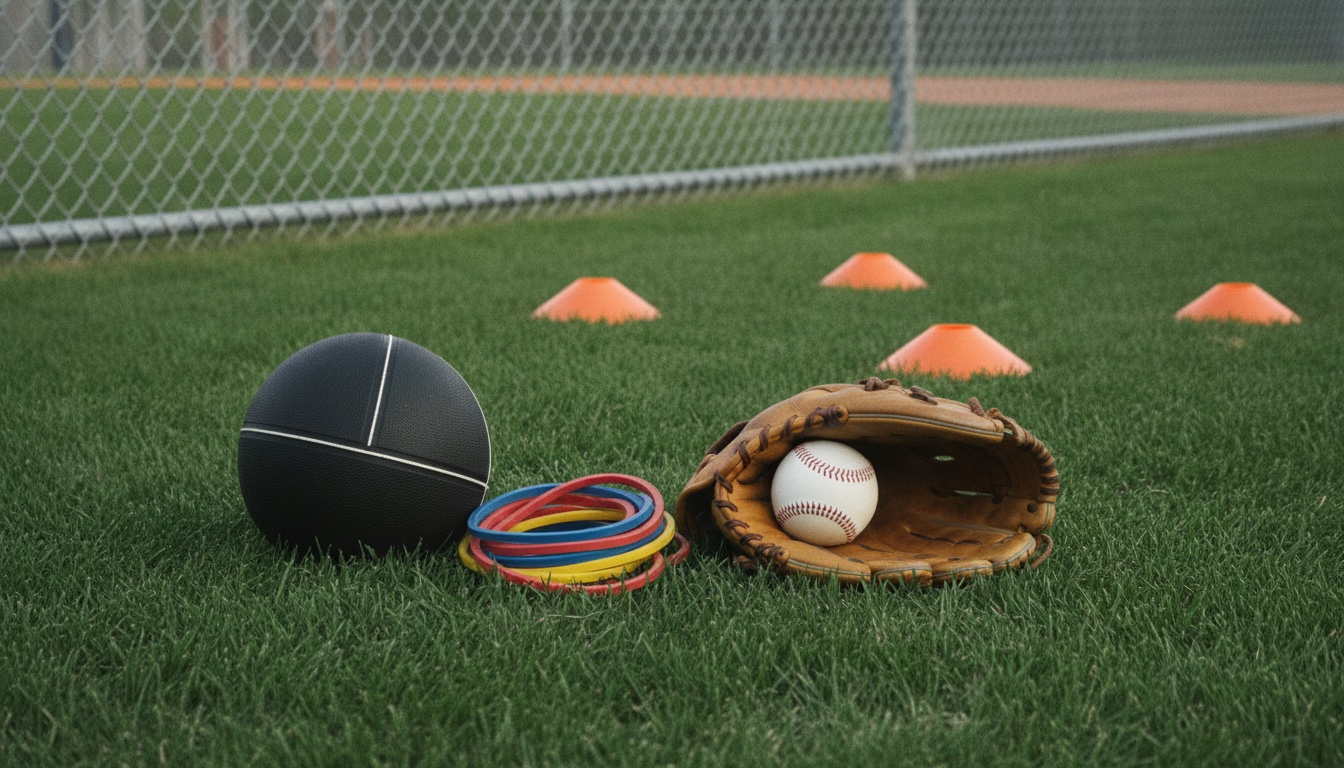
Both sessions together take about 30-35 minutes. The equipment needed is minimal — a medicine ball, a set of resistance bands, and access to a barbell or dumbbell for one lower-body movement.
Session A — Bounce-Back Day (Day 1 after an outing)
Session B — Power Maintenance (Days 2-3)
What About Weighted Ball Work In-Season?
We get this question constantly. Our position: structured weighted ball velocity programs belong in the offseason for high school pitchers, especially ages 14-17. Stacking overload ball work on top of an active pitching schedule and a strength program creates more total arm stress than most developing pitchers should absorb during a season.
If you completed a structured weighted ball protocol during the fall or winter and your arm is well-adapted, light constraint work — connection balls, not heavy overload balls — in your Day 2-3 bullpen session is manageable. If this is your first year of organized velocity training, skip it until the offseason. One season of patient maintenance is worth more than one spring of aggressive overload followed by a mid-summer shutdown.
Red Flags: When to Stop All Velocity Work
This is the section most in-season training guides skip entirely, and it is the most important one.
Stop velocity-focused training immediately if a pitcher reports arm fatigue more than 48 hours after a start — not muscle soreness, but the heavy, dead sensation that says the arm has not yet recovered. This is a workload problem and it requires rest, not more stimulus.
Stop if mechanics start breaking down mid-game in ways that were not present in April. Early hip opening, elbow dropping below shoulder height, loss of hip-to-shoulder separation showing up by the fifth inning — when these appear in May, they are usually a physical load problem wearing a mechanics mask. Reduce throwing volume and back off the training before reaching for a mechanical fix.
Stop for any pain or tenderness at the medial elbow. This is an immediate sports medicine visit. No exceptions, no stretching it out.
When any of these appear, shift entirely to mobility work, light band exercises, and full rest before appearances. Protecting the arm is the job.
The Bigger Picture
For pitchers 14-17, the long-term development arc matters more than any single season’s velocity number. The athletes we have seen develop most consistently through high school carry physical qualities built across multiple sports — hip mobility, rotational power, posterior-chain strength — that transfer directly to the mound. The youth athletic development hub covers how we think about building complete athletes at this stage, and our article on plyometric training for youth baseball players goes deeper on the explosive movement training that underpins in-season velocity maintenance.
In-season training done right keeps you at 84 mph in June when the summer scouts show up, not 79. There is no single moment where you feel it working. It just means you finish April where you started it, and that is the whole point.