- Practice time
- 90 minutes
- Ages
- All ages
- Drills
- 10, in 7 blocks
- You need
- Cones, a ball for every two players, timer, a tee and net
The 90-minute plan
- 0:00
Dynamic warm-up
10 min- Jog, high knees, carioca, lunge walks, two short sprint races to first
Say: “Last one to the line picks up the cones.”
- 0:10
Catch play with a target
12 min- Partners at 30 feet moving back to 60, five in a row at the chest earns a step back
Say: “Point your glove at the chest, then throw where you're pointing.”
- 0:22
Focus: ground balls, three stations
36 min- Station A: short-hop rollers from 15 feet, field it out front (12 min)
- Station B: fungo grounders at shortstop, throw to first (12 min)
- Station C: partner rollers, 10 forehand and 10 backhand (12 min)
Say: “Glove on the ground early, see it into the glove.”
- 0:58
Water
3 min- Three minutes on the clock, then jog to the next block
- 1:01
Hitting stations
18 min- Tee-then-soft-toss into a net (9 min rotations)
- Baserunning off contact on the coach's go or back call (9 min rotations)
Say: “Hit the middle of the ball, back through the middle of the field.”
- 1:19
Competitive game: 21 Outs
8 min- Defense records outs on coach-hit grounders, every error costs one
Say: “Two hands, quick feet, firm throw.”
- 1:27
Huddle
3 min- One takeaway said by a player, then announce the next practice's focus
Say: “What's one thing you got better at tonight?”
Get "Youth Baseball Practice Plan Template (Printable, Any Age)" as a free PDF
Instant download, plus free coaching resources in your inbox. No spam.
✓ You're in — here's your download
↓ Download the PDFBookmark it for the field — and check your inbox for more free coaching resources.
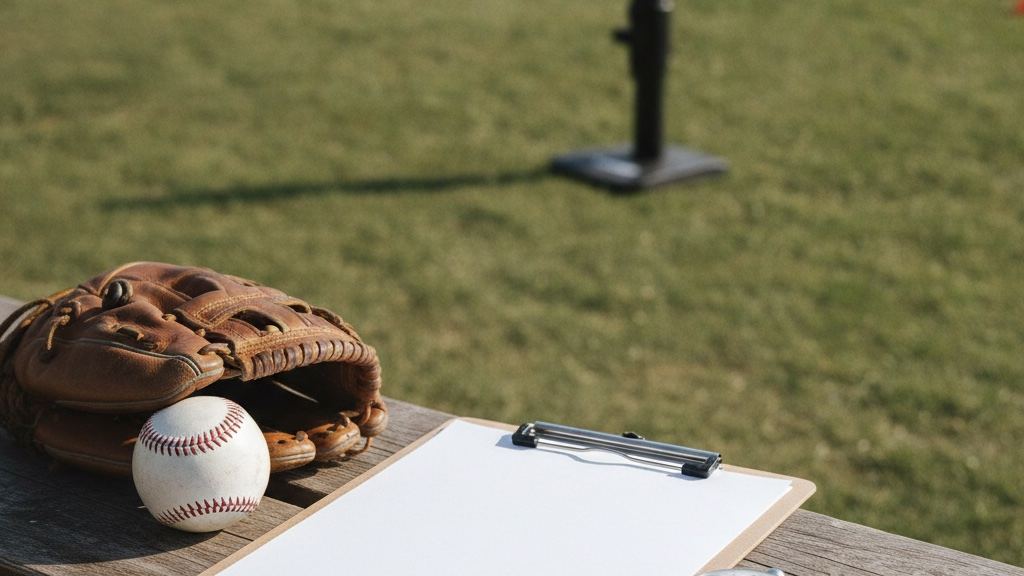
Tuesday, 5:40 PM, twenty minutes before practice. My assistant texts: “What are we doing tonight?” I’m in the parking lot flipping over a fast-food receipt to sketch out the evening. For years that was my practice planning. Some nights it worked. Plenty of nights I lost the middle 20 minutes to a drill that ran long, and we never got to the thing I actually wanted to fix from Saturday’s game.
What fixed it wasn’t a better drill book. It was one sheet of paper with the same boxes every time.
The short answer: a good youth baseball practice plan template has five things: (1) one written focus for the day, (2) time blocks with start times, not just durations, (3) a station grid that shows which group is where during each block, (4) the equipment each block needs, and (5) a “standing around” check so no kid sits idle for more than a couple of minutes. Fill it in the night before. It takes about 10 minutes once you’ve done it twice.
Below is the template we use from 7U all the way to high school. It’s built to be reusable. For full age-specific plans with the drills already chosen, use our 6U tee ball, 8U, 10U, 12U or 14U plans. This page is the blank sheet underneath all of them.
The Printable Template
Copy this into a doc, or print it straight from this page. One sheet per practice.
Header
| Field | Fill in |
|---|---|
| Date / Field / Start–End time | ____________________ |
| Players expected / Coaches available | ____ players / ____ coaches |
| Today’s ONE focus | ____________________ |
| Where it came from (last game, last practice) | ____________________ |
| Weather / field plan B | ____________________ |
Practice blocks
| Start | Block | Min | What we’re doing | Coach | Equipment | Idle check |
|---|---|---|---|---|---|---|
| :00 | Arrival + dynamic warm-up | Cones | ☐ | |||
| Throwing / catch play | Balls (1 per 2) | ☐ | ||||
| Skill block 1 (focus) | ☐ | |||||
| Skill block 2 / stations | ☐ | |||||
| Water | 3 | ☐ | ||||
| Team block (situations / baserunning) | Bases, helmets | ☐ | ||||
| Competitive game | ☐ | |||||
| Huddle + one takeaway | 3–5 | Head coach | ☐ |
Station grid (use during skill blocks)
| Rotation | Station A | Station B | Station C | Station D |
|---|---|---|---|---|
| 1 (start ____) | Group 1 | Group 2 | Group 3 | Group 4 |
| 2 (start ____) | Group 4 | Group 1 | Group 2 | Group 3 |
| 3 (start ____) | Group 3 | Group 4 | Group 1 | Group 2 |
| 4 (start ____) | Group 2 | Group 3 | Group 4 | Group 1 |
| Coach / self-run |
After practice (2 minutes, same night)
| Question | Note |
|---|---|
| Did we hit the focus? (Y / partly / N) | |
| Which block ran long, and why? | |
| Next practice’s focus |
That last box is the most important one on the sheet. It’s where tomorrow’s plan starts, and it’s why the next practice takes 10 minutes to plan instead of 30.
How to Fill It In: Timing by Age
Most templates you’ll find online hand you fixed blocks: 20 minutes of this, 20 of that, two hours total. That doesn’t work for a 7U team that has a 60-minute weeknight slot, or a 14U team that needs most of its time on team defense. Start from the total time you actually have, then split it.
| Age | Typical practice | Warm-up + throwing | Skill / station blocks | Team block + game | Station length |
|---|---|---|---|---|---|
| 6U–8U | 60 min | 15 min | 25 min (3–4 stations, 6–8 min each) | 15 min | 6–8 min |
| 9U–10U | 75–90 min | 20 min | 30–40 min | 20–25 min | 10–12 min |
| 11U–12U | 90 min | 20–25 min | 35–40 min | 25–30 min | 12–15 min |
| 13U–14U | 90–120 min | 25 min | 40–50 min | 30–40 min | 15–20 min |
Two rules sit on top of that table:
- Write start times, not just minutes. “6:22 — rotate” is something you can hold yourself to. “15 minutes” turns into 25 the second a drill starts going well.
- Spend the most time on the focus. If Saturday’s problem was throwing to first, that skill gets the longest block, not an equal slice. GoRout’s example plans give every skill 20 minutes. We don’t. Equal time means nothing gets fixed.
If you’re new to rotating groups, our guide to running a station-based practice covers staffing, signals and what to do when you only have one assistant.
A Filled-In Example: 90 Minutes, 12 Players, 2 Coaches
Here’s the template filled in for a 10U team whose focus came from a weekend game where we booted four routine ground balls. Use it as a model for how specific each line should be.
That’s 90 minutes with 36 of them on the focus. The before-practice routine in Block 1 is broken down in detail in our team warm-up routine guide, and if you need more games for Block 6, we keep a list of fun, gamified baseball drills that work at every level.
The Column Nobody Else Puts on the Sheet: The Idle Check
Here’s the box we added after watching video of our own practice. I set a phone on the fence one night with my 10U team and counted. During a 15-minute “infield practice” block, our shortstop got four ground balls. The other ten kids in line averaged about three. Fifteen minutes, three reps.
Now every block on our template has an idle check: before practice, look at each block and ask how many kids are standing still at any given moment. If the answer is more than two or three, the block needs another station, a partner drill, or a second line. Common fixes:
- One line, one coach → two lines. A player tosses rollers to the second line while the coach hits fungoes to the first.
- Live BP with nine fielders → three hitters rotating fast, with everyone not on defense hitting in the cage or doing tee work.
- “Wait for your turn” baserunning → everyone runs at once from different bases on the coach’s call.
This also matters for development, not just behavior. Kids under 12 build athleticism through lots of movement, things like changing direction, throwing and sprinting, more than through standing in a line. A plan with tight idle checks is a more athletic practice without adding a minute.
Common Template Mistakes We See
- Five focuses. One sheet, one focus. A second skill can be maintenance, like catch play, but only one gets the long block.
- No plan B. Write the rain or short-field version in the header. When the field is taken or the sky opens, you’ll be glad you did. Our indoor practice plan slots straight into the same blocks.
- Scrimmage as the default ending. A full scrimmage at 8U is 16 kids watching two. A short competitive game built around the focus gets more done.
- No after-practice notes. If you skip the last box, you start from zero next time.
Gear That Makes the Template Work
You don’t need much: cones to mark station boundaries, a ball for every two players, a stopwatch or phone timer, and at least one tee and net so a hitting station can run itself while coaches are busy elsewhere. If you’re stocking up for spring, theranchsports.com gives our readers 10% off with no sales tax, which helps when a full team set of balls and two tees adds up fast.
For everything else about building your season, from the first practice to tryouts, start at our baseball coaching hub or browse every plan on the practice plans page.
Download this as a free PDF — get the free PDF here