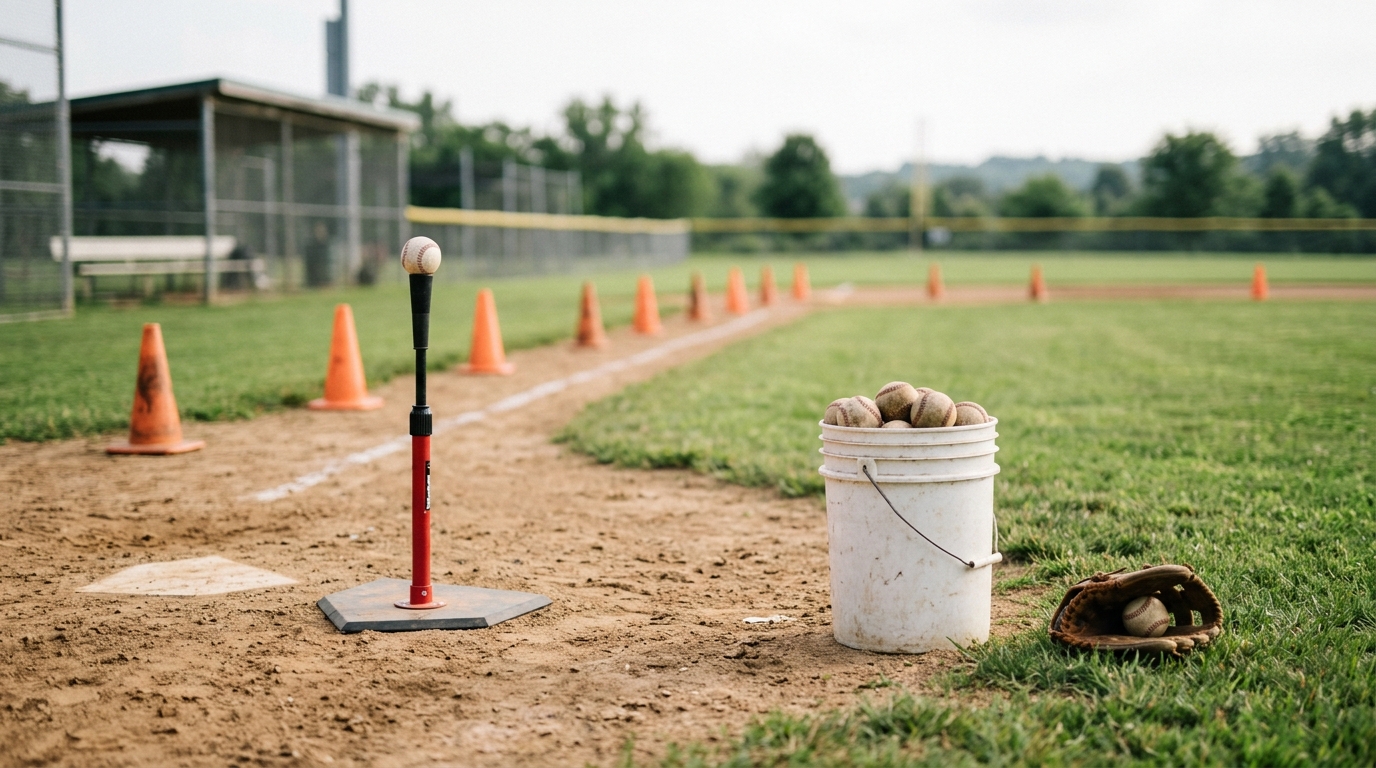
Three coaches, 16 players, 75 minutes. The first time I ran a station-based practice with my 10U group, I drew it up on a napkin in the parking lot before practice. Four stations, four groups of four, a stopwatch on my phone, and one assistant. It wasn’t perfect — I forgot to assign a station for base running and had six kids standing around a cone by minute 30. But by the end of practice I noticed something I hadn’t seen all season: every single kid had been moving the whole time. No one was watching a bird in center field. No one had their glove on their head. They were playing baseball.
That napkin became the template I’ve refined over the last decade, across rec leagues, club teams, junior high, and high school. Station-based practice is the single highest-leverage change any youth coach can make, and it doesn’t require a full staff or extra budget to pull off.
What Station-Based Practice Actually Is
Organize your roster into small groups — typically 3–4 players each — that rotate through 3–5 timed skill stations across the practice block. Each station runs for a fixed time window, not a set number of reps. Groups rotate on a signal. You, as the head coach, roam rather than anchor to one station.
That’s the whole framework. The power is in repetitions per player per minute. In a traditional all-team drill where you throw ground balls to one kid at a time, 15 players watch while one player works. In a station model, all 15 are working simultaneously. The math isn’t close — stations give every player 3–5x more active reps in the same practice window.
Before You Arrive: Plan It in 10 Minutes
Good station practices start the night before, not on the field. Here’s the habit that keeps planning manageable:
- Pick 3–4 skills that match your current team priorities — not every skill, just this week’s focus.
- Assign each station a fixed physical location (first base line, home plate area, outfield grass, mound). Fixed locations mean players know exactly where to go without debate.
- Flag which stations need a coach and which can run themselves. Aim for at least one self-managed station — this frees a coach to roam and coach, instead of running drills.
- Write group assignments on a whiteboard or notecard posted in the dugout. Players check the board; you don’t burn 5 minutes calling names.
For a full menu of station ideas by age and skill, our batting cage station breakdown covers hitting, fielding, and throwing stations you can slot directly into this structure.
Rotation Timing by Age
This is where a lot of coaches go wrong — they either rotate too fast (players never settle in) or too slow (they check out). Benchmarks we use:
| Age Group | Station Length | Rotations per Practice |
|---|---|---|
| 7U–9U | 10–12 minutes | 4–5 rotations |
| 10U–12U | 13–17 minutes | 3–4 rotations |
| 13U–High School | 18–22 minutes | 3 rotations |
Younger players have shorter attention windows and benefit from more novelty — keep the clock moving. Older players can sustain longer blocks when the task has real depth (a live BP rotation, a bullpen session, a defensive film breakdown).
Always use time, not reps, to trigger rotation. When players know a station lasts 15 minutes, they pace themselves and work with more intention. Counting reps creates rushing and shortcuts.
Staffing Stations When Help Is Short
Most youth coaches aren’t working with a full staff. If you have yourself and one assistant, you can still run four stations cleanly — the key is self-managed station design.
At least one station should run independently, without a coach present. Good self-managed options for any age:
- Tee work with a partner checklist — players take turns hitting and calling out checkpoints (weight back, hip turn, follow-through)
- Short-hop net — players feed each other grounders off a portable net frame
- Base-running reads — a cone card with a traffic-light system (green = go, yellow = read, red = hold) guides players through first-to-third decisions
For the stations that need coaching, you and your assistant anchor the two most technical ones. I usually take the throwing or pitching station; my assistant covers live toss or infield. A reliable adjustable youth batting tee at theranchsports.com makes tee stations genuinely self-sufficient — players can adjust height without a coach resetting it between reps, and they ship with no sales tax.
Managing the Rotation Without Losing 5 Minutes
The rotation itself is where station practice dies for most coaches — disorganized transitions eat 4–5 minutes per rotation, which wipes out the efficiency gain. Here’s the sequence that keeps it clean:
30-second warning: One short whistle. Players finish their current rep, organize any loose gear, and line up at their station ready to move.
Rotation signal: One long whistle — groups rotate clockwise to the next station (always clockwise, so no one debates direction). They jog, not walk.
Transition window: 30–60 seconds for groups to arrive, read the station card, and get set up. The card should be a 2–3 line description of the drill — no paragraph, just the task and one cue.
Total transition time once this is practiced: under 90 seconds. First week, plan for 3–4 minutes. The habit tightens with repetition.
The Station Captain System (What Most Practice Guides Skip)
Here is something I have not seen spelled out anywhere else: for players 12U and up, designate an experienced player as the Station Captain at each station. Their job is simple — they know the drill before practice starts (you brief them during warm-ups), they demonstrate for the group when it arrives, and they keep reps flowing while you’re at another station. They are not coaches. They don’t diagnose swing mechanics. They just model the task and keep things moving.
This frees you to roam with genuine attention rather than glancing over your shoulder every 90 seconds. It also builds game-management awareness and leadership — the kind of composure and responsibility that our youth baseball coaching philosophy guide emphasizes as a long-term development goal.
For 10U and younger, skip the captain system and rely on cone cards with a picture or two-line description. If they can read it, they can run it.
A Complete Sample Rotation (10U, 75-Minute Practice)
Four stations, four groups of four players, 15 minutes per station. This is the rotation I run most often with my 10U groups at the start of a new skill block:
After all four rotations, bring the group in for a 5-minute debrief. Ask two or three players: “What’s one thing you improved today?” This closes the learning loop and takes almost no time.
Building the Habit
The first station practice your team runs will feel chaotic. Transitions will be slow. Someone will go to the wrong station. A kid will forget what station 3 does. That’s fine — that’s normal.
By the third station practice, it’s a different team. Players know the structure, they move with purpose, and your practice efficiency climbs dramatically. Pair this rotation framework with our full 10U baseball practice plan for a complete picture of how to build the 90 minutes around these station blocks — including warm-up sequencing and team segment time.
For a full-season approach to practice structure from 6U through high school, our baseball coaching hub has the progressions, practice templates, and coaching philosophy we’ve developed over two decades with this program.
Download this as a free PDF — get the free PDF here
Get "How to Run a Station-Based Youth Baseball Practice" as a free PDF
Instant download, plus free coaching resources in your inbox. No spam.
✓ You're in — here's your download
↓ Download the PDFBookmark it for the field — and check your inbox for more free coaching resources.