Tuesday night, 5:55 PM. Your first U8 player comes sprinting across the parking lot in a World Cup jersey two sizes too big, loses his ball, chases it down, grinning the whole time. Two more arrive thirty seconds later, arguing about the best goal of the tournament so far. Practice doesn’t officially start for five minutes, but in every way that matters it already has. The question is whether you have something for those kids to do besides stand around — because at this age, a kid standing around is a kid drifting toward the playground.
Here’s the direct answer: a good U8 soccer practice runs 60 to 75 minutes and follows a simple arc — an arrival activity kids can join the moment they show up, a dribbling-heavy warm-up, two or three short stations, and a 4v4 small-sided game to finish. Every player has a ball in their feet for most of the hour, because touches on the ball are the entire curriculum at this age. No laps, no lines, no lectures — if kids are standing still or listening to a coach talk for more than 30 seconds, the practice plan has failed them.
The Three Rules That Make or Break U8 Practice
Before the drills, the rules we never violate. No laps — running without a ball teaches nothing a 7-year-old needs and burns the energy you want channeled into touches. No lines — a line of five kids means four kids doing nothing; every activity below is designed so the whole group moves at once. No lectures — demonstrate for 20 seconds, say one cue, play. Kids this age learn through their feet, not their ears.
The deeper reason is developmental. Ages 6 to 8 sit inside the prime window for building fundamental movement skills — balance, coordination, change of direction — and the ball is just the toy that makes the repetitions fun. Our full guide to athletic development for ages 6–10 covers the science, but the practical takeaway for soccer is simple: maximize touches, maximize decisions, minimize standing.
One of our coaches spent years coaching Division II college soccer, and what surprised people most was how little instruction filled our U8 sessions. The line we heard constantly: you can spot which college players grew up in street-soccer environments versus drill-line environments within one training session — the street kids have touch, deception, and joy; the line kids have technique that falls apart under pressure. So we build U8 practice to look as much like street soccer as an organized hour allows.
Our 60-Minute Framework:
- Arrival Activity: 8 minutes (rolling start)
- Dribbling Warm-Up: 14 minutes
- Skill Stations (3 stations): 18 minutes
- 4v4 Games: 15 minutes
- Team Huddle: 5 minutes
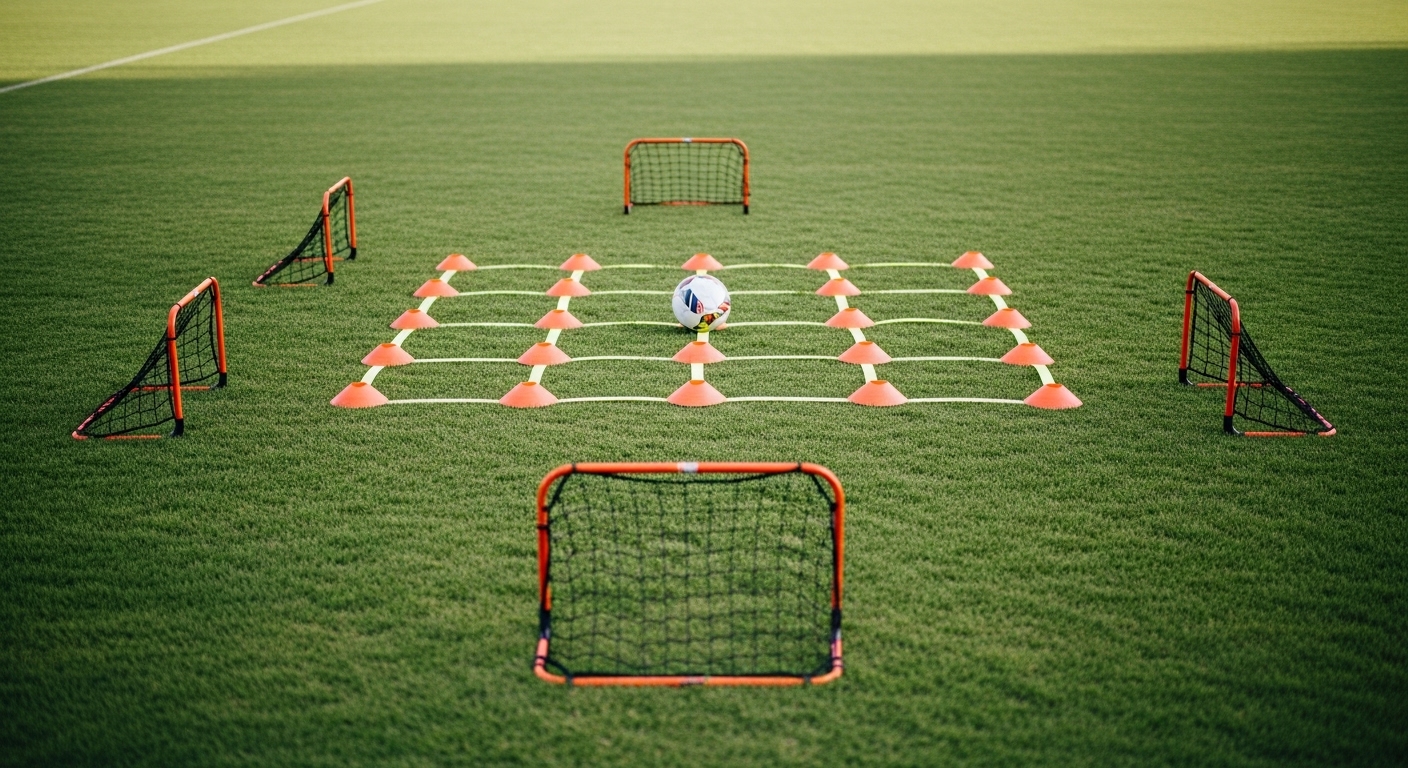
Setup takes ten minutes before the first kid arrives: scatter 25–30 cones, set up four small goals (cones work fine), and pump up spare balls. A bag of practice pinnies and a stack of cones is the entire equipment budget for this whole plan.
The Full U8 Soccer Practice Plan
Every activity below assumes one ball per player unless noted. If a kid shows up without one, hand them a spare before they reach the field.
Phase 1 — Arrival Activity (8 minutes, rolling start)
Phase 2 — Dribbling Warm-Up (14 minutes)
Phase 3 — Skill Stations (18 minutes — three stations, 6 minutes each)
Split the group into three even teams and rotate every six minutes on the whistle. With one coach, run the 1v1 station yourself and let the other two run on autopilot — they’re designed for it. Rotations are sprints with the ball, not walks.
Phase 4 — The Game (15 minutes)
Phase 5 — Close It Out (5 minutes)
A Quick Word on Heading
You’ll get the question from a parent eventually, so know the rule: U.S. Soccer prohibits heading entirely — in both practices and games — for players U11 and younger. Nothing in this plan involves heading, and nothing at this age should. There is no soccer development cost to waiting; there is real risk in not waiting.
Adapting for 6 Kids or 12 Kids
This plan flexes without rewriting it. With 6 kids: skip the station rotation and run all three station activities as whole-group blocks back to back, then finish with one 3v3 game instead of two 4v4s — 3v3 actually gives each kid more touches anyway. With 12 kids: the plan runs as written — three stations of four, two 4v4 games — just recruit a parent per station; the station designs need a supervisor, not a coach. Stretching to 75 minutes: lengthen each station to 8 minutes and the 4v4 block to 20 — never add new activities; longer play beats more variety at this age.
One more adaptation note: if your group is fast and clean through the slalom station, the next progression is dedicated change-of-direction work — our library of speed and agility drills for young athletes has a half-dozen games that bolt straight into the station rotation.
Let Them Be World Cup Obsessed — and Multi-Sport
If your players are sleep-deprived from watching the World Cup this summer, use it instead of fighting it. Let them pick a player to “be” during the 4v4 games, let them celebrate goals like they’re on TV, and watch effort levels jump. Obsession with the game is rocket fuel; your job is just to point it at touches.
What you shouldn’t do is let that obsession become year-round, soccer-only training at age seven. The evidence is consistent that multi-sport athletes become better players — broader movement vocabulary, fewer overuse problems, longer careers in sport. The basketball season and the gymnastics class are helping their soccer. Protect them.
Run It, Then Make It Yours
The first time we ran this exact session, what struck us wasn’t the soccer — it was the noise. Sixty straight minutes of laughing, arguing about sharks-and-minnows results, and begging to keep the 4v4 going past pickup time. That’s the metric at U8. Touches build players, but joy builds players who come back — and a kid still playing at 12 passes every kid who peaked at 8.
Keep the skeleton — arrival activity, ball-each warm-up, stations, 4v4 — and swap games freely as you learn what your group loves. For more session plans, age-group guides, and drills as we publish them, our soccer coaching hub is the home base.
Download this as a free PDF — get the free PDF here
Get "U8 Soccer Practice Plan: A Complete 60-Minute Session" as a free PDF
Instant download, plus free coaching resources in your inbox. No spam.
✓ You're in — here's your download
↓ Download the PDFBookmark it for the field — and check your inbox for more free coaching resources.