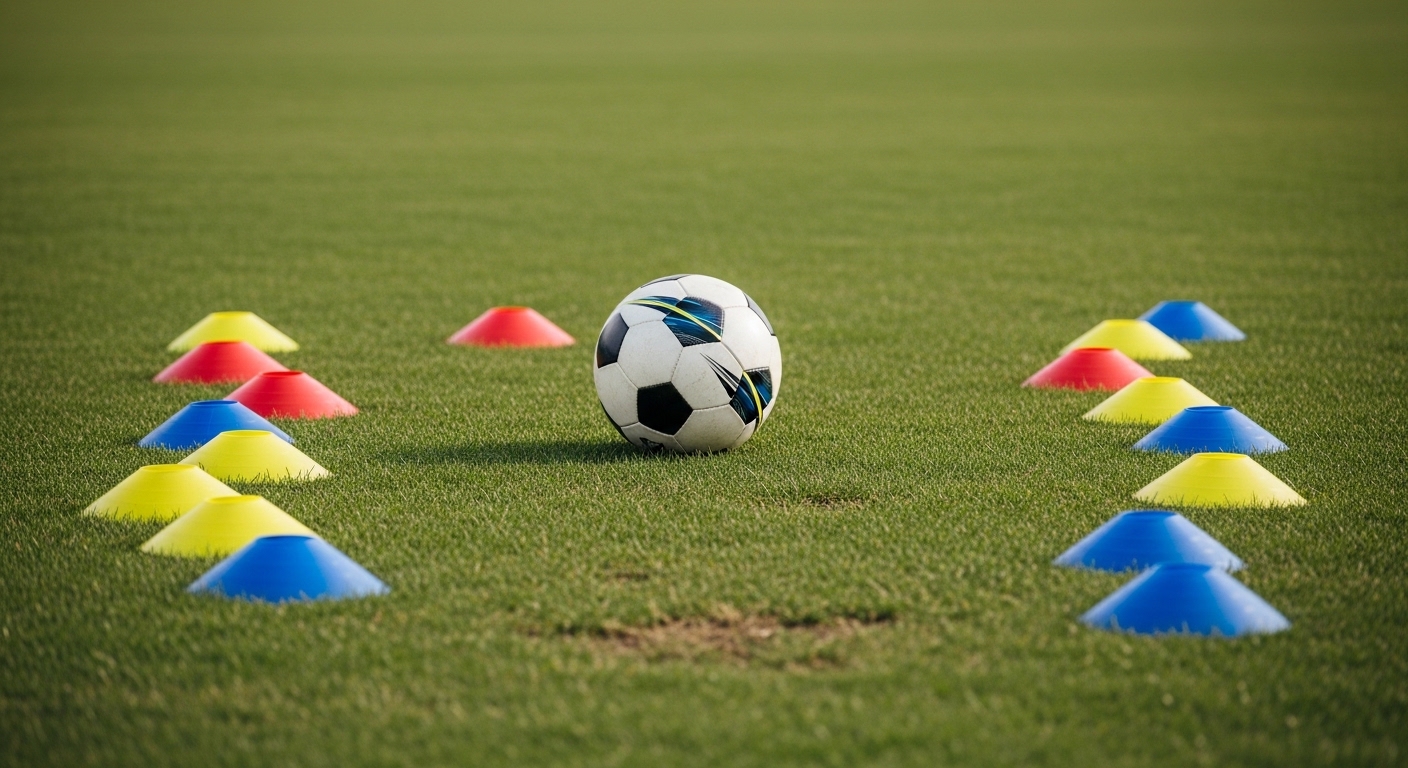
The email from the league lands on a Tuesday: “Thanks for volunteering! Your roster of twelve 7-year-olds is attached. First practice is Saturday.” You’ve watched plenty of soccer — half the country has the 2026 World Cup on right now — but you’ve never run a practice in your life, you don’t own a single cone, and Saturday is four days away. Three of the kids on that roster have never kicked a ball outside their backyard.
That’s where almost every youth soccer coach starts. We’ve stood on that exact patch of grass, and this guide is everything we wish someone had handed us before that first Saturday.
Here’s how to coach youth soccer for the first time in plain terms: keep every player with a ball at their feet as much as possible, run short and simple activities instead of lines and lectures, and finish every practice with a small-sided scrimmage. Your job isn’t tactics — it’s maximizing touches, keeping it fun, and making sure every kid wants to come back next week.
What You Actually Signed Up For
Let’s set the record straight, because the title “coach” carries baggage. You are not signing up to be a tactician. At the recreational youth level, you signed up to be an organizer, an encourager, and the adult who makes sure twelve kids are moving, smiling, and safe for an hour at a time.
That’s genuinely good news. The things that make youth practices succeed — energy, structure, patience — don’t require any playing background. One of our coaches spent years on a Division II college soccer staff, and his honest take is that coaching 7-year-olds is harder in some ways: college players will run a drill wrong for ten minutes and self-correct, while a 7-year-old will pick up the cone, put it on their head, and announce they’re a wizard. Both situations are coaching. Only one of them is in the manuals.
Expect to give about three hours a week: one or two practices plus a game. Expect chaos early. Expect that by week four, when the same warm-up routine starts itself without you saying a word, you’ll be shocked how much you enjoy this.
The Equipment List (and What NOT to Buy)
You need far less than the internet says you do. Here’s the full kit for a first-time coach:
- A bag of balls — at least one per player. Size 3 for U6–U8, size 4 for U9–U12. Nothing kills a youth practice faster than six kids waiting for one ball.
- Cones — 20–30 flat disc cones. They mark grids, gates, and goals. This is your whole “facility.”
- Pinnies — 8–10 mesh practice vests in two colors, for splitting teams instantly.
- A whistle and a first-aid kit — many leagues provide the first-aid kit; carry it anyway.
- Shin guards for every player — this one’s on the parents, but you enforce it. No shin guards, no practice.
Parents will ask you where to get this stuff, so have an answer ready: any sporting-goods retailer carries properly sized youth soccer gear, and the right size matters far more than the brand — a size 4 ball for U10s, shin guards that actually cover the shin, and cleats that fit today rather than next spring.
What NOT to buy: agility ladders, full-size goals, rebounders, coaching software, tactic boards. None of it touches player development at this age, and a tactic board in front of 6-year-olds is a prop, not a tool. Balls, cones, pinnies. That’s the job.
Your First Practice Template
Here’s the 60-minute first-practice template we use with new teams from U6 through U10. Run the same structure every week — kids relax when they know what’s coming, and a predictable routine cuts your discipline problems in half.
Notice what’s missing: lines, laps, and lectures. If you ever look up and see four kids standing in a line waiting for a turn, change the activity.
The Small-Sided Games Philosophy
This is the single most important concept for a new soccer coach, so we’ll spend a minute on it. U.S. Soccer’s player development model puts young kids in small-sided games — typically 4v4 at U8 and 7v7 at U10 — instead of full 11v11 soccer, and the logic is pure arithmetic.
Put twenty kids on a big field and one ball, and most of them will go entire minutes without touching it. Put four kids on a small field and the same ball, and every player is constantly involved — dribbling, defending, deciding. Fewer kids means more touches, more 1v1 moments, more shots, and more of the small decisions that actually build soccer players. The kid hiding at full-back in an 11v11 game can’t hide in a 4v4.
Carry this into practice even if your league’s game format is bigger. Two simultaneous 4v4 scrimmages beat one 8v8 scrimmage every single time, because every player gets roughly double the soccer.
What to Expect at Each Age
A huge share of first-year coaching frustration comes from expecting things a kid’s brain and body can’t deliver yet. Calibrate here:
U6 (ages 4–5): Swarm ball. Everyone chases the ball in a clump, someone occasionally scores in the wrong goal, and at least one player will sit down mid-game to examine a bug. All of this is developmentally normal. Your goals: fun, basic dribbling, and learning which goal is theirs. Sessions of 45 minutes, max.
U8 (ages 6–7): The clump starts to loosen. Kids can dribble with intent, attempt real passes, and play simple 1v1 and 2v2 games. They still understand “spread out” for about eight seconds at a time. Keep everything a game with a score, because “drills” die fast at this age.
U10 (ages 8–9): The lights come on. Players can hold rough positions, string together passes, and understand simple concepts like support (“be somewhere your teammate can pass to you”). This is where 7v7 shines — enough players for real shape, few enough for constant involvement.
U12 (ages 10–11): Real tactical teaching becomes possible — switching the field, pressing together, defensive shape. Skill gaps between kids widen here; your job is keeping the late bloomers engaged, because plenty of them pass the early stars by high school.
One safety rule you must know cold: U.S. Soccer prohibits heading for players U11 and younger — in both practices and games. If the ball is in the air, they play it with chest, thigh, or feet, and an intentional header in a game results in a free kick for the other team. Don’t teach it, don’t drill it, and correct it when it happens.
Through this whole age range, soccer should be one of several sports your players sample. We’ve written before about why multi-sport athletes turn into better players — the coordination and athleticism built in other sports shows up directly on the soccer field, and the burnout that comes from year-round single-sport schedules at age 9 is real.
Positions: Don’t Lock Kids In
Resist the urge to “solve” your team by assigning permanent positions. The big kid who boots the ball gets parked at defender, the fast kid lives at striker, the quiet kid gets buried at fullback — and three seasons later you have four players who’ve only ever seen one slice of the game.
Rotate everyone through every position, including goalkeeper where your format uses one, across the season. Yes, you’ll concede some goals when your scorer is playing in the back. That trade is worth it every time: defenders who’ve played forward understand attackers, forwards who’ve defended work harder to win the ball back, and at this age nobody — including you — knows what kind of player each kid will become. The 8-year-old who looks like a natural defender today might be your most creative midfielder at 12, but only if someone let her play there.
Game Day: Subbing, Sidelines, and Sanity
Games are where new coaches get rattled, so simplify ruthlessly.
Sub fairly and visibly. In recreational soccer, every player should get roughly equal minutes — many leagues require it, and you should do it even if yours doesn’t. Write a substitution plan before the game, in shifts, and stick to it regardless of score. Equal playing time is also the number one source of parent conflict in youth sports; a written rotation you can show anyone is your best defense. If a parent does challenge you on minutes or positions, our guide on handling difficult sports parents walks through exactly how to have that conversation without it going sideways.
Coach quietly. Kids can’t process joystick coaching — “pass! shoot! get back!” — while also playing. Give instructions before shifts and at halftime, then let them play and make mistakes. The mistakes are the curriculum.
Model the sideline you want. Your parents will mirror your demeanor. If you’re calm, encouraging, and respectful to the referee — who is often a 14-year-old making $20 — your sideline follows. The final score of a U8 game is the least important thing that happens on a Saturday.
Talk to Parents Before They Talk to You
Send a parent letter before your first practice. Not after a problem — before. Cover your coaching philosophy (development and fun over wins), the equal-playing-time policy, the practice and game schedule, what gear kids need, and how to reach you. Five minutes of writing prevents 90 percent of the sideline friction that wears coaches out, because parents who know the plan in week one don’t invent their own version of it in week six. We have a ready-to-send parent communication letter template you can adapt in ten minutes.
Then keep the channel open: a short weekly message about what the team is working on turns parents into allies who reinforce your coaching at home.
The 3 Mistakes Every First-Time Soccer Coach Makes
We’ve watched (and committed) all three:
1. Coaching like a parent watching TV soccer. New coaches replicate what they see in professional broadcasts: positional lectures, set-piece planning, shouting instructions all game. Pro soccer is the end product of fifteen years of development; your job is the first year of it. Touches, fun, repeat.
2. Talking too much. The classic new-coach practice is five minutes of explanation for every two minutes of activity. Kids learn soccer by playing soccer. Cap every explanation at 30 seconds, demonstrate instead of describe, and coach individuals with quick private cues while the game keeps running.
3. Measuring the season in wins. A first-time coach who goes 2–8 but returns eleven of twelve players next season had a phenomenal year. Retention is the real scoreboard at this level — kids who stay in the game get coaching for years; kids who quit at 8 get none.
You’re More Ready Than You Think
Every coach you’ve ever admired ran a first practice once, and most of them were handed a roster on a Tuesday too. Show up with balls, cones, and a plan. Keep every kid moving. End with a scrimmage and a specific compliment. Do that for ten weeks and you’ll have done the job better than you imagine.
When you’re ready to go deeper — practice plans by age, skill progressions, season planning — our soccer coaching hub collects everything in one place.
Download this as a free PDF — get the free PDF here
Get "How to Coach Youth Soccer: First-Time Coach's Guide" as a free PDF
Instant download, plus free coaching resources in your inbox. No spam.
✓ You're in — here's your download
↓ Download the PDFBookmark it for the field — and check your inbox for more free coaching resources.