It’s 5:30 on a Tuesday and you’re standing on a patch of grass with eleven 5-year-olds, a mesh bag of balls, and a practice plan you printed an hour ago. Two kids are picking dandelions. One is crying because his shin guards feel weird. Three are kicking balls at the goal you haven’t set up yet, and one just asked if you brought snacks. Welcome to U6 soccer — and with the 2026 World Cup playing out across North America right now, you probably have more first-timers on your roster than any season in memory. These kids have been watching soccer on TV all summer and they showed up wanting to play.
Here’s the short answer: The best U6 soccer drills for beginners are simple games with a story — sharks and minnows, red light green light, clean the bedroom — where every kid has their own ball and every activity lasts five to eight minutes before you switch. No lines, no laps, no lectures. If every player gets hundreds of touches and leaves wanting to come back, practice was a success.
What Success Actually Looks Like at U6
Before the drills, get the goal straight. At this age you are not building soccer players. You are building kids who like soccer.
Our soccer coach — a former Division II coach who has run sessions from kindergarten through college — puts it this way: a U6 practice succeeded if two things happened. Every kid touched the ball a lot, and every kid wants to come back next week. That’s the whole scoreboard. Not passing accuracy, not positional awareness. Touches and smiles.
This lines up with everything we know about athletic development in the 6-to-10 window: young kids build coordination and ball familiarity through huge volumes of playful repetition, not through instruction. A 5-year-old who gets 300 touches chasing a “shark” around a square learns more about dribbling than one who waits in line for 3 touches and a coaching lecture.
So measure your practices honestly. Did kids spend most of the hour with a ball on their foot? Did they laugh? Did anyone ask “can we play that again?” Those are your wins.
The Three Rules That Make Every U6 Practice Work
One ball per kid, always. Sharing means waiting, and waiting means dandelion-picking. Every activity below assumes each player has their own ball at their feet. If your club doesn’t supply enough, ask parents to bring one — and make sure it’s a size 3. A full-size ball is comically wrong for a 4-year-old’s legs.
Five to eight minutes, then switch. A U6 attention span runs about as long as one of their cartoon segments. The moment energy dips — and it will dip fast — call out the next game. You are not abandoning a drill that “wasn’t working”; you are managing fuel. Plan six or seven games for a 50-minute practice and assume you’ll use all of them.
No lines, no laps, no lectures. Lines mean standing. Laps mean running without a ball, which kids this age experience as punishment. Lectures mean a circle of small faces staring at the dandelions behind you. If you catch yourself talking for more than 20 seconds, stop talking and roll out the next game.
Every game needs a story, too. “Dribble through the cones” is a drill; “escape the sharks” is an adventure. Same touches, completely different buy-in. Four-year-olds will run through a wall for a story.
7 Game-Based U6 Soccer Drills for Beginners
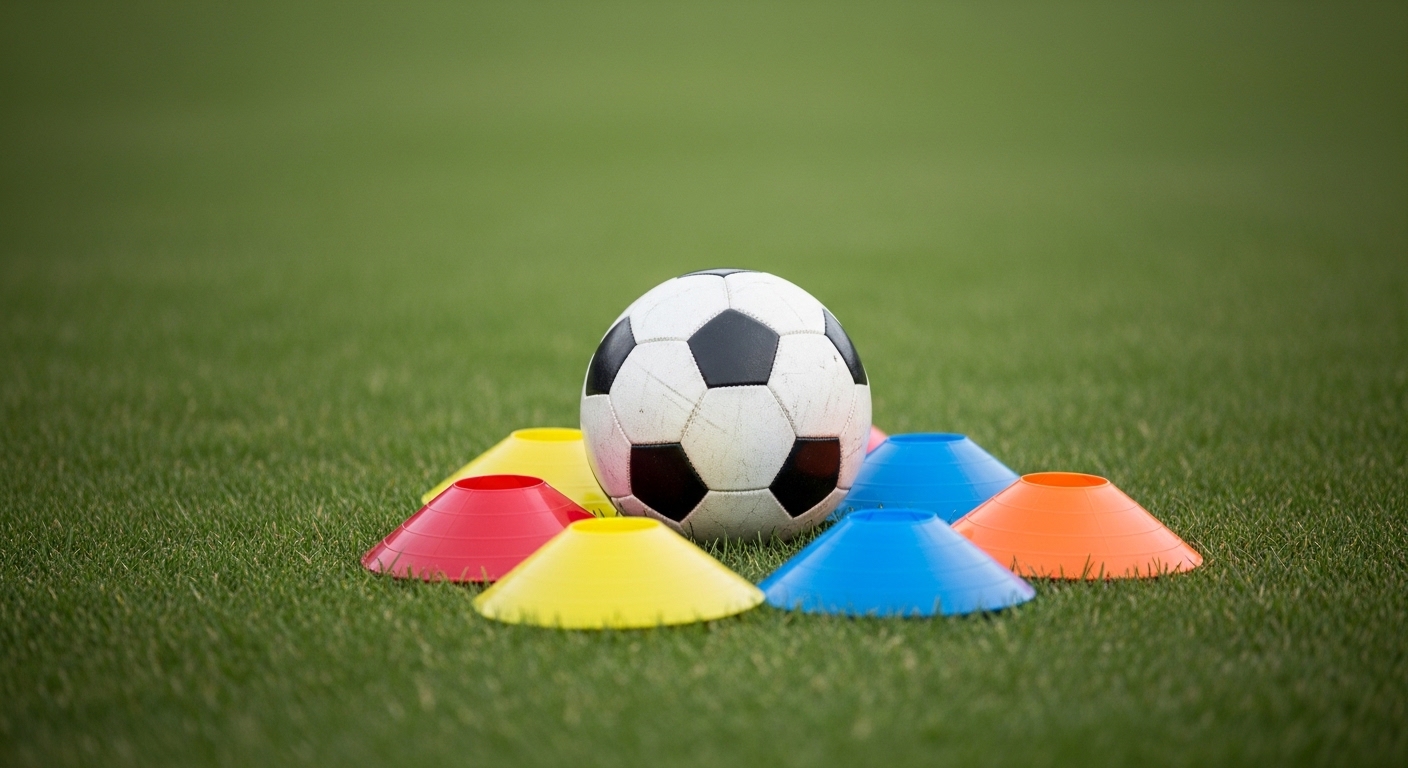
For all of these you need a small grid of cones — roughly 20 by 25 steps — and a ball for every player. We recommend grabbing a set of size 3 balls and mini cones if your club doesn’t provide them; one bag covers the whole season. Set up the grid before kids arrive so you can start the first game the moment they show up.
End practice with a few minutes of free play — a tiny scrimmage with no positions and no instructions. The swarm is developmentally correct.
Managing the Chaos (Honestly)
If you are a parent who got handed a roster and a whistle, here is the truth nobody tells you: a good U6 practice still looks like chaos. Kids will wander. Someone will cry. Someone will score on the wrong goal and celebrate hard. None of that means you are failing.
Our soccer coach tells a story from his first season running a kindergarten clinic, years after coaching at the college level. He had a beautifully scripted session — progressions, technical points, the works. Ten minutes in, half the group was lying in the grass watching clouds. He scrapped the script, yelled “everybody escape the shark!”, chased them around with his arms out, and got more dribbling out of those kids in eight minutes than the entire planned session would have produced. We’ve built every U6 plan around that lesson since: at this age, you are not a tactician. You are a camp counselor with cones.
A few practical chaos-managers that work for us: learn every kid’s name by week two and use names constantly, because “Mia, great stop!” lands a hundred times harder than “good job, guys.” Recruit a parent or two as shark, traffic cop, and shoelace-tier. And when an activity dies early, let it die — having the next game ready matters more than finishing the current one.
One more thing worth saying to the parents on your sideline: this age is about falling in love with movement, not picking a sport. The kids who become the best players later are almost always the ones who played multiple sports growing up, so let soccer season be soccer season and basketball season be basketball season.
A Quick Word on Safety
Two non-negotiables. First, no heading the ball — U.S. Soccer prohibits heading in practice and games for players 10 and under, and at U6 it should never even come up. If a ball pops into the air, teach kids to let it bounce or control it with their body. Second, use a size 3 ball for this age group. The right ball size makes every touch easier and every drill more fun.
Your First Practice Starts Here
Pick four or five of the games above, set up your grid early, bring a loud and playful voice, and judge the night on touches and smiles. The kid who spent half of practice doing somersaults still got more out of being there than you think — and if she’s begging to come back Saturday, you coached it right.
For more practice plans, age-by-age progressions, and game-day guidance, visit our soccer coaching hub. And if the World Cup buzz has your kid juggling rolled-up socks in the living room, ride that wave — it’s the best free motivation a coach will ever get.
Download this as a free PDF — get the free PDF here
Get "U6 Soccer Drills for Beginners: 7 Games Kids Love" as a free PDF
Instant download, plus free coaching resources in your inbox. No spam.
✓ You're in — here's your download
↓ Download the PDFBookmark it for the field — and check your inbox for more free coaching resources.