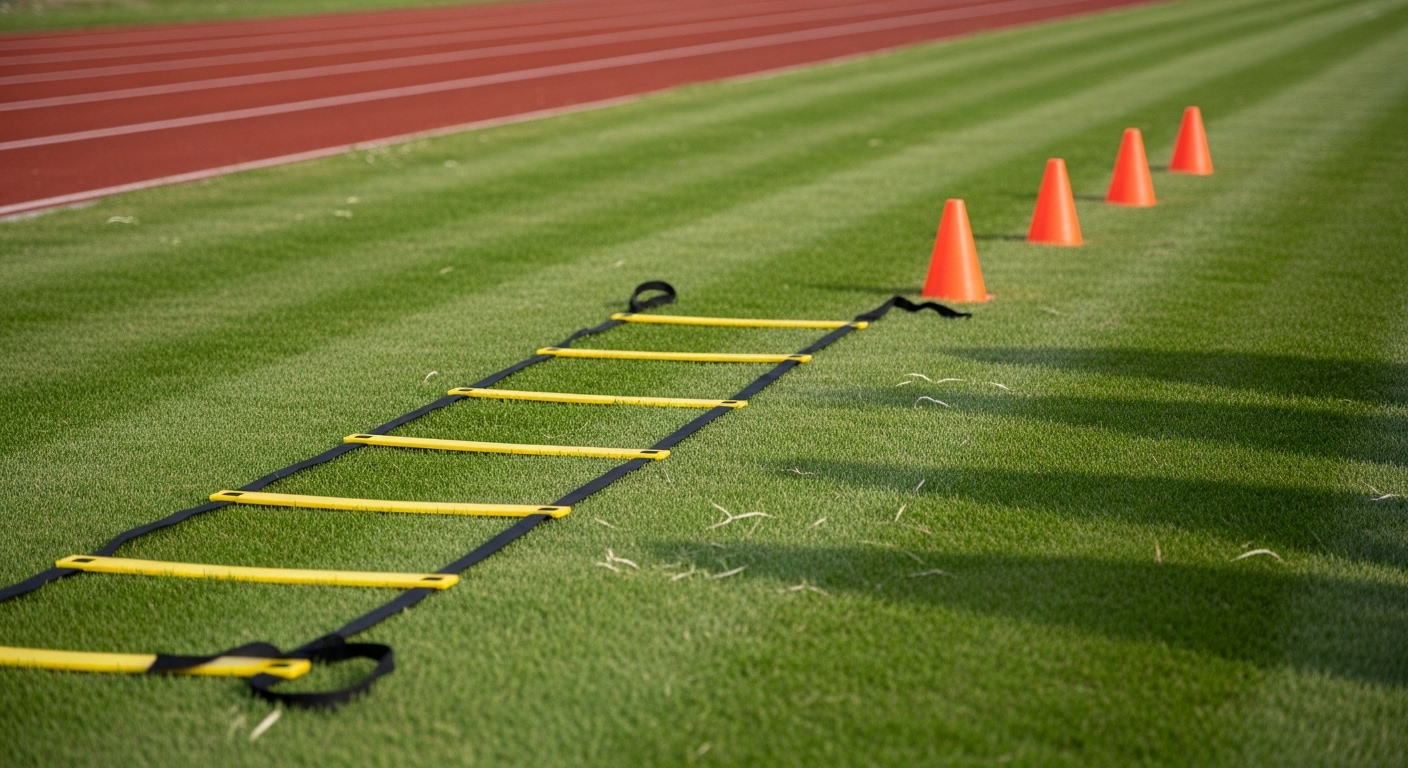
I had a 13-year-old outfielder last season — one of the physically stronger kids on the team — who could not close on a fly ball. His first step was late, his posture was upright, and his sprint looked like someone jogging with extra arm effort. We put him through a cone agility circuit before practice three weeks in a row trying to “fix” his footwork. He actually got measurably slower.
Not because he was not working. Because we were thinking about speed wrong.
Here is the direct answer: Top speed mechanics in youth athletes develop through three things — a strength foundation, basic motor pattern drills done with intent (A-march, A-skip, B-skip, falling start), and high-effort straight-line sprint volume with full rest between reps. Complex mechanics cuing — wall drives, wicket runs, resisted harness work — belongs last in the progression and is largely unnecessary before age 13 or 14. Build strength, sprint fast, rest fully. That is the framework everything else hangs on.
Why Strength Comes Before Mechanics
The most persistent myth in youth speed development is that slow kids are running wrong. Research from coaches who work with large populations of youth athletes — and our own experience coaching athletes from 7U through high school — points consistently to the same root cause: most poor sprint mechanics come from a lack of strength, not bad movement patterns.
Here is why this matters. If an athlete lacks the hip strength, posterior chain development, and single-leg stability to load properly under sprint conditions, they physically cannot get into the positions a sprint drill is trying to teach. Forcing those positions onto a weak base does not produce a faster athlete. It produces a tense, stiff, over-coached kid who thinks about their feet instead of running.
The training implication is real. Before any sprint drill progression matters, athletes need to be doing the basics: squats, hinge patterns, single-leg work, pushes, pulls, and loaded carries. Our guide on bodyweight training for young athletes walks through what this looks like at different ages with zero equipment. Until that foundation is in place, A-skips and wall drives are window dressing.
The Three-Phase Speed Development Model
Once an athlete has a base level of athletic strength, speed development follows a natural sequence. Most youth coaches skip phase one entirely, which is why so many speed programs stall.
Phase 1 — Motor pattern foundation (ages 7–12) Young athletes are in the most receptive window of their lives for motor learning. This is where we introduce athletic shapes — tall posture, knee drive, arm swing mechanics — through low-intensity, high-repetition drills. No timing. No competition. Just movement exposure. The goal is to build the blueprint the nervous system will later use at full speed.
Phase 2 — Sprint intent and acceleration work (ages 11–15) Now athletes layer sprint-specific drills with genuine effort. A-marches, A-skips, B-skips, falling starts, and short acceleration sprints of 10–30 yards. Athletes begin to feel the connection between posture, force application, and output. Full rest between every rep. Two to three speed sessions per week, never more than 15 minutes of actual sprint work per session.
Phase 3 — Mechanical refinement and sprint volume (ages 14+) Older athletes have the strength and coordination to hold positions under real sprint conditions. This is when wall drives, resisted sprint accelerations, and longer straight-line sprint progressions have the highest payoff. Volume increases, but quality remains the filter.
The same model applies across every sport we coach. A soccer player developing first-step acceleration, a baseball player who needs to turn and run on contact, a basketball player beating a defender off the dribble — the phases are universal. For the youngest athletes especially, see our deeper breakdown in athletic development for youth athletes ages 6–10.
The Drill Sequence: What Goes in Practice
This is the progression we run for athletic-development athletes in dedicated speed blocks. Phases 1 and 2 together make a complete speed day for athletes under 14. Add Phase 3 drills for older athletes with solid strength training backgrounds.
Phase 1: Movement and motor patterns
Phase 2: Acceleration development
Phase 3 (ages 14+ with strength training background only)
The Rest-to-Work Ratio: The Gap Most Youth Speed Programs Miss
This is the part almost no youth speed article addresses, and it is what separates a real speed development session from a glorified conditioning drill.
Speed requires full neuromuscular recovery between reps. For a 20-yard sprint, that means 90 seconds to 2 full minutes of rest. For a 50-yard sprint, 3 to 4 minutes. For an 80-yard sprint, 4 to 5 minutes. These rest periods feel uncomfortable for coaches used to keeping practice moving. But without them, you are not training speed — you are training the ability to run tired.
The practical rule we use: the athlete should feel fully ready to run again before the next rep starts. If they are still catching their breath, they wait. This is especially important for athletes under 12, who recover faster physiologically but need to learn what “ready” feels like. A 15-minute speed block done properly — with full rest — produces better adaptations than 45 minutes of hustle-focused speed circuits.
This is also why dedicating a piece of practice specifically to speed work beats bolting it onto the end of a long conditioning session. Fatigued athletes running fast practice poor mechanics and absorb none of the neuromuscular stimulus they are supposed to.
What Fixed the Outfielder
We scrapped the cone circuits. We added two days a week of strength work — bodyweight squats, Romanian deadlifts with a dowel rod, single-leg hops for landing mechanics. And we ran three speed sessions per week, ten minutes each: A-skips, falling starts, and full-effort 30-to-50-yard sprints with walk-back rest.
Six weeks later, he was one of the faster outfielders in our program. Not because we fixed a technical flaw. Because his body finally had the physical capacity to sprint the way his nervous system already knew how to.
The best speed coaches I have learned from over the past two decades all say a version of the same thing: give young athletes strength, give them sprint exposure at full effort, give them rest, and trust the process. The mechanics follow.
If you want a full framework to pair this with, our speed and agility drill library covers lateral quickness, change-of-direction, and first-step work that complements the linear speed model above. Speed development is not one drill — it is a system. Build it right from the start and the results take care of themselves.