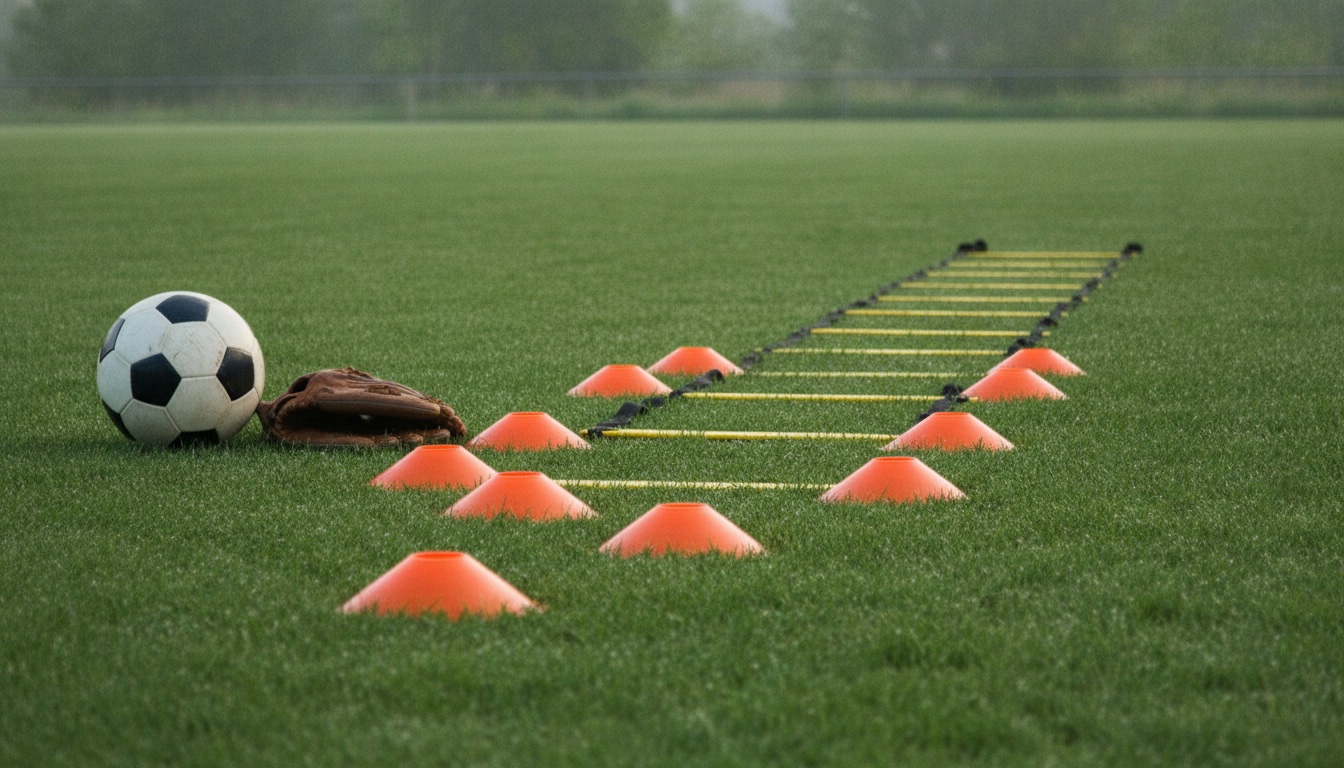
I had a 10-year-old in my outfield group last fall who was one of the fastest kids on the field in a straight line. Get him from first to third and nobody caught him. But put cones out for a change-of-direction drill — a simple 5-10-5 — and he would stutter, lose his footing, and pull up short on every cut. A parent watching from the bleachers said, “He is just not great at agility.” I said, “He has not learned to stop yet.”
That distinction — between raw speed and the ability to decelerate before changing direction — is the one most youth speed programs skip entirely. Skipping it does not just limit performance. It sets kids up to roll ankles, strain groin muscles, and damage knees during the exact drills that are supposed to make them better athletes.
The short version: Before young athletes run agility ladders, do cone drills, or cut at full speed, they need to master force absorption — the ability to receive and control the load their joints face every time they decelerate or land. Without that pattern trained, agility drills build compensatory habits at speeds the body cannot handle safely.
What Force Absorption Actually Is
Every time an athlete decelerates — stopping a sprint, landing from a jump, planting to cut laterally — their muscles and joints absorb a ground reaction force several times their body weight. In adults who have trained this pattern deliberately, the hips, glutes, and quads receive that load gradually across a range of motion. In young athletes who have not trained it, the force dumps straight into the knees and ankles instead.
Force absorption is the skill of receiving that load efficiently: hinging at the hip, bending the knee through a controlled range, and keeping the foot under the body rather than ahead of it. It sounds simple. It is not. It is a motor pattern that must be trained deliberately before it becomes reliable under speed.
Youth performance coaches make the same mechanical point: young athletes cannot effectively produce explosive force if they cannot first absorb force. This is not a general wellness statement — it is a mechanical prerequisite. Landing, decelerating, and changing direction are all variations of the same pattern at their root. Build absorption first, and everything built on top of it becomes more explosive and structurally safer.
Why Agility Drills Done Too Early Do Not Transfer
Here is what happens when a 9-year-old runs a five-cone drill without the absorption pattern trained: they move quickly while their body compensates — leaning too far into cuts, bending the ankle laterally to absorb load, shortening the approach distance so less deceleration is required. Coaches sometimes call this good instincts. What is actually happening is the body self-limiting to avoid loading it cannot control.
Pre-pubescent speed gains come almost entirely from coordination and motor recruitment, not structural strength. That is good news — it means the nervous system is highly adaptable during these years. But it also means that if you build motor patterns on top of a broken foundation, those patterns stick. A kid who learns to plant by rolling the ankle outward will still plant that way at 16, only now with 50 more pounds of body weight behind it.
The research is consistent on sequencing: change-of-direction speed depends on lower-limb strength and the ability to decelerate linearly first. Coordination and controlled movement patterns come before sport-specific agility progressions — and sport-specific agility work produces the most transfer once athletes can control the base movements without compensating.
The Three-Tier Progression We Use
We follow this sequence with every new athlete in our program, regardless of sport:
Tier 1 — Absorb. Land, stop, hold. No concern for speed. We are training positions.
Tier 2 — Stabilize. From a held position, reload and push. The athlete learns to produce force from a sound base.
Tier 3 — Accelerate. Now drive out at speed. The deceleration pattern is wired before the acceleration is layered on.
Most youth programs start at Tier 3 and wonder why the movement looks messy. Start at Tier 1. Spend more time there than feels necessary. Speed catches up quickly once the pattern is in place — and the cuts are sharper, the ankles hold, and the body does not break down.
Thomas Summers, an MLB strength coach whose youth programs work with players in the 11-to-15 range, frames the problem the same way: the most common mistake is skipping the strength foundation and jumping straight to speed work. The point of building the base first is not to make kids wait — it is to make sure the pattern they are loading is actually sound.
Force Absorption Drill Progression
These five drills are our starting point with any new athlete, typically for the first two to four weeks of a training block. Once athletes clear the readiness standard described below, these drills stay in the warm-up routine for the rest of the year.
The LTAD Connection: Every Sport Benefits
This is not a baseball principle or a single-sport protocol. The Long-Term Athlete Development model identifies the 6 to 12 age window as the primary period for acquiring fundamental movement skills — the patterns that become automatic before puberty raises the structural stakes and training loads. Force absorption is one of those fundamental skills, and it transfers to every sport that involves running, which is every sport.
In our program we have coached athletes across baseball, basketball, and soccer who all came in moving faster than their ability to stop. The drill progressions are identical regardless of the sport. A 9-year-old who masters force absorption will play every sport better at 12 because the movement quality underneath all of it is sound. For the full framework on how foundational physical skills map to age windows, the youth athletic development resources hub is the right place to start.
Once athletes have the absorption base in place and are ready to build explosive power on top of it, plyometric training for youth baseball players applies the same tier structure to jump and bound training. The force absorption prerequisites built here are exactly what make those programs transfer safely and effectively.
When Are Kids Ready to Add Full-Speed Agility Drills?
Not a fixed age — a readiness standard. We look for three things before adding change-of-direction work at full speed:
- Landing quality: Can the athlete stick a two-foot landing from a 6-inch drop without knee cave or heel rise, consistently across 10 or more reps?
- Sprint-to-stop control: Can they decelerate from three-quarter speed to a full controlled stop, reliably?
- Single-leg stability: Can they hold a single-leg landing for 2 seconds with minimal wobble?
When all three are reliable, agility drills — ladders, 5-10-5s, reactive cone work — start producing real transfer. Before those standards are met, the same drills are compensatory patterns that ingrain the wrong movement habits.
For most athletes 8 and under, Tiers 1 and 2 are the complete program. For 9 to 11-year-olds with no prior training background, expect 4 to 6 weeks at Tier 1 and 2 before adding Tier 3 work. Athletes who have been in a structured program for a full season often clear the readiness standards in 2 to 3 weeks.
The Takeaway
If you are watching your athlete struggle with change-of-direction drills, do not assume they are just not an agility player. Ask whether they have been trained to decelerate first. That is the missing piece almost every time.
Speed and agility are a sequence, not a switch. Build the absorption pattern, and the explosive cuts follow on their own.
For the full sprint mechanics picture — once athletes are absorbing force well and ready to develop top-end speed — our guide to youth speed training and sprint mechanics covers what proper sprint form looks like and how to coach it at each age level.