- Type
- Speed & strength
- Ages
- 12u-14u
- Read time
- 10 min
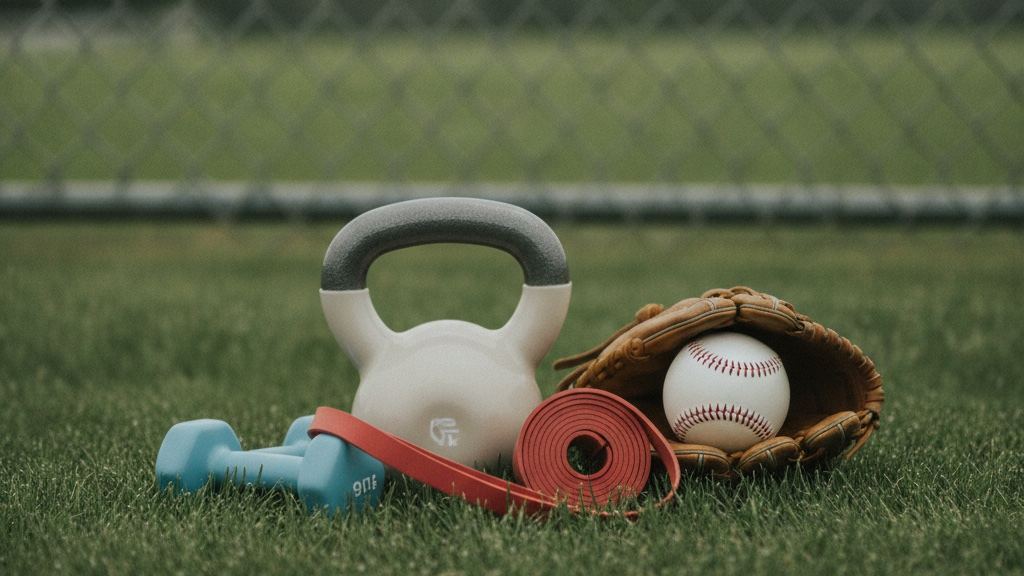
Every spring we watch the same thing happen. A 13-year-old spends the winter getting stronger, shows up to the first tournament driving the ball into the gaps, and then stops training the week games start because “it’s the season now.” By the middle of the schedule his legs are gone in the sixth inning, his throws across the diamond have lost their carry, and his parents are wondering what happened to the kid from March.
The short answer: youth baseball players ages 12 to 14 should keep strength training during the season, just less of it. Two short full-body sessions a week of 20 to 25 minutes, with fewer sets, no grinding reps, and nothing that leaves them sore for a game, is enough to hold on to what they built in the off-season. In a heavy tournament week, one session is fine. The only wrong answer is zero.
The rest of this guide covers why stopping costs so much, how to schedule sessions around games and pitching, and the exact session we use with our own 12U to 14U players.
Why Stopping in March Costs You in May
Strength is a use-it-or-lose-it quality. A player who stops all strength work when the season starts does not hold his off-season level for three months. He drifts back toward where he started, and he does it during the part of the year when he most needs his legs and trunk to hold up.
Baseball itself does not replace that work. A game is a lot of standing with a few all-out efforts mixed in. Throwing and swinging are also one-sided: the same hip rotates the same direction hundreds of times a week. Without something to balance that, the front hip tightens up, the back side of the shoulder falls behind, and the nagging stuff starts to show up.
The guidance from strength coaches who work with high school and college players is consistent on this point: train at least once and ideally twice a week during the season, keep sessions short, and do not chase new personal bests. That advice is written for older players, though, and it needs two adjustments for a middle schooler.
Maintenance Is the Wrong Word for a 12-Year-Old
Most in-season advice talks about “maintaining” strength. That makes sense for a college junior with four years of lifting behind him. It makes less sense for a 12-year-old who learned to hinge at the hips in January.
A newer athlete is still improving every time he practices a movement well. His gains at this stage come mostly from coordination and control, not from heavy loading, and that kind of progress does not require much fatigue. So for this age group we think about the season as small, steady practice of good movement instead of a holding pattern. The dose is low, but the direction is still forward.
That is also why we do not test maxes or add weight on a schedule in season. If a rep looks crisp, we keep it. If it slows down or the form changes, the set is over. If your player is brand new to lifting, start with our guide on when kids can start weight training before adding any load.
The Three Rules We Use In Season
1. Leave two or three good reps in the tank. Every set should end with the player feeling like he could have done more. Soreness is not the goal in season. A sore player is a slower player on Saturday.
2. Cut the sets, keep the quality. We drop total volume to roughly half of an off-season session. Two sets of most things is plenty. What stays the same is how well each rep is done.
3. Go easy on the lowering phase of new exercises. Slow, heavy lowering and brand-new movements are what cause next-day soreness. The season is not the time to introduce a new exercise the day before a doubleheader. Stick with movements the player already knows from the off-season training plan.
How to Schedule It Around Games
This is where most of the published advice stops being useful for youth families. The sample schedules out there assume a high school team with games on Monday, Wednesday and Friday. A 13U travel player has practice twice during the week and three to five games packed into a weekend.
Here is how we lay out the two common weeks.
| Week type | Session A | Session B | Notes |
|---|---|---|---|
| Weekend tournament (Sat-Sun) | Monday or Tuesday | Wednesday | Nothing but mobility on Thursday and Friday |
| Weeknight league games (e.g. Tue/Thu) | Wednesday | Saturday | Keep Wednesday short |
| School ball plus club overlap | One session only | Skip | Total workload is already high |
| Bye week or rainout | Monday | Thursday | Add one set to each exercise |
The principle behind the table: put the harder work as far from the next game as you can, and leave at least 48 hours between a session and first pitch. Monday after a tournament works well because the player moves, gets blood flowing, and is fully recovered by the weekend.
The school-plus-club row matters more than it looks. A lot of 13- and 14-year-olds play for a junior high team and a club team in the same months. When that happens, the answer is less training, not more. One short session keeps the habit alive.
What Changes for Pitchers
Pitchers follow the same plan with one extra rule: the lower-body and trunk work goes on the day after an outing, not the day before.
The day after pitching, the arm needs easy movement and the legs can handle work. So that session looks like squats, hinges, carries and light band work for the upper back, with no heavy pressing or pulling. Then the second session of the week lands at least two days before the next time on the mound.
We learned to be strict about this. I had a 14U right-hander a couple of seasons ago who did a hard upper-body workout with his older brother on a Thursday night and then started for us Saturday morning. His velocity was down, his command was worse, and he told me in the dugout his arm felt heavy. Nothing was injured. He just showed up to the game already tired. We moved his lifting to Mondays after that and the heavy-arm complaint went away.
Throwing volume still comes first for arm health. Strength work supports a sensible throwing schedule; it does not make up for too many pitches. Our long toss program for youth pitchers covers the throwing side of the week.
The 20-Minute In-Season Session
This is the session our 12U to 14U players run, usually in a garage, a driveway or the corner of the cage. It needs a light dumbbell or kettlebell, a band, and a few feet of floor. A player who has never lifted can do every exercise with bodyweight only.
A simple band setup covers half of this session, and it travels in a bat bag for hotel-weekend tournaments. If you need one, we point families to a set of loop and tube resistance bands at theranchsports.com, where our readers get a 10% discount with no sales tax. For more ways to use them, see our resistance band training for youth athletes guide.
What to Leave Out Until the Off-Season
Some things are good training and still do not belong in the middle of a season:
- High-volume medicine ball throws. A player who throws and swings five days a week is already getting a lot of rotation. A few easy throws are fine; a 60-throw session is not.
- Heavy overhead pressing and long sets of push-ups to failure. The shoulder gets plenty of stress from throwing.
- Long-distance running as conditioning. Baseball is short bursts. A few sprints at practice do more than two miles around the outfield.
- Jump training the day before a game. Save hard plyometrics for the early part of the week or for the off-season.
- Anything new. New exercises go in during a bye week or after the season.
Growth Spurts Change the Plan
Twelve to fourteen is when a lot of boys grow three or four inches in a year. During a fast growth spurt, a player can look less coordinated for a few months, and the areas around the knees, heels and throwing elbow can get sore more easily.
When we see a player in the middle of one, we do not stop his training. We lower the load, keep the movements, add more mobility work for the hips and ankles, and watch his throwing volume closely. Pain at a joint or a growth area is a reason to stop and see a doctor or physical therapist, not something to train through. Our hip mobility exercises for youth baseball players fit well on the off days during this stretch.
The Long-Term View
In a long-term athlete development model, these years are about learning to train, not about peaking for a 13U tournament. The in-season habit matters more than any single session. A player who learns at 12 that training continues through the season, in a smaller dose, arrives at high school already knowing how to manage a year.
This is also where multi-sport athletes have an edge. The player coming off a basketball or soccer season has been sprinting, cutting and jumping all winter, and that carries into spring. If your player has another sport in season at the same time as baseball, count that as training load and trim this plan to one session a week. We cover the bigger picture in our youth athletic development hub and the full yearly layout in the strength and conditioning program for ages 12-15.
Two short sessions, done well, from the first game to the last. That is the whole plan, and it is the difference between the player who fades in May and the one who is still driving the ball in the championship game.