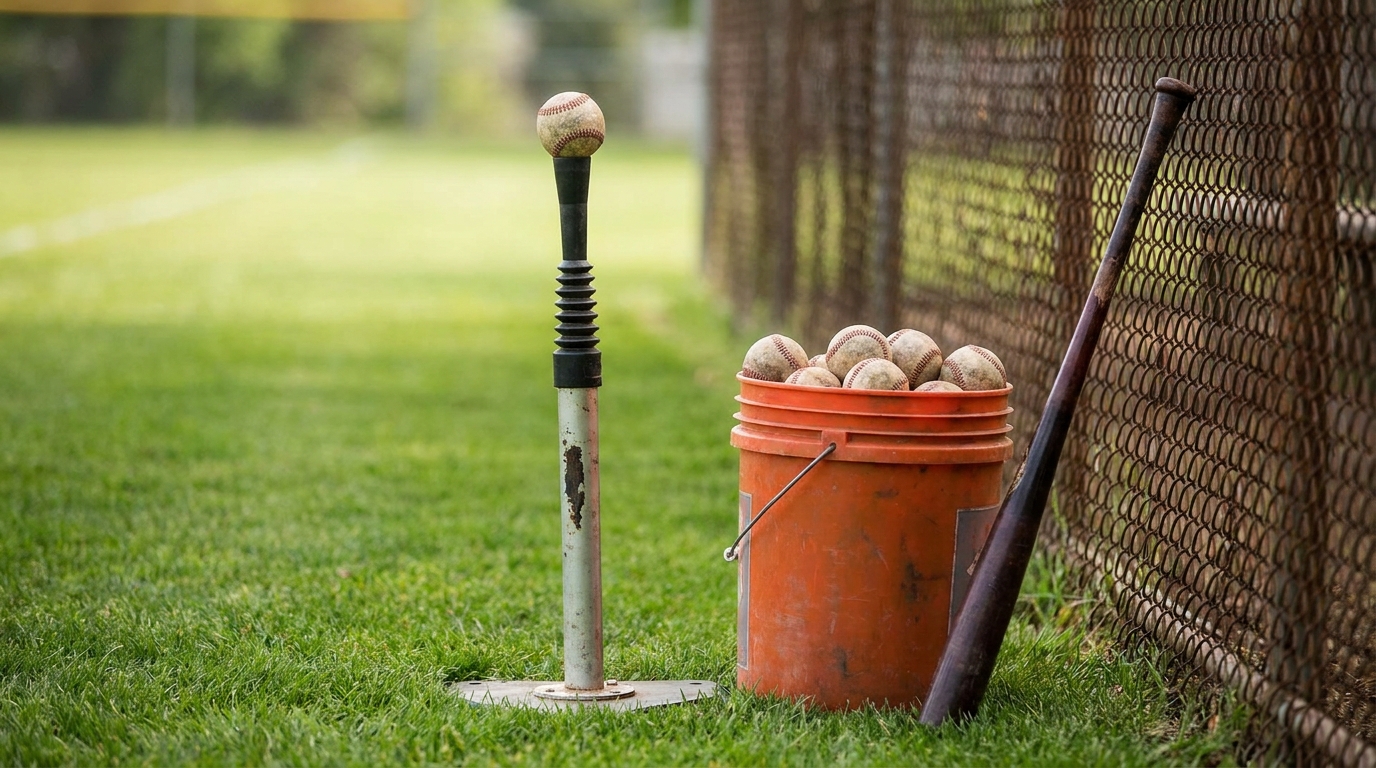
A 12-year-old walked into our batting cage last spring with a textbook stance and zero bat speed. His hands were flying — all arms, no rotation — and every ball off the tee was a weak grounder to the left side. Three months and a focused off-season later, he was barreling balls to the gap consistently. The difference wasn’t a new batting stance or a lighter bat. It was understanding where bat speed actually comes from.
The short answer: Bat speed is generated from the hips and core, not the hands. The fastest youth hitters we coach use their lower half to build rotational force, then let that energy transfer through a connected, compact swing. The drills that move the needle fastest are hip-shoulder separation work, overload/underload swings, and compound strength movements that train the glutes and posterior chain — not grip-strength gadgets or extra tee cuts alone.
Why Most Youth Hitters Swing With the Wrong Muscles
Walk any youth dugout and you’ll hear a coach yell “swing harder.” The problem is that most young athletes respond by swinging harder with their arms — which is exactly backwards. The arms are the last link in the kinetic chain. When a hitter fires their hands first, they short-circuit the whip effect that generates real bat speed.
We call this arm-only swinging, and it’s the most common speed killer we see in players from 9U through JV ball. The kid looks like he’s working hard. He’s not lazy. He’s just using the wrong muscles in the wrong order. The fix isn’t another swing adjustment — it’s teaching the body to load and rotate from the ground up.
Hip-Shoulder Separation: The Foundation of Every Fast Swing
Every high-velocity swing shares one non-negotiable: the hips open before the shoulders. This hip-to-shoulder separation creates rotational torque — sometimes called the rubber-band effect — that coils energy through the core and releases it into the barrel. When a hitter loses that separation, when shoulders and hips rotate together as one unit, the rubber band never loads and bat speed drops significantly.
A drill we use to teach this from day one: have your hitter set up at the tee and pause at heel plant. At that moment, their hips should already be 45 degrees open toward the pitcher while the front shoulder is still closed, pointing back at the mound. Hold that loaded position for two full seconds, then complete the swing. It feels unnatural at first. But within a few sessions the body internalizes the sequencing.
For athletes who genuinely struggle to get into that hip-open position — especially tall, lanky hitters who haven’t grown into their own frames yet — it’s almost always a mobility problem before it’s a mechanics problem. Pairing this work with hip mobility exercises for baseball players unlocks the range of motion the drill actually requires, so the body can do what you’re asking of it.
Overload and Underload Bat Training
This is the most research-supported method for increasing swing speed, and it fits easily into any practice structure:
- Overload swings: Use a bat 5–8% heavier than game weight (a donut sleeve on the barrel works fine). Take 10–15 focused swings off a tee or front toss, prioritizing full rotation — not strength grinding.
- Underload swings: Switch immediately to a bat 5–8% lighter than game weight, or a whiffle ball bat. Swing at maximum effort, every rep. The goal is pure speed — let the arms feel fast.
- Game-weight swings: Finish with 10 cuts at normal weight to groove the speed into actual swing mechanics before stepping off the tee.
The contrast between heavy and light forces the nervous system to recruit fast-twitch muscle fibers more aggressively. After three to four weeks of consistent overload/underload work — two sessions per week — most athletes show measurable gains in how quickly they move the barrel through the hitting zone.
The Gap Most Bat Speed Programs Miss: Full-Body Strength
Here’s what most bat speed articles skip over entirely: the fastest youth hitters we have coached weren’t the ones who put in the most tee reps. They were the athletes who were strong through their hips and posterior chain.
Recent work from a strength and conditioning resource focused on baseball athletes — specifically the Summers Method, which examined full-body power transfer for hitters — reinforced something we have been applying with our older players for several years. Hip and glute strength is the primary engine of bat speed. The training that showed the biggest transfer to swing velocity was compound movement, not arm or forearm isolation work.
For our 13–15 year old players, we run a two-day-per-week bat speed circuit. It layers strength and swing work back to back so the nervous system ties the two together:
This circuit runs 35–40 minutes and works well as a pre-practice commitment or a dedicated skills session on an off day. If you need a tee that adjusts across the full zone, theranchsports.com offers 10% off with no sales tax — a legitimate deal when you’re buying equipment for a program rather than a one-time gift.
For how to structure the full off-season and in-season lifting calendar around this age group, our baseball strength program for 12–15 year olds lays out a complete periodized approach.
The Fence Drill: Fixing the Swing Path First
Before any of this strength work pays off in a game, the swing itself has to be compact enough to use the rotational energy you’re building. A long, looping swing dissipates power before the barrel ever reaches the contact zone.
The fence drill addresses this without a single verbal cue. Set up one bat length from a chain-link fence, tee a ball, and swing. If the barrel clips the fence on the downswing, the path is too wide. The fence does the teaching — no coaching needed. Most youth hitters self-correct within 30–50 reps, and once the path is shorter, every rep of strength work and overload training has somewhere to land.
Age-Appropriate Progressions
9U–11U: Do not rush into compound lifting. At this age, bat speed work is mechanics-first. Focus on the hip-shoulder separation drill, overload/underload swings, and the fence drill. Bodyweight split squats and lighter med ball work (6 lbs or less) are appropriate. Skip the barbell entirely — the pattern matters more than the load.
12U–14U: This is when rotational strength training starts producing real returns. Introduce the circuit above with conservative loads and tight coaching on movement quality. Pair it with competitive drill formats to keep tee reps high without burning athletes out — see our fun and gamified baseball drills for youth practice for formats that keep this work competitive.
15U and up: At this age, athletes who built a movement foundation in earlier years can push loading progressively and see rapid bat speed gains. Combine heavier lifting cycles with increased cage volume during the pre-season and watch exit velocities climb.
The Rep That Actually Changed Everything
I had a 13-year-old last season who was frustrated after six weeks of work with no visible results in games. We pulled video — his mechanics were cleaner, his separation was measurably better, and his exit velocity on the tee was up 4 mph. But in live at-bats he was still bailing out early, collapsing his front side the moment he saw a breaking ball.
We backed almost entirely off cage work for two weeks and went back to split squats. The problem wasn’t his swing pattern. He didn’t trust his front leg under pressure. Once he had the strength and the proprioceptive confidence to hold that stride against an off-speed pitch, the swing did what we trained it to do.
Bat speed is physical, but the athletes who get there fastest are the ones who understand what their body is supposed to do and why. Build the foundation below the belt. Then let the swing express it.
Download this as a free PDF — get the free PDF here
Get "How to Build Bat Speed for Youth Hitters: Drills That Work" as a free PDF
Instant download, plus free coaching resources in your inbox. No spam.
✓ You're in — here's your download
↓ Download the PDFBookmark it for the field — and check your inbox for more free coaching resources.