Last spring I watched a 13-year-old shortstop lose three miles per hour off his fastball over the course of a single tournament weekend. His mechanics looked fine from the mound. His arm slot was consistent. His windup hadn’t changed. What had changed — and what nobody had checked — was that after four games in two days his hips had locked up completely, and he was throwing almost entirely with his arm.
We put him through a quick hip assessment after his Sunday start and found what I’ve come to expect in about half our middle school athletes: his lead hip had almost no internal rotation. Every throw was compensating. Every pitch was loading his elbow and shoulder instead of generating force from the ground up.
Hip mobility is one of the most overlooked performance and injury-prevention factors in youth baseball. When a player’s hips can’t rotate freely, power has to come from somewhere — and that somewhere is almost always the lower back, shoulder, and elbow. A targeted 10–12 minute routine, done consistently, creates measurable improvements in bat speed and throwing velocity within four to six weeks.
Here’s the system we use with our teams, including how to run it as a group warmup with twelve kids and how to identify which athletes need extra attention before a single pitch is thrown.
Why Hip Mobility Matters More Than Most Coaches Think
Rotational sports are hip sports. The longer version involves understanding hip-shoulder separation — the gap created when the hips rotate toward the target while the upper body stays loaded behind. That separation is the engine of both bat speed and throwing velocity.
When a hitter’s hips clear early and freely, the shoulders whip through late, creating torque. When a pitcher’s lead hip internally rotates and blocks, the arm comes through with elastic recoil rather than muscular effort alone. In both cases, the hip does the setup work that makes the arm look good.
The problem is that tight hip flexors and limited hip internal rotation prevent that separation from ever happening. A player with restricted hips has no choice but to rotate everything together — hips, torso, and arms moving as one block. The result is flat bat speed, reduced throwing velocity, and a delivery that dumps load into the lumbar spine and up the kinetic chain into the shoulder and elbow.
This isn’t theoretical. The Summers Method framework links hip mobility directly to arm health precisely because of this compensation chain: tight hips create lumbar overload, which shifts stress to the throwing shoulder, which accelerates elbow breakdown. In our experience coaching youth players from 10U through high school, the kids who show up with chronic elbow soreness almost always also show limited lead-side hip internal rotation when you test them.
The body finds a way to generate the rotation it needs. If the hip won’t provide it, the lower back takes over. That’s fine for a weekend. Across a 60-game travel summer, it’s the slow accumulation of damage that ends seasons — and sometimes careers.
The 90-Second Field Assessment Every Coach Should Run
Before you build a mobility program, you need to know which players need it most. Here’s a simple screen we run at the start of every new season — no equipment, takes about 90 seconds per athlete.
The Seated Internal Rotation Test: Have the athlete sit on a bench or low bleacher with knees at 90 degrees and feet hanging free. Ask them to swing both feet outward simultaneously — this tests internal rotation at the hip. A healthy hip should allow the foot to swing 30–45 degrees from neutral. If a player can barely move their foot outward, or if one side is dramatically more restricted than the other, they’re flagged for extra mobility work.
The Hip Hinge Test: Stand the athlete with feet hip-width apart. Ask them to hinge at the hips — not bend at the waist — and reach toward the ground while keeping a flat back. Players with tight hip flexors will immediately compensate by rounding the lower back or bending the knees excessively. Note who breaks down and how quickly.
Flag anyone who can’t clear 25 degrees of internal rotation or who immediately loses spine angle on the hip hinge. These athletes benefit from daily mobility work, not just pre-practice warm-up. For everyone else, the group routine below is sufficient maintenance.
Static vs. Dynamic: A Quick Framework
In youth baseball we use dynamic stretching before practice and games — movements through a range of motion that warm tissue and prepare the neuromuscular system for explosive activity. Static stretching (held positions) works better after practice or in recovery sessions, where you’re actually creating tissue length change rather than just activating movement patterns.
The routine below blends both. Each exercise notes whether to use it dynamically in warm-up or statically in recovery.
The Core Hip Mobility Exercises for Youth Baseball Players
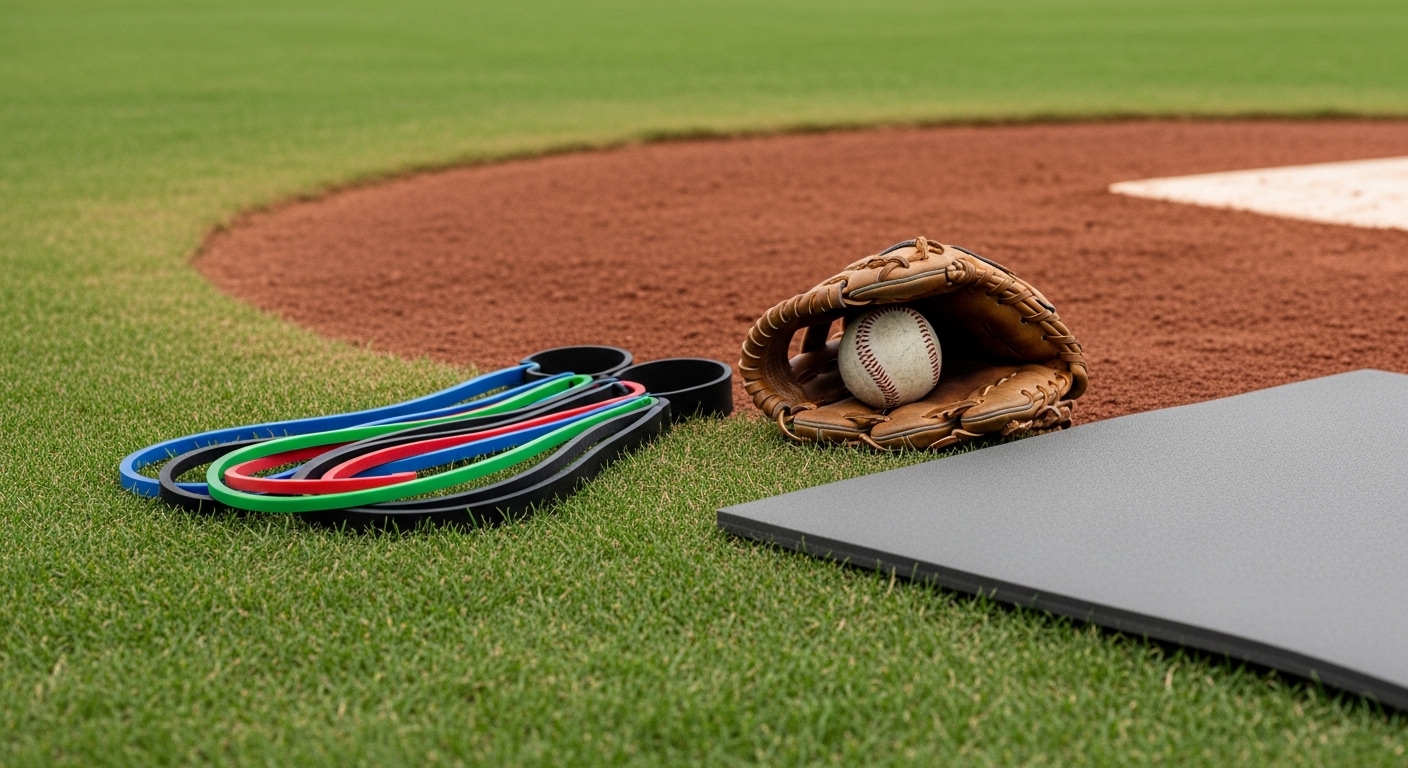
You can pick up resistance bands for baseball training from Baseline Sports — flat loop bands work well for the lateral walks and hip activation work, and orders ship with no sales tax and 10% off.
Age-Specific Progressions
One reason generic hip mobility programs don’t stick with youth players is that a one-size routine ignores where athletes actually are developmentally.
10U (Ages 9–10): Most kids this age are naturally flexible but have poor body awareness — they don’t know where their hips are, let alone how to control them. Skip the half-kneeling rotation drill; it requires proprioceptive awareness they haven’t developed yet. Focus on the 90/90 stretch (dynamic, 30 seconds per side) and the hip flexor lunge without the overhead reach. Keep it fun: call the 90/90 “the figure-four” and run it while you talk through the day’s plan. Three minutes total is plenty.
12–14U (Ages 12–14): This is the most important window. Growth spurts create rapid tightness as bones lengthen faster than soft tissue adapts. Players who were flexible at 10 may feel locked up at 13, and this is exactly when arm injuries spike. Run the full four-exercise sequence. Add static holds post-practice at least three days a week. This is also when the seated internal rotation screen becomes non-negotiable at the start of every season.
High School (Ages 14+): Athletes can handle load-based mobility work. Progress lateral band walks with heavier resistance and longer sets. Add a standing hip CAR (controlled articular rotation) — slow, full circles of the hip in a standing position — to develop active range of motion, not just passive flexibility. Mobile plus strong is the goal. Passive flexibility without strength at end range creates instability, not performance.
For more on how bodyweight strength and mobility work together as athletes develop, our guide to bodyweight exercises for young athletes covers the overlap without requiring a gym.
Running This as a Team Warmup With 12 Kids
Theory is easy. Twelve 11-year-olds who want to go throw is reality. Here’s exactly how we structure our team hip mobility warmup in under 12 minutes.
Minute 0–2: Two laps, then dynamic leg swings — forward/back and lateral, 10 reps each leg. Gets heart rate up and tissue warm before we ask it to move through range.
Minute 2–5: Full team does the 90/90 stretch together on the outfield grass. Coach calls the cue, everyone rotates on the same count. Athletes who are stiffer are immediately visible — you’re running your assessment passively while they warm up.
Minute 5–8: Hip flexor lunge stretch, both sides, twice through. We pair players and have them call out each other’s form: is the back knee under the hip, is the glute squeezing? Peer coaching keeps attention up and builds body awareness faster than a coach demonstrating alone.
Minute 8–10: Lateral band walks along the foul line. We keep four or five bands in the bag — half the team walks while the other half does standing hip circles. Switch and repeat.
Minute 10–12: Half-kneeling rotation drill with bats. This doubles as a visual diagnostic: you can see immediately who is rotating from the trunk versus who is just moving their arms.
Then straight into catch. The first throw of the day happens with hips that have already moved through their full range of motion. For a full practice structure that this warmup slots into cleanly, our 12U baseball practice plan and youth baseball infield drills both lay out the complete session arc by age group.
The Compensation Chain: Why This Is Also Arm Care
When the hips don’t rotate freely, the body finds another way to generate the rotation it needs. That almost always means the lumbar spine starts working as a rotation segment — which it is not designed to do. Lumbar vertebrae are built for flexion and extension. When they’re repeatedly asked to rotate under load, the overuse stress accumulates. Kids start showing up with low back tightness, then soreness, then something that requires time off.
Meanwhile, because the body still has to get the arm through, the shoulder and elbow compensate upward. Medial elbow stress — the structural loading pattern that leads to UCL problems — is downstream of lumbar overload, which is downstream of hip restriction. We’re not saying every youth Tommy John case starts in the hips. We are saying that coaches who build hip mobility into their regular program are doing real arm-care work, whether they’re thinking about it that way or not.
This is why we run the field assessment screen at the start of every season and why we flag athletes who show asymmetrical hip rotation. The goal isn’t flexibility for its own sake — it’s making sure force travels through the kinetic chain the way it’s supposed to, from the ground through the hips, through the core, and out through the arm. For more resources organized by age group and skill domain, the baseball coaching hub is a good starting point.
A Consistent 4-Week Starting Block
If you’re implementing this from scratch, here’s the minimum effective dose.
Weeks 1–2: Run the team warmup routine before every practice. No additional work yet. Let athletes get comfortable with the movements and develop body awareness.
Weeks 3–4: Add a post-practice static stretch day twice per week — 90/90 and hip flexor lunge, held 45–60 seconds, both sides. For flagged athletes, assign the 90/90 as daily homework: three minutes each side, every evening.
By the end of four weeks, re-run the seated internal rotation test. Most flagged athletes will show measurable improvement. More importantly, you should see it in their mechanics — hitters who were casting the bat will start to clear the hips first, and pitchers who were arm-throwing will start to feel what it means to drive off the back hip.
Hip mobility is not a flashy topic. It does not generate highlight reels. But in our experience, it is one of the highest-leverage things a youth baseball coach can address — simultaneously improving performance and reducing the injury risk that cuts young careers short before they’ve really started.
Download this as a free PDF — get the free PDF here
Get "Hip Mobility Exercises for Youth Baseball: Coach's Guide" as a free PDF
Instant download, plus free coaching resources in your inbox. No spam.
✓ You're in — here's your download
↓ Download the PDFBookmark it for the field — and check your inbox for more free coaching resources.