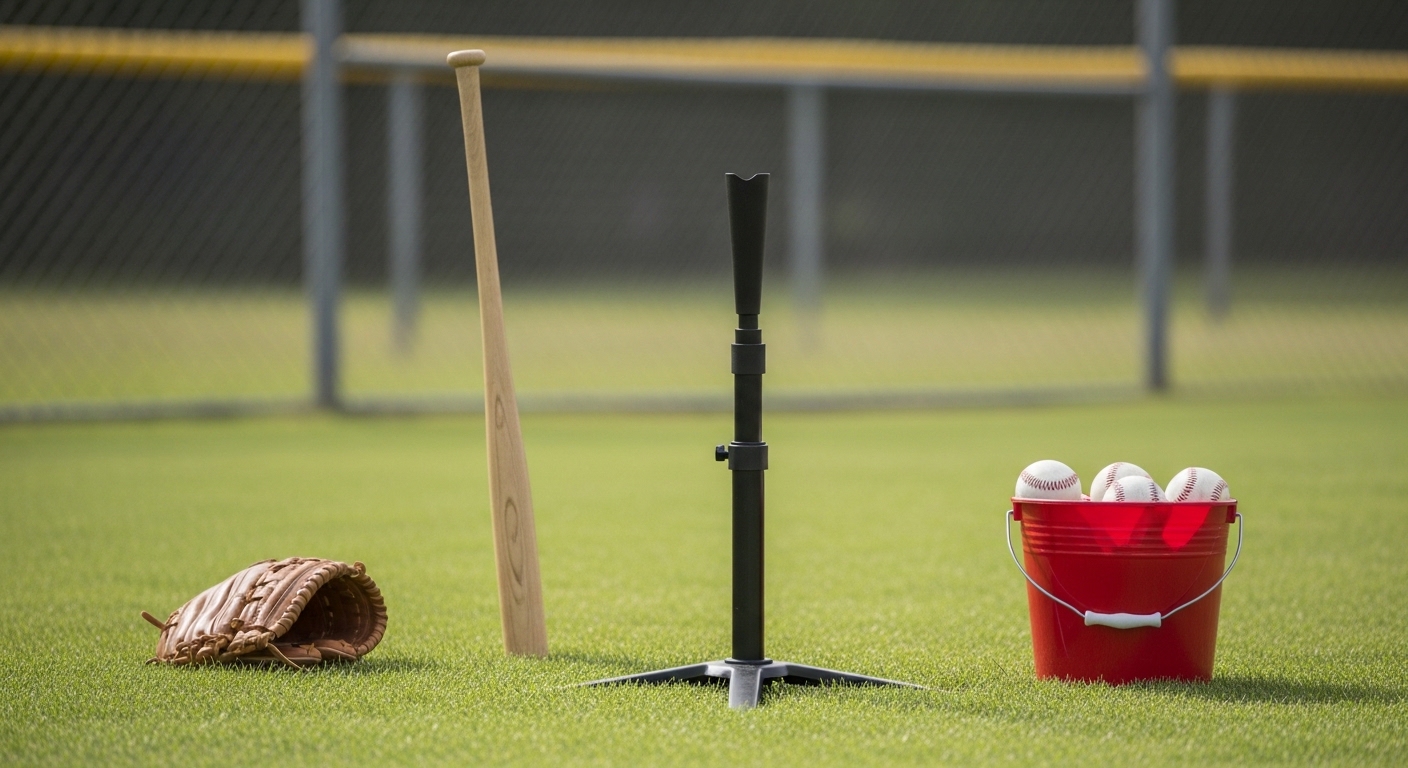
The first time I ran a 6U tee ball practice, I had twelve five-year-olds, two parent volunteers, one bag of baseballs, and a plan that lasted about nine minutes before complete chaos took over. One kid wandered toward the parking lot. Another decided the batting helmet was a better throwing target than the ball bucket. Three players had abandoned baseball entirely and were digging a hole in the infield dirt with their cleats.
That practice taught me more about coaching 6U than any clinic I have been to since.
A 6U tee ball practice works best as three or four parallel stations running simultaneously, with 4–5 kids per station rotating every 10–12 minutes, for a total session of 60–75 minutes. Every kid stays active at all times — no lines, no waiting, no drifting into left field. That structure — not a scripted drill progression — is what makes these practices actually run.
What 6U Athletes Actually Need
Most tee ball practice plans are scaled-down versions of 10U plans. They are not the same thing. A six-year-old is in a motor development window where balance, spatial awareness, and hand-eye coordination are the real teaching targets. Stance mechanics and swing path matter far less than getting kids to track a moving object, move their feet, and throw in the right direction.
Every season I see this play out: the 6U players who develop fastest by 8U are not the ones with the most polished mechanics at tee ball. They are the ones who moved the most, threw the most, and had enough fun to keep showing up every week.
Keep that in mind as you run this plan. And if you are a first-year coach still finding your footing, our beginner’s guide to coaching youth baseball walks through the management and mindset side of running practices with young athletes — worth reading before your first session.
Why Parallel Stations Beat Single-Line Drills
Here is what kills 6U practices: one drill, twelve kids, eleven standing in line. The moment a kid is not physically doing something, you have lost them. At this age, boredom and chaos look identical — and both spread fast.
The parallel station model solves this. Three or four stations run simultaneously, 4–5 kids per station, one parent volunteer per station running the drill while you float. Your job as coach is to cycle through all stations, give one cue per group, and keep the energy up — not to be the primary instructor at every drill.
For a team of 12–16 players, you need two to three parent volunteers. Send them a message before practice with one sentence describing their station and one phrase to repeat. That is all they need.
6U Tee Ball Practice Plan — 70 Minutes
Warm-Up: Dynamic Movement Circuit (10 min)
Get them moving before any baseball begins. Six-year-olds arrive wound tight — burning off the edge first makes every station run cleaner.
Station Block 1: Three Stations, 10 Minutes Each (30 min)
Split your team into three equal groups and rotate every 10 minutes. Parent volunteers run Stations 1 and 2. You run Station 3.
Water Break (5 min)
Non-negotiable at 6U. Use this time to rotate equipment, swap out wet balls, and check in with volunteers on how their stations went.
Station Block 2: Baserunning and Scrimmage (20 min)
Cool-Down and Team Circle (5 min)
Bring everyone in and sit them in a circle. Go around asking each player to name one thing they did during practice — not something they did well, just something. This builds reflection habits from the very first week and gives the quiet kids a moment of airtime in team culture. Close with the cheer.
Coaching Cues That Land at This Age
Abstract instruction does not reach a six-year-old mid-drill. Visual and physical cues do. Here is what we use consistently:
- Fielding: “Alligator mouth” — glove on the bottom, bare hand ready on top to secure
- Hitting: “Watch the ball sleep on the tee, then wake it up”
- Throwing: “Point your glove at your target, then let the ball go”
- Baserunning: “Don’t stop until I say stop”
One cue per player per rep. A 6-year-old in motion can hold exactly one instruction at a time. Give two and they process neither.
When Practice Looks Like Chaos (It Is Okay)
First-year coaches often apologize after watching a 6U session. “That looked like a disaster.” It was not. A ball rolling to the wrong station, a kid sitting down mid-drill, a five-minute water break stretching to ten — that is not failure. That is tee ball.
Real progress at this age does not look polished. It looks like a kid fielding a ground ball instead of stepping over it. It looks like a throw that goes in the right direction even if it bounces twice first. Those are the wins worth calling out. Set expectations with parents before the first practice: the goal this season is fun, fundamentals, and showing up. Everything else is a bonus.
What Comes Next: Building Toward 8U
Everything in this plan — the shuffle footwork, the tee tracking reps, the baserunning reads — is building toward 8U, where coach pitch enters, fielding positions become real, and kids start making genuine decisions on the field. The station rotation structure we use here scales directly into that next level. When your players are ready for that step, our 8U baseball practice plan lays out the full progression with the same format and higher skill demand.
The Athletic Foundation Under All of It
The freeze-tag warm-up, the cone shuffle drill, the baserunning reads — none of that is specifically baseball. It is athletic development: balance, spatial awareness, reaction time, lateral movement. These physical qualities compound over a career. The more of them you build at 6U, the faster kids absorb real mechanics at 8U and 10U. For a fuller look at what appropriate development looks like for this age group across all sports, our guide on athletic development for youth athletes ages 6–10 pairs well with this practice plan and is worth bookmarking for the whole season.
You can also browse all our baseball coaching resources at /baseball-coaching/.
Download this as a free PDF — get the free PDF here
Get "6U Baseball Practice Plan: Complete Tee Ball Guide" as a free PDF
Instant download, plus free coaching resources in your inbox. No spam.
✓ You're in — here's your download
↓ Download the PDFBookmark it for the field — and check your inbox for more free coaching resources.