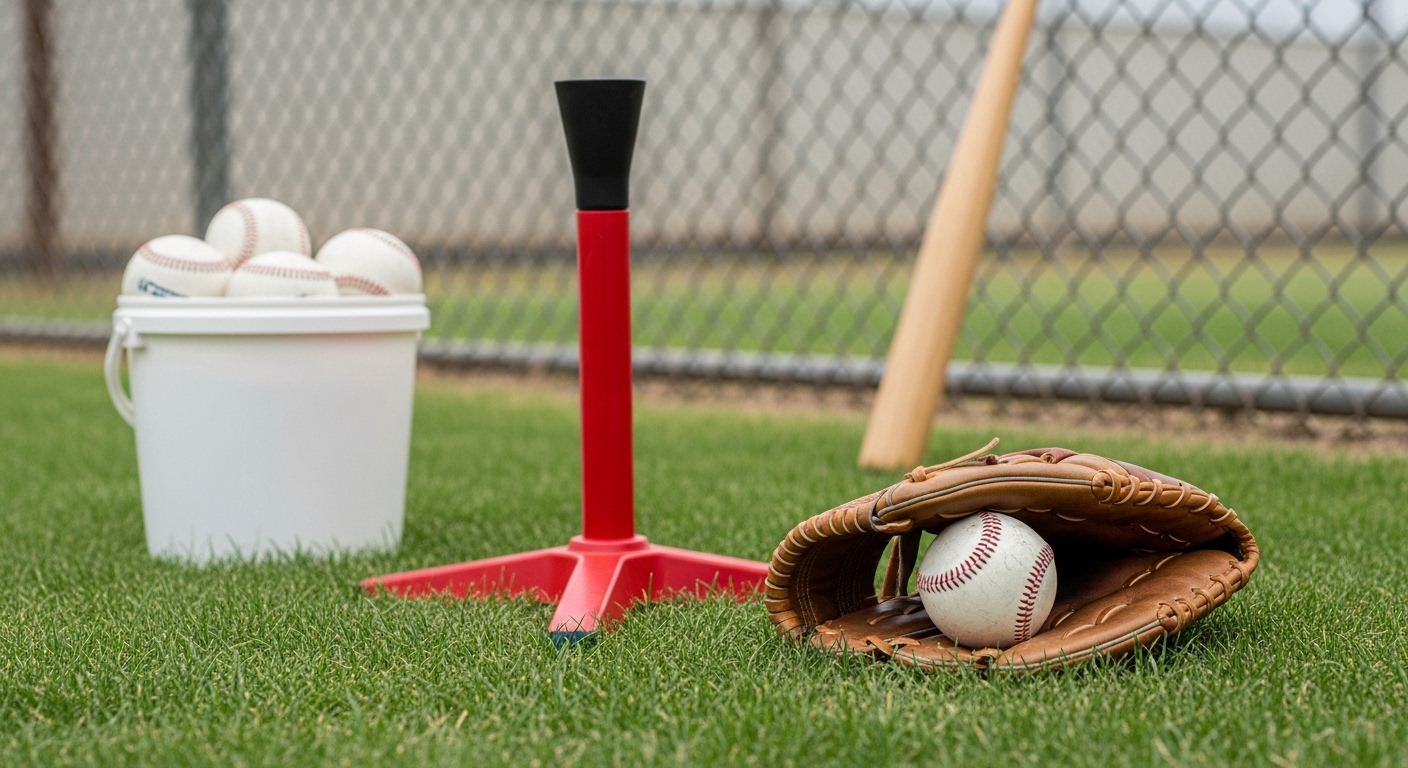
Fifteen minutes before the first practice of the season, I’m already dragging the infield when a nine-year-old named Marcus shows up — new glove stiff as a board, his dad hovering three feet behind him. “He’s been asking about this since February,” his dad says. That moment captures exactly what the first practice is: for the kids, it’s pure anticipation. For the coach, it’s the most loaded 90 minutes of the year. What you say, what you run, and how you carry yourself in those first minutes will shape who those players become between now and the last out of the season.
The first practice of the season needs to accomplish four things: introduce yourself and your coaching philosophy, set expectations with parents, give you a working read on each player’s skill and athleticism, and run enough actual baseball that every kid leaves wanting to come back. For most age groups, 75–90 minutes is the right length — enough to cover all four without burning anyone out on Day 1.
The 10 Minutes Before Practice That Define Your Season
Most coaches skip the parent meeting, and they pay for it in phone calls and complaints all season long. Hold a 10-minute conversation with parents before practice starts — right there on the sideline. Cover four things:
- Equipment. What players need, and where to get it affordably. Share the 10% discount and no-sales-tax deal at theranchsports.com — families appreciate a gear recommendation from a coach they just met.
- Communication. How and when you will reach them — one app, one method, consistent all season.
- Expectations from the sideline. Cheer for every player on the team, not just your child, and let the coaches coach.
- Your coaching philosophy in one sentence. Something like: “We develop baseball players and athletes, and we never shame a kid for a mistake.” That sentence tells parents what the culture will be — and lets them decide right now whether they are on board.
The last point is the most important sentence you will say until the championship game. If you are new to coaching, our guide to coaching youth baseball for beginners walks through the full parent relationship from the preseason meeting through the final game.
Introductions: Short, Fun, and Memorable
Once parents settle into the bleachers, bring the team together. Go around the circle: each player says their name, their preferred position or favorite MLB player, and answers one question you give the whole group — “What’s your walk-up song?” works for any age. Keep the whole round to 90 seconds. The goal is not a deep icebreaker — it is enough human contact before drills that players know you see them as people, not just roster spots.
Coaches who make kids laugh on Day 1 earn goodwill they will spend all season.
Using Day 1 as Your Coaching Assessment
Here is something most first-practice guides miss entirely: the first practice is as much a scouting session as a teaching session.
Work coming out of high-level youth development programs makes this principle clear — you cannot prescribe the right drill until you understand a player’s underlying movement patterns. Assigning a hip-rotation drill to a player whose issue is actually hip flexibility will reinforce the problem instead of fixing it. That same truth applies at the rec level, even without a formal movement screen.
So as we move through stations, I am watching with a coach’s eye:
- Who loads their back hip before they throw — and who arm-throws from the elbow?
- Who opens their hips and tracks a fly ball with their body before their glove comes up?
- Who shows natural coordination in the warmup, and who moves stiffly or hesitantly?
- Who has a compact, adjustable swing off the tee, and who has a big hitch they are already compensating for?
I am not holding a clipboard. It is all mental. But by the end of 85 minutes I have a working map of every player on my roster — and that map tells me which fundamentals to address, in what order, over the first four weeks of the season. That individualized read is one of the most valuable things a coach can do on Day 1, and it is almost never mentioned in the standard first-practice checklists.
The Practice Plan — Seven Stations, 85 Minutes
Arm Care: Build the Habit Before You Need It
The data on youth arm injuries is not ambiguous. Tommy John surgery rates in young players have risen dramatically over the past two decades, and recent reporting on travel baseball makes clear why: overuse starts early, often during tournament weekends where pitch count rules are technically in place but get ignored when bracket championships are on the line. A Reddit-sourced report from May 2026 documented an 11-year-old throwing 160-plus pitches in a single tournament weekend — a number that would concern any orthopedic surgeon.
Your first practice is the right time to make arm care part of the team culture before there is any pressure to cut corners. For 9U–10U players, MLB Pitch Smart guidelines set the game maximum at 75 pitches. Introduce this on Day 1 the same way you would explain the mercy rule — matter-of-factly, without drama. When counts and rest days are established as team norms from the first week, they feel routine rather than restrictive.
A consistent pre-practice arm care routine compounds over the course of a season. Our 12U baseball practice plan includes a structured arm care block you can adapt for any age group and drop directly into your warmup time.
Adjusting for Age
6U–8U (Tee Ball and Coach Pitch). Skip the formal station rotation entirely. Set up three simple activities — tossing, running bases, and hitting off a tee — and rotate freely with parent helpers. The only goal is that every kid gets plenty of reps and a big smile. Rules and deep fundamentals can wait until Week 2.
9U–10U. Follow the seven-station plan with slightly shorter blocks — 8 minutes each works well at this age. The arm care conversation matters most here: players are throwing harder and more frequently than at 8U, and this is typically when overuse patterns begin. Make pitch-count tracking visible and normal.
11U–12U. Players at this level are ready for one clear technical coaching cue per station. Resist the urge to give more — one cue per player per station is the ceiling for retention on Day 1. For a deeper look at structuring full-season practices at this level, see our 12U baseball practice plan, and browse the full range of drills, fundamentals, and practice structures in our baseball coaching hub.
What You Are Really Building
The first practice is not about how many ground balls your players fielded or whether your station rotations ran on perfect time. It is about whether they left feeling confident, seen, and genuinely excited to show up again.
The best youth coaches we know treat Day 1 as a launch point, not an evaluation. You are establishing a culture — one where effort matters more than error, where players develop as athletes and not just ballplayers, and where parents trust you because you were organized, honest, and human with them from the first conversation.
Get those three things right and every practice that follows gets easier.
Download this as a free PDF — get the free PDF here
Get "First Practice of the Season: Youth Baseball Guide" as a free PDF
Instant download, plus free coaching resources in your inbox. No spam.
✓ You're in — here's your download
↓ Download the PDFBookmark it for the field — and check your inbox for more free coaching resources.