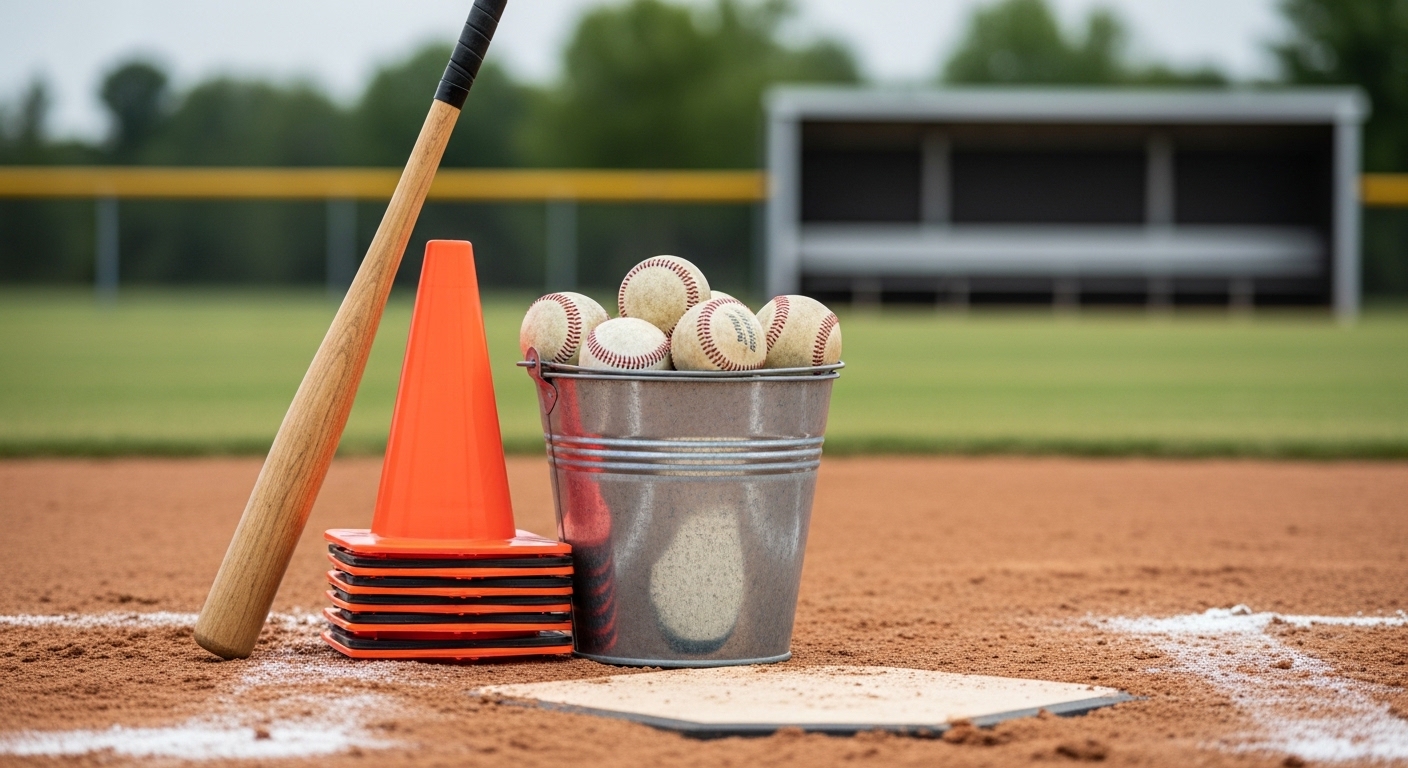
The third week of April I had nine kids at practice who had just come off an 0-for-8 weekend across two rainout doubleheaders. They were flat — arms at their sides, feet shuffling through the grass, eyes on everything except the bucket of balls at home plate.
I scrapped the practice plan and called out: “We’re playing Kill the King.” Within thirty seconds every one of them was loud.
That’s the whole argument for gamified baseball practice in one memory. Kids who won’t sprint to a cone will sprint to beat a teammate. When you turn reps into a game, they stop counting the reps.
The short answer: Gamified drills create a feedback loop — a clear win condition, instant results, and enough competition to make players care. You don’t need new equipment or elaborate setups. You need a point system, a winner, and a reset rule for when the energy starts to dip. The games below are the ones we run most in our program, organized by skill and scaled for different age groups.
Why Gamification Works — and When to Schedule It
Most articles on this topic just hand you a list of drills. What they skip is the when.
Competition mid-practice is the sweet spot. Gamified drills need players who are warm but not yet fading. Running Kill the King as the very first drill of the night means nobody’s body is ready. Running it last means nobody’s mind is still in the building. We schedule our game-format drills in the second third of practice — after dynamic warm-up and catch, before the low-energy finish.
We also use what I call the reset rule: if a game runs three-plus rounds and the energy starts to dip, change the scoring, flip the teams, or swap the game entirely. Youth players’ engagement has a short half-life, and the fastest way to kill a great drill is to run it one round too many.
Hitting Games
Kill the King
This is the format that YouTube research from Driveline Baseball confirmed works across every age group we coach — 8U through high school — because it gamifies approach, not just contact.
Each round has a built-in condition: Round 1, ball must land fair. Round 2, ball clears the pitcher’s mound. Round 3, air ball or line drive past the infield. Points stack per round. The coach sets a “King” target total, and any hitter who beats it earns a name on the whiteboard. For 7U–8U, simplify the round conditions. For 12U and up, add a “barrel or no points” rule to raise the standard.
Wiffleball Tee Race
Split the lineup into two teams. Both tee up simultaneously. First team to put 10 fair balls into a bucket wins the round. It is pure-volume contact work with a built-in timer, and the noise level at practice doubles immediately. Works with any age group old enough to hold a bat.
Fielding and Throwing Games
Hot Potato Circle
Knock It Off — Throwing Accuracy Game
500 — Fly Ball Competition
The 500 game runs cleanly alongside an infield ground ball station. Pair it with the drills in our youth baseball infield drills guide for a full station practice where every player is moving at once.
Pitching Games
Levels — The Gamified Pitching Drill
The biggest gap I find in almost every “fun drills” article online: none of them include a gamified pitching format. The Levels game, developed and popularized by Driveline Baseball for youth development, is the best one we have seen — and our research into their YouTube sessions confirms why it lands so well with young pitchers.
Set up a three-zone target on a net or a strike-zone poster: top zone, middle zone, low zone. Assign point values — low zone scores highest (3 pts), middle is 2, top is 1. That is intentional. You want pitchers chasing the low zone because that is where real command lives in a game. Each pitcher throws 10 pitches per round and tracks their own running total across multiple sessions. They compete against their own previous best, not just whoever is on the mound next to them. That self-competition builds the kind of intrinsic motivation that “just throw strikes” coaching never produces.
Strength and Power Game — Med Ball Volleyball
This section barely appears in the “fun baseball drills” space online, and that is a real miss. We run this at every fall camp and the carry-over to throwing is direct.
Split into two teams across a low rope or pool noodle. Use a 4 lb med ball for 8U–10U, 6 lb for 12U and up. Teams toss back and forth volleyball-style — underhand passes, chest passes, or overhead throws depending on the round. Ball lands on your side: one point for the other team. First to 10 wins.
The transfer shows up in real results. Over three fall camp cycles with our 12U group, we watched arm strength tick up measurably in kids who did two rounds of med ball work per session alongside their bullpen reps — more than in groups that stayed with pitching reps alone. It develops rotational power and catch-and-release timing in ways a baseball alone cannot fully replicate, especially in athletes under 12.
This pairs well with our article on speed and agility drills for young athletes if you want to build a full athletic-development block alongside your baseball skill work.
The Gamification Framework — Make Any Drill a Game
Here is what the list articles always miss: you do not need a specific named game. You need a formula.
Three ingredients turn any drill into a competition:
- A clear win condition — first to 10, beat the King’s total, last one standing
- Instant feedback — players know immediately if they earned the point or gave it away
- A reset rule — change the format before the energy dies, not after
I use this constantly at practice. I will flip a routine ground ball line into “first team to 5 clean reps with no errors wins a water break.” The drill itself does not change — the stakes do. Kids who were half-paying attention suddenly cannot afford to let their teammate down.
Wire these games into a station rotation for maximum efficiency. Our batting cage station ideas for youth baseball practice lays out how to structure the rotation so nobody is standing in a line waiting for a turn.
Gear Note
If you are running Kill the King with tee work, you need a tee that adjusts across your full lineup — one height does not fit a 7U and a 12U in the same drill. We use a height-adjustable batting tee at theranchsports.com that holds up through a full season of daily use. They offer 10% off with no sales tax on training equipment.
Download this as a free PDF — get the free PDF here
Get "Fun & Gamified Baseball Drills for Youth Practice" as a free PDF
Instant download, plus free coaching resources in your inbox. No spam.
✓ You're in — here's your download
↓ Download the PDFBookmark it for the field — and check your inbox for more free coaching resources.