We had a 7-year-old in our program last fall — great kid, completely obsessed with baseball since he could walk. His dad had already put him in pitching lessons at 6 and private hitting instruction by 7. When we ran a basic athletic screen on his first day with us — lateral shuffle, single-leg hop, moving catch — he couldn’t control his body well enough to complete any of them cleanly. He could talk through his two-step load sequence from memory, but he couldn’t land on one foot without stumbling.
That’s the pattern we keep seeing at the 6–10 age range, and it’s exactly why we’ve built our early-athlete development approach the way we did.
The short answer on athletic development for youth ages 6–10: This window is the most important time to build foundational movement — agility, balance, coordination, and speed — across multiple sports and free play, not locked into sport-specific drills. Long-term athletic development research and twenty-plus years of our own coaching experience both point to the same conclusion: kids who build this foundation first are dramatically better athletes by 12 than kids who specialized early. Start with the athlete. The sport-specific skill follows.
The LTAD Framework: Where 6–10-Year-Old Athletes Actually Are
The Long-Term Athletic Development (LTAD) model — the framework used by most national governing bodies and youth sports organizations — identifies ages 6–9 for boys and 6–8 for girls as the “FUNdamentals” stage. The name isn’t marketing fluff. This is the period when the nervous system is most receptive to learning new movement patterns, what sports science calls a “sensitive period” for coordination and motor skill acquisition. That window doesn’t stay open forever.
What that means practically: structured training at this age should target movement quality, not sport mechanics. A 7-year-old who learns to decelerate and change direction efficiently is building something that pays dividends in every sport for the rest of her athletic life. A 7-year-old working on batting stance mechanics is building something far more narrow — and it usually doesn’t even stick yet, because the foundational movement to support it isn’t there.
We’ve coached athletes who were in sport-specific academies from age 6. Most plateau hard around 11–13. Meanwhile, the kids who spent those early years playing multiple sports and moving freely keep climbing. After enough cycles of watching this play out, it’s not surprising anymore. It’s just what happens.
The ABCs of Athletic Development for This Age Group
Before we talk drills, every young athlete in our program gets evaluated on four foundational qualities — what the LTAD framework calls ABC skills:
Agility — the ability to change direction efficiently without losing balance or speed. We look for smooth deceleration and controlled redirects. A kid who hits the brakes awkwardly and stumbles before turning has real work to do here — and it’s very fixable at this age with the right drills.
Balance — both static (holding a position) and dynamic (staying controlled while moving). A clean single-leg landing after a hop tells us a lot. Watching a kid run the bases tells us more: does the outside shoulder fly wide on every turn, or can they stay compact and controlled through a change of direction?
Coordination — the ability to sequence multi-limb movements smoothly. Catching a bounced ball while moving, throwing underhand with accuracy, skipping rope with consistent rhythm. None of these are baseball or soccer skills on their own — they’re the building blocks every sport runs on.
Speed — at this age, we mean first-step acceleration mechanics, not top-end speed. How quickly can a 7-year-old get from stopped to full sprint in three steps? That initial burst is highly trainable early and transfers across every sport the athlete plays. Our speed and agility drills for young athletes break down the exact progression we use.
Multi-Sport Participation Isn’t Optional — It’s the Plan
Our program is rooted in baseball, but we actively encourage every athlete under 12 to play multiple sports year-round. This isn’t selfless — it’s strategic. We’ve written a full breakdown of why multi-sport athletes are better players, but here’s the short version.
Soccer players bring lateral footwork. Basketball develops explosion off the ground and aerial body control. Wrestling builds proprioception and upper-body kinesthetic awareness you simply cannot develop from swinging a bat. Every movement pattern from another sport feeds back into baseball mechanics in ways that are hard to fully measure but impossible to miss on the field.
Research from the American Development Model and long-term youth sport studies consistently shows that early sport specializers face higher overuse injury rates and burnout before high school. We’ve coached enough athletes over twenty-plus years to say this with confidence: the 16-year-old who played three sports at 10 almost always outperforms the 16-year-old who was in year-round baseball at 10. The multi-sport athlete is more resilient, adapts faster to coaching, and typically still loves the game when it matters most.
The Mistake Most Youth Coaches Make at This Age
Here’s the angle most standard LTAD resources don’t address enough: most 6U–8U coaches are too structured with sport-specific technique and not structured enough with athletic movement — and it shows in their athletes by age 11.
I’ve watched coaches spend 35 minutes of a 45-minute 7U practice on fielding mechanics with kids who can’t yet run and stop cleanly, can’t track a ball consistently in flight, and have no real hip stability to speak of. The mechanics don’t stick — not because the kids aren’t trying, but because the movement foundation to hold them isn’t there yet. You’re building on sand.
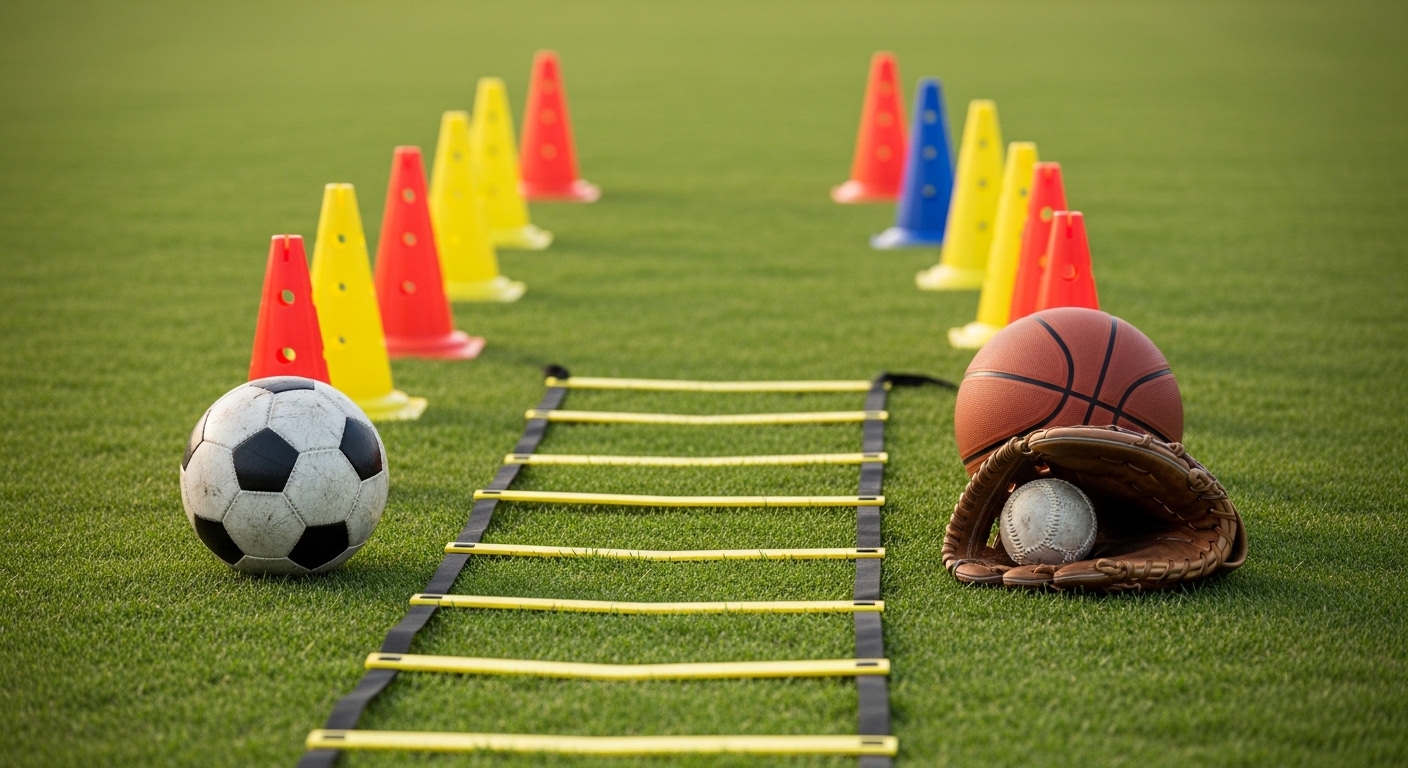
What we do instead: the first 20–25 minutes of every practice with this age group is pure athletic movement. Ladder work, cone reaction drills, tag games, multi-directional sprints, even basic tumbling rolls. We treat it like structured recess — fast, competitive, loud, and genuinely fun. The sport-specific work in the second half is shorter and simpler. And it sticks better, because the nervous system is fully activated and the kids are physically engaged.
That one shift — athletic development first, sport skill second — is the most impactful change any youth coach at this level can make.
Our Movement Practice Plan for Ages 6–10
Run this block at the start of every practice. Each station is short — the goal is quality reps of varied movement, not fatigue. The most versatile piece of equipment we use with this age group is a flat agility ladder; we keep a youth agility ladder at theranchsports.com in our bag for every session — they ship without sales tax, which adds up when you’re equipping a whole team.
Where We Want a 10-Year-Old to Be
By the time an athlete leaves this developmental window, here is what our coaching team is looking for — not stat lines or tournament records:
- Can decelerate and change direction under control without losing balance
- Can track and receive a moving object from multiple angles and heights
- Can land cleanly on one leg after a hop in any direction
- Shows comfortable first-step acceleration from multiple starting positions
- Has moved in at least two different sports environments and brings that variety with them
If a 10-year-old can do those five things, we can teach them baseball mechanics, soccer tactics, or whatever sport-specific skill set they want to pursue — and it will actually stick. If they can’t, we go back to the athletic foundation first, even if it is mid-season. That time is never wasted.
Build the athlete. The sport-specific skill follows naturally.
For more on how we structure athletic development across every age group from 6U through high school, visit our youth athletic development hub.