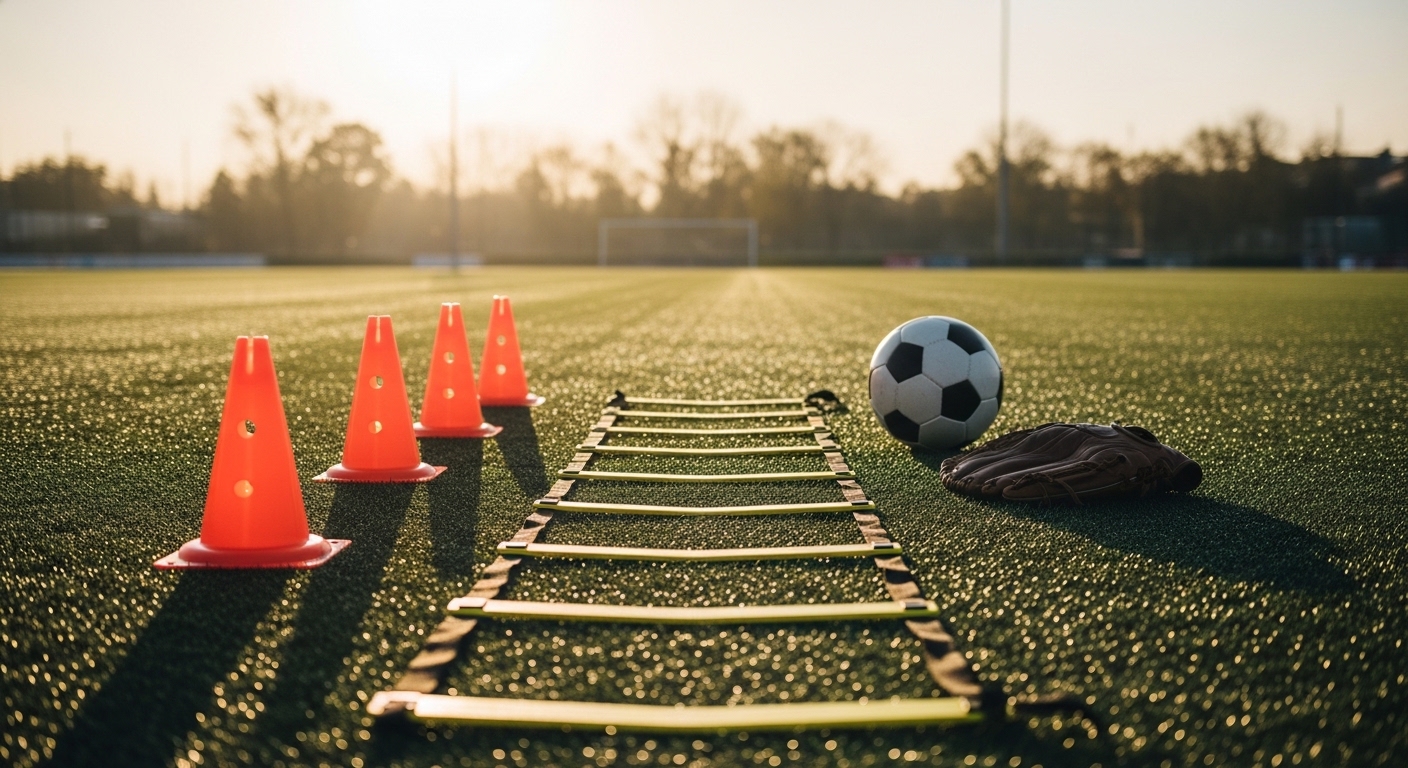
I had a 10-year-old outfielder last spring who could outrun every kid on his team in a straight line — great arm, great instincts, fastest kid at tryouts. But every time he broke on a fly ball, he’d overshoot it by three steps, sliding past the catch point with no control over his own momentum. His problem was not speed. It was that nobody had ever taught him how to stop. We spent the next four practices on deceleration before touching a single ladder drill, and by the end of the month he was tracking and reacting to balls more cleanly than athletes two years older.
Speed and agility training for young athletes is not complicated, but most programs get the order wrong. Here is the short answer: the best speed and agility drill sequence for young athletes builds from a stable athletic ready position → reactive footwork → linear speed → change of direction — in that order, every session. For athletes under 12, movement quality and body control always come before raw speed. Rush that progression and you build fast kids who get hurt.
Why Speed and Agility Training Matters Beyond Practice Reps
Every sport demands speed and agility — a shortstop reacting to a hard grounder, a midfielder accelerating past a defender, a basketball guard cutting backdoor on a broken play. But those movement patterns are built in dedicated training, not just by playing games.
Long-term athlete development research confirms what we have seen across two decades on our own fields: athletes who train foundational movement patterns between ages 7 and 14 develop faster, more durable neuromuscular habits than athletes who specialize early without this base. They sustain fewer lower-body injuries, adapt faster when they reach high school competition, and are more coachable because they already understand how their bodies move.
Our athletes compete across baseball, soccer, basketball, and football. We run the same speed and agility foundations with all of them because the movement toolkit is nearly identical across sports. A first-step cut in soccer is the same biomechanical event as a baserunner reading a pickoff move or a receiver breaking off a route. Build the foundation once — it transfers everywhere.
The Step Every Program Skips: The Athletic Ready Position
Before any drill, every athlete needs to be able to hold — and instantly snap into — the athletic ready position. This is the single biggest gap we see in athletes who come to us having “done ladder work” elsewhere but still look slow on the field.
The ready position is simple: feet shoulder-width apart, knees tracking over the second toes, a slight hip hinge so the hips sit back, weight loaded onto the balls of the feet, arms bent and loose at the sides. When an athlete is locked into this position, they can push explosively in any direction in under two tenths of a second. When they stand flat-footed or keep their knees straight, their first step is always late — and no amount of ladder repetitions will fix a bad starting position.
We drill this separately. We call out “ready!” and watch the group snap into position. Any athlete who straightens their knees, drops their heels, or rounds their back gets a cue before the next rep. It takes about two sessions to make it automatic.
The 5-Drill Sequence We Use Every Pre-Season
This is our actual sequence — the one we run with athletes from 8U through high school, scaled to age. Run it in this order every time. Each phase primes the nervous system for the one that follows.
The Deceleration Gap: What Almost Every Program Gets Wrong
Every article on youth speed training covers sprints, ladder patterns, and cone drills. Very few address deceleration as a standalone skill — which is backwards, because the most common youth sport injuries (ankle sprains, knee strains, ACL damage) happen during the deceleration and cut phase, not during straight-line running.
We added a dedicated deceleration drill three seasons ago after I watched a 12-year-old on our soccer-cross-training group pull up lame on a routine stop-and-go rep. She was fine — a minor ankle tweak — but when we reviewed the footage, she was braking almost entirely on straight knees with her weight forward over her toes. She had never been coached any differently, and honestly most youth coaches do not think to coach it.
The correction is simple and teachable: when decelerating, athletes push their hips back and down, loading the glutes and hamstrings rather than the knee and ankle joints. It takes three dedicated practice sessions to build the habit. After that it is automatic, and you see it transfer directly into games — fewer awkward stumbles, cleaner cuts, and athletes who can change speed and direction under full control.
Scaling the Sequence by Age
For athletes ages 7 to 9, cap the session at 20 minutes. Skip the T-drill and run Steps 1 through 3 plus the deceleration shuttle. Young athletes fatigue their central nervous systems faster than their muscles — once attention drops and form breaks down, the session is over. Quality over quantity, every time.
For athletes ages 10 to 13, the full five-drill sequence runs about 38 to 40 minutes. After the T-drill, add a reactive layer: coach signals left or right just before the athlete reaches the top cone, and the athlete must cut to that side. You are now training first-step reaction, not just footwork pattern.
For high school athletes, add a resistance band to the pogo jumps anchored at hip height, extend the T-drill to a 5-10-5 shuttle with a flying start, and push deceleration reps up to 10 with a 45-degree plant-and-cut at the end of each rep. They are ready for higher plyometric intensity and complex reaction patterns.
Building This Into Your Program
We run this sequence twice per week in pre-season — typically Monday and Thursday — giving athletes 48 or more hours of recovery between sessions. That recovery gap is where neuromuscular adaptations actually consolidate. Cramming speed work into consecutive days does not accelerate development; it just accumulates fatigue and increases injury risk. If you coach baseball, these drills also slot cleanly into the warm-up block of our 12U station-rotation practice plan.
If you want to go deeper on the full athletic development framework we use with athletes from 7U through high school — including periodization, multi-sport programming, and how to layer speed work across a full competitive season — our youth athletic development hub covers it in detail.