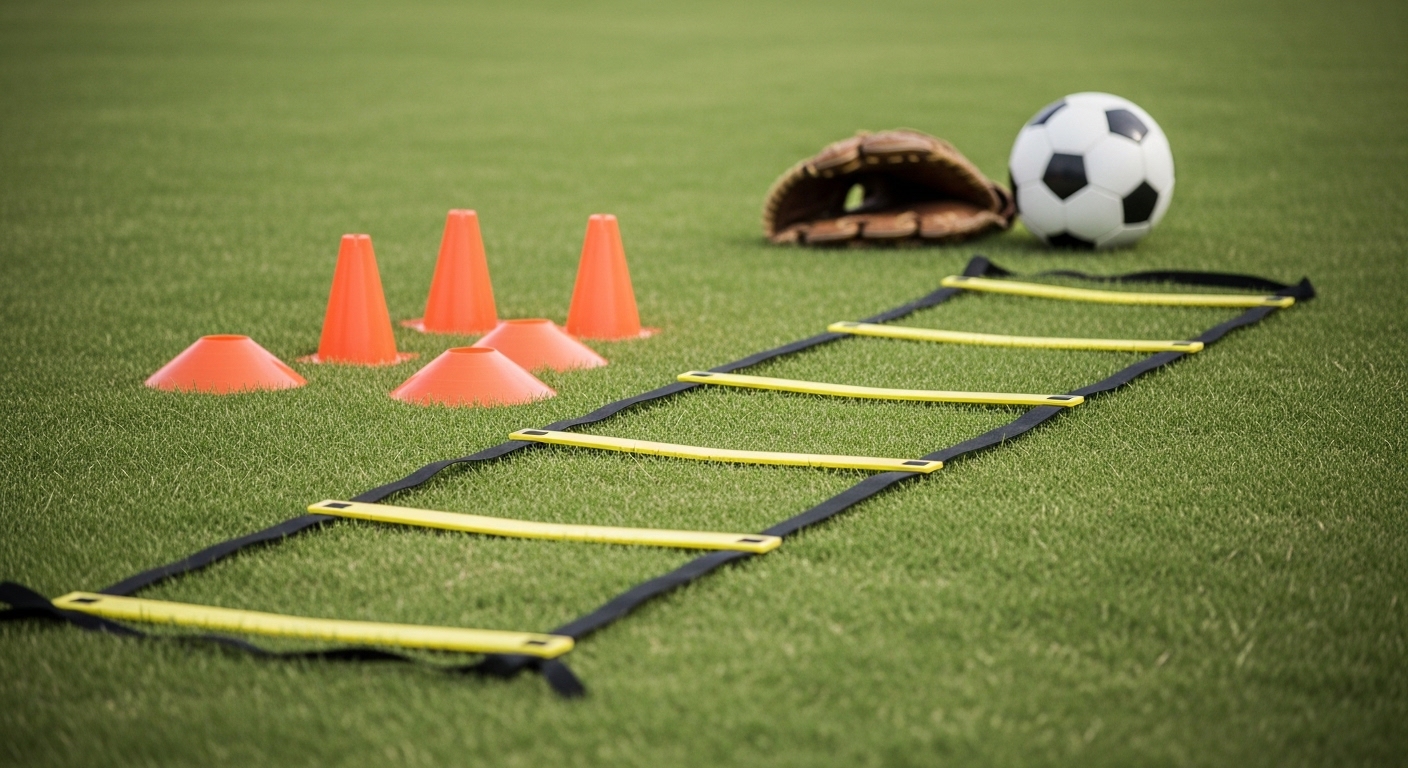
Last spring I had a 9-year-old infielder who could thread a ladder sequence perfectly at practice — quick-step, icky shuffle, lateral runs, all of it — but the moment a ground ball took a bad hop in a game, he froze. The footwork was there. The athleticism wasn’t.
That moment is what I use to explain the ladder to parents and coaches who ask about it. Agility ladder drills for kids build coordination, rhythm, and body awareness — and those are real, valuable gains. But the ladder is a coordination tool, not a speed machine. The fastest, most athletic kids we’ve coached learned the ladder alongside strength work and multi-directional movement — not instead of it.
Here’s the short answer: The best agility ladder drills for kids are single-step forward runs, lateral two-in/two-out patterns, and the icky shuffle, introduced in that order as coordination improves. Start slow — one foot per square at walking pace — build rhythm before adding speed, and pair every ladder session with basic strength movements like broad jumps and short sprints to translate coordination gains into real game athleticism.
What the Agility Ladder Actually Builds
Most coaches treat the ladder as a speed developer. Research on youth sprint and agility performance tells a more nuanced story: ladder training consistently improves foot speed, coordination, and proprioception — a young athlete’s internal sense of where their body is in space — but it does not reliably transfer to sport-specific agility on its own.
That is not a knock on the ladder. Proprioception and rhythm are foundational. A kid who can feel where her feet are at full speed is better positioned to learn cutting, first-step quickness, and direction changes. But athletes who combined ladder work with sprint volume and strength training improved significantly more than ladder-only groups. We see this play out year over year in our own program.
The kids who get genuinely fast are the ones doing sled work and plyometrics one day, ladder and sprint work the next, and sport-specific movement the day after. Twelve ladder reps every day is not a speed program — it is a coordination drill that needs context.
Age-Appropriate Progressions
5–8 Years: Coordination First, Speed Last
At this age, getting one foot in each square without looking down is a genuine neurological win. The brain is building motor pathways, not refining them. Do not rush it. Our full guide to athletic development for ages 6–10 covers where ladder work fits in this window.
For 5-to-8-year-olds, keep patterns simple — single-step forward, two-feet-in jumps — keep sessions under 12 minutes, and wrap the ladder into a game. We run relay races, color-call games where a coach shouts which pattern to switch to mid-run, and a beat-your-best challenge where kids track how many clean passes they can make without stepping on a rung. That competition drives more effort than any drill instruction can.
What does not work at this age: constant verbal corrections. A 6-year-old whose feet keep landing flat is doing her developmental best. Model it yourself, run alongside them, let them watch the older athletes — the motor patterns come with repetition and time.
9–12 Years: Rhythm, Reaction, and Multi-Sport Transfer
This is the prime window for ladder work. Neural plasticity is high, kids can process complex movement patterns, and they are competitive enough that technique coaching actually lands.
Introduce the lateral patterns here — the icky shuffle, the in-and-out side step. Add reaction elements: a coach shouts go at irregular intervals, or calls left or right at the ladder exit to force directional decisions under fatigue. This is also the age to be intentional about sport variety. Research on youth sport specialization is consistent that athletes who play multiple sports through age 14 to 15 develop better overall athleticism and carry significantly lower rates of overuse injury. The agility ladder is a perfect multi-sport tool — it builds the same foundational movement quality whether your athlete plays baseball, soccer, basketball, or all three.
13+ Years: Speed, Complexity, and Transfer
Older athletes should move through patterns at near-maximum speed with minimal rest between reps. Add cognitive load — mid-sequence pattern changes, a ball tossed at the ladder exit, a direction-change sprint off the last rung. The goal now is transfer: can they take the foot speed and body control built in the ladder and apply it in a real game situation? If the answer is still “not really,” the missing piece is almost always strength, not more ladder reps.
The Strength Connection Most Coaches Miss
A three-phase approach from high-level youth speed development work applies directly here. Phase one: build relative strength first — jumps, hinge patterns, basic sled work. Phase two: add sprint drills performed at full effort. Phase three: layer in sprint volume and footwork patterns. The ladder belongs in phases two and three. It is most effective after athletes have a baseline of lower-body strength, not as a standalone starting point.
Strength deficiency is the number one cause of poor movement mechanics in young athletes — not bad technique. When a kid runs through the ladder with shuffling, awkward footwork, the instinct is to slow him down and drill technique. But often the root cause is that his legs and hips are not yet strong enough to drive proper ground contact. Build the strength and the mechanics frequently fix themselves, which is exactly what we have observed with the three-phase approach in our program.
For athletes under 10, keep the strength work simple: broad jumps, squat-to-jump, lateral bounds. No equipment required. Five minutes of this before the ladder — every session, every time. Our speed and agility drill sequence for young athletes shows how to layer sprints and deceleration work on top of this base.
A 5-Drill Ladder Sequence for Youth Practice
For this sequence you need a quality flat agility ladder on grass or a gym surface. We recommend picking up a durable agility ladder at theranchsports.com — they carry solid youth options built to handle daily outdoor use. Rest 30 to 45 seconds between reps and 60 seconds between drills. For athletes under 10, cut the rep volume in half.
Making Ladder Work Stick for Young Athletes
The biggest mistake we see coaches make is letting ladder work become mechanical — endless silent reps, constant correction, zero variety. Kids under 10 disengage fast when the fun disappears, and when kids disengage they stop pushing their threshold.
We use timed relays where two athletes race from opposite ends, personal-best challenges where kids track their clean completion time, and pattern-call games where the coach calls a drill name and athletes must recognize and execute immediately. The engagement gap between a timed relay and a silent rep series is enormous with younger groups. The athletes who improve fastest are almost always the ones having the most fun doing it.
Two to three ladder sessions per week is the right dose for most youth athletes. More than that and you are cutting into time that should go toward sport play, strength work, and simply being a kid.
Agility ladder drills are one piece of a complete athletic development program — not the whole picture. For a full breakdown of how we structure athleticism across a multi-sport youth season, visit our youth athletic development hub. The goal is always the same: build a complete athlete first, a sport-specialist second.
Building movement quality in young athletes — before sport-specific specialization — is one of the highest-value investments a coach or parent can make. The coordination and body awareness kids develop in these foundational years pays dividends in every sport they play, every year they play it.