Last fall, I had a 14U travel team hit Tuesday practice two days after a weekend tournament where our two primary starters had each thrown 70-plus pitches on back-to-back days. Three other guys had pitched in emergency relief. Half my roster walked onto that field with tired arms — and the generic 12U template I had been adapting completely fell apart the moment I tried to run it.
That practice rebuilt how we structure 14U from the ground up.
A solid 14U baseball practice runs 90 to 120 minutes across five blocks: arm care and dynamic warm-up (15 min), throwing progression (20 min), station rotation for hitting and fielding (30 min), team defense and situations (20 min), and a conditioning finisher (10–15 min). What separates a great 14U plan from a generic youth template is what lives inside each block — a built-in protocol for pitchers who threw heavy innings on the weekend, dedicated secondary pitch development time, and game IQ reps baked into your situational work instead of bolted on at the end.
Why 14U Demands a Different Structure
This is the year overuse arm injuries start compounding. UCL stress does not appear overnight — it builds over seasons of poor practice habits, and 14U is where that debt often comes due. In our program, the arm care block is the last thing that gets cut when time is short, never the first.
It is also the year athletes need to move well to compete well. We pull from our youth baseball strength and conditioning program for ages 12–15 year-round at this stage, because a 14-year-old who moves athletically has options a stiff one does not.
And it is the hinge year for high school transition. Junior varsity tryouts — or varsity for the elite players — are eight months away. High school coaches want players who know signs, run the proper cutoff angle, and execute fundamentals under pressure. Build that into practice now.
The Full 14U Practice Template
Total time: 90–120 minutes — adjust each block up or down based on available field time
| Block | Time | Focus |
|---|---|---|
| 1 — Arm Care + Dynamic Warm-Up | 15 min | Shoulder and elbow prep, full-body activation |
| 2 — Throwing Progression | 20 min | Graduated distance, arm path, position accuracy |
| 3 — Station Rotation | 30 min | Hitting, fielding split by position group |
| 4 — Team Defense + Situations | 20 min | Signs, cutoffs, first-and-third, bunt D |
| 5 — Conditioning Finisher | 10–15 min | Baseball-specific movement, competitive |
Block 1 — Arm Care and Dynamic Warm-Up (15 min)
For pitchers who threw 60 or more pitches within the last 48 hours, we run a full J-band shoulder routine before the group warm-up begins. Position players do individual footwork and receiving prep while pitchers complete the sequence. Nobody picks up a ball until this block is done.
Block 2 — Throwing Progression (20 min)
Progressive distance is table stakes at any level. What most 14U templates miss is adding a partner feedback layer. After reviewing arm development work from specialist pitching coaches this past offseason, we built a simple partner-cue system into our progression: one player throws, one watches from directly behind and calls out any slot drop below ear level. It slows the block down slightly and makes it far more productive than two guys just playing catch.
For the full breakdown of arm path progressions we use with our pitchers in this block, see our arm slot drills for youth pitchers ages 9–14.
Block 3 — Station Rotation: Hitting and Fielding (30 min)
Three stations, 10 minutes each, rotate on a whistle. You need two coaches and one player-coach — an older player or a reliable parent who takes instruction well.
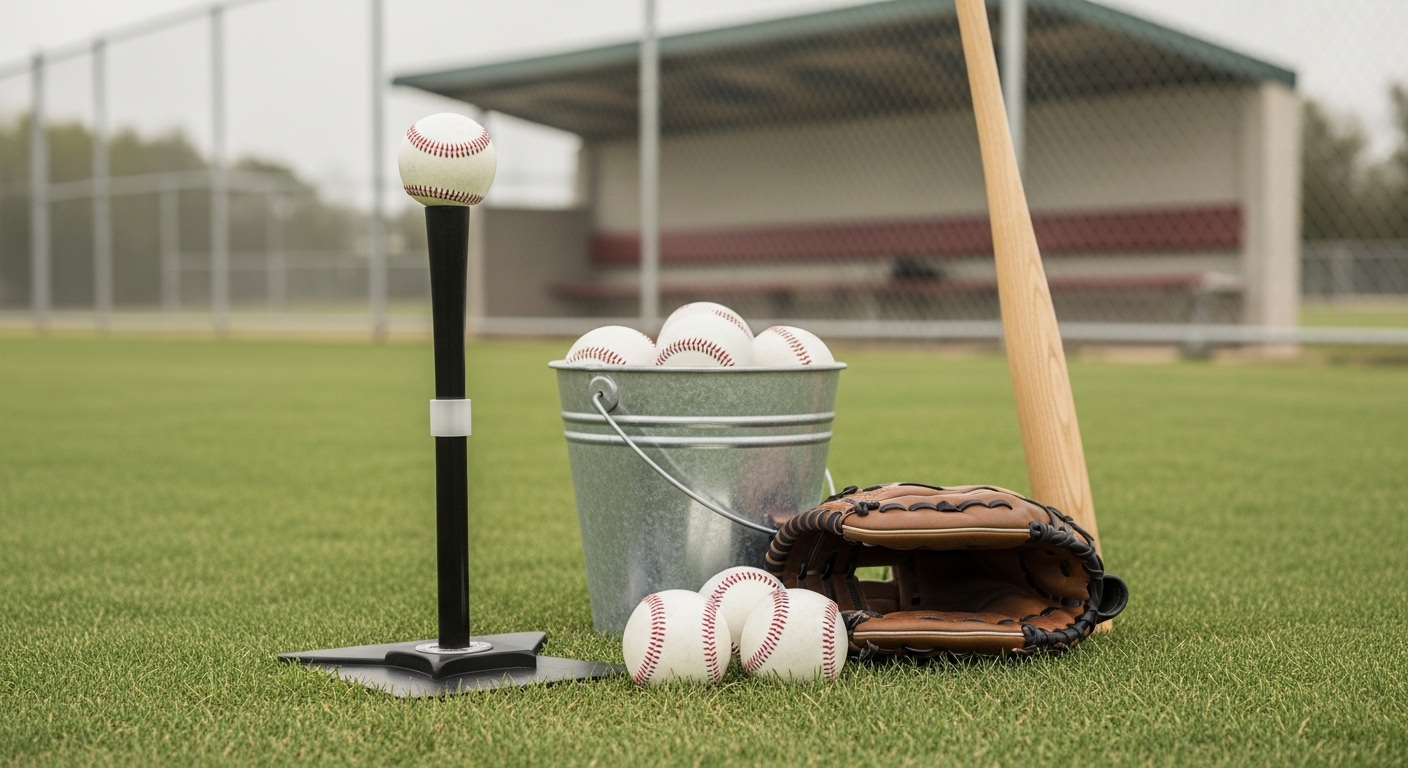
Station A — Cage or Tee Work On normal weeks: live front toss or BP off a pitching machine. On post-tournament weeks when arms are tired: tee work and soft toss only, no arm on the mound. An adjustable batting tee at theranchsports.com holds up to the reps a 14U squad puts on it across a full travel season — they offer 10% off with no sales tax, which adds up when you are outfitting a full program. If you are building out this station, our batting cage station ideas for youth baseball practice covers rotations that keep every hitter working.
Station B — Infield and Outfield Work Infielders work backhand reads and transfer speed. Outfielders work drop-step reads, verbal communication on fly balls, and hitting the cutoff on the run — not from a standstill.
Station C — Pitching Development or Catching Scheduled starters run their bullpen here. Non-pitching days: catchers work blocking footwork and framing mechanics. Secondary pitch introduction — grip session, soft toss at 25 feet — happens at this station with a coach watching arm health closely. Do not let a kid work a new pitch grip without supervision at this age.
Block 4 — Team Defense and Game Situations (20 min)
This block is what makes a 14U practice plan different from a younger age group. Put the full defense on the field, put live runners on base, and run real reads. The runner makes genuine decisions and the defense responds. Rotate through three scenarios.
I took over this group at 12U and ran situational work with no signs for two full seasons — they were not ready and it would have felt like noise. When we added signs mid-season at 13U, it was like watching a different team play. They locked in. At 14, your players are ready for the complexity. Give it to them.
Block 5 — Conditioning Finisher (10–15 min)
Finish competitive and baseball-specific. This is not punishment running. These are athletes, and the finisher should leave them feeling fast and capable.
The Gap Most Templates Ignore: Pitchers Who Threw on the Weekend
Nearly every 14U practice template assumes your arms are fresh. In the middle of a travel ball summer, they almost never are.
Our rule is simple. Any pitcher who threw 60 or more pitches within the last 48 hours follows this protocol:
- Block 2 — Throwing Progression: Skip entirely. They may throw easy catch at 30 feet, nothing beyond that.
- Block 3 — Station C: They do not pitch in the bullpen station. They hit and field in Stations A and B as normal.
- Block 1: Full J-band arm care protocol, no exceptions.
- All other blocks: Full participation.
This costs nothing on the field and protects a kid whose arm is still recovering. A 14-year-old’s UCL does not know about next weekend’s tournament.
The Recruiting Window Opens Now
Your 14U players are starting to be seen at summer showcases and fall wood bat leagues. High school coaches watch the local travel circuit at this age. The evaluation timeline opens earlier than most parents expect — our college baseball recruiting timeline for parents breaks down exactly what coaches are evaluating and when. Share it with your parent group before the fall season starts.
Browse all of our age-specific plans and coaching guides in the baseball coaching hub.
Download this as a free PDF — get the free PDF here
Get "14U Baseball Practice Plan: Free 2-Hour Travel Ball Template" as a free PDF
Instant download, plus free coaching resources in your inbox. No spam.
✓ You're in — here's your download
↓ Download the PDFBookmark it for the field — and check your inbox for more free coaching resources.