Three years ago I had a 13-year-old outfielder on my club team who was genuinely one of the slowest kids at tryouts. Smart player, excellent reads, terrible times. I spent six weeks coaching his sprint mechanics — arm drive, forward lean, knee lift, stride angle. All the standard cues. His sixty-yard dash did not move.
When I shifted entirely to building his lower-body strength and left the sprint coaching alone, things changed within a month. Not because he suddenly understood how to run. Because his legs finally had enough force capacity to express any speed at all. We went back to the mechanics work three months later and every cue I had given him six weeks earlier suddenly clicked.
The direct answer: Most young athletes are slow because they cannot produce enough force into the ground — not because their sprint mechanics are wrong. Before mechanics coaching can work, an athlete needs a real strength base that allows them to express speed. The path is three sequential phases: build strength, develop plyometric capacity through proper landing mechanics, then apply sprint cues on top of a body that can actually respond. Most speed programs start at phase three and wonder why the results are so inconsistent.
The Mechanics Coaching Trap
Walk into a youth speed camp and within ten minutes you will see kids doing A-skips, wicket drills, and wall marches. These are legitimate training tools. They are also the wrong starting point for most youth athletes, and applying them before the physical base is built produces mediocre results that make coaches and parents conclude the athlete is just naturally slow.
Sprint mechanics are a force multiplier. They improve the efficiency with which the body transfers force into forward momentum. But if the underlying force production capacity is not there, you are multiplying a small number — and you still end up with a small number.
The core insight from the Overtime Athletes coaching methodology is this: the majority of youth athletes who struggle with speed have a power problem, not a mechanics problem. The fix is not more cues. The fix is a stronger, more explosive athlete.
Why Force Production Is the Real Speed Lever
At the most fundamental level, speed is a product of ground-reaction force — how much force you can push into the ground, and how quickly. Everything in sprint performance either amplifies or interferes with that capacity.
In most young athletes, ground-reaction force capacity is low relative to what older athletes can produce. Not because young athletes are incapable of developing it, but because the vast majority have never trained specifically to build it. They have run around. They have played sports. But they have not trained the neuromuscular patterns that drive force production.
The upside is that this changes quickly. Young athletes respond rapidly to strength stimulus, and those force production gains translate almost directly into speed improvement — often before a single sprint mechanics drill has been introduced. We have consistently seen the largest speed gains in our program not during sprint work, but in the four to eight weeks following a focused strength block.
Phase 1 — The Strength Foundation
We do not begin speed development with any athlete who cannot first demonstrate baseline movement quality. Before adding load, we want to see:
- Bodyweight squat: Full depth, knees tracking over toes, no forward trunk collapse
- Single-leg balance: 10 seconds each side without hip compensation
- Broad jump landing: Two feet, absorbed contact, no stumbling on the catch
- Glute bridge: Full hip extension held, no lumbar substitution
These are not easy for athletes who have never trained. A clean deep bodyweight squat with stable knees requires coordination and hip mobility that many young athletes simply do not have yet. This is the starting line, not the finish line.
Once movement quality is established, strength sessions run two to three times per week, 20-25 minutes. Core exercises: goblet squats (working toward 20% bodyweight for 8 controlled reps), single-leg Romanian deadlifts, hip hinges, and lateral band walks using resistance bands for youth athletes — available at theranchsports.com with 10% off and no sales tax through our link. The goal is not hypertrophy. It is building the neural foundation for force production.
For parents wondering about age appropriateness, our full guide to when kids can start weight training covers the developmental case for early strength work. The short answer: bodyweight-first training is appropriate for any athlete who can follow instruction and is developmentally ready for structured activity — that includes athletes as young as 7.
Phase 1 typically runs 4-10 weeks depending on the athlete. Do not rush it. Every phase downstream depends on this one being real.
Phase 2 — Plyometrics and Landing Mechanics First
The second place speed programs go wrong is treating plyometric training as jumping exercises and progressing athletes toward higher outputs before they have learned to land properly.
The landing is where the training adaptation actually happens. Every time an athlete lands from a jump, the involved muscles go through the stretch-shortening cycle (SSC) — a rapid eccentric loading followed by an explosive concentric contraction. When the landing is well-absorbed (hips back, knees tracking, quiet and controlled contact), the SSC stores and returns elastic energy efficiently. That return of elastic energy is what makes explosive athletes feel springy and powerful.
When an athlete lands stiff-legged, with collapsed knees and a loud impact, the body absorbs the contact as joint stress. The SSC does not load properly. The athlete accumulates wear, not power.
We teach this sequence strictly in order:
- Step off a 6-inch box and stick the landing — two feet, freeze, evaluate body position
- Broad jump for distance — land and hold 3 seconds before the next rep
- Consecutive broad jumps — only once single-rep landing is reliably controlled
- Vertical work — last, after horizontal landing is fully trained
Volume starts at 20-30 total foot contacts per session, never on back-to-back days. Athletes under 10 stay with double-leg work exclusively. Progress here is measured by landing quality, not jump height or set length.
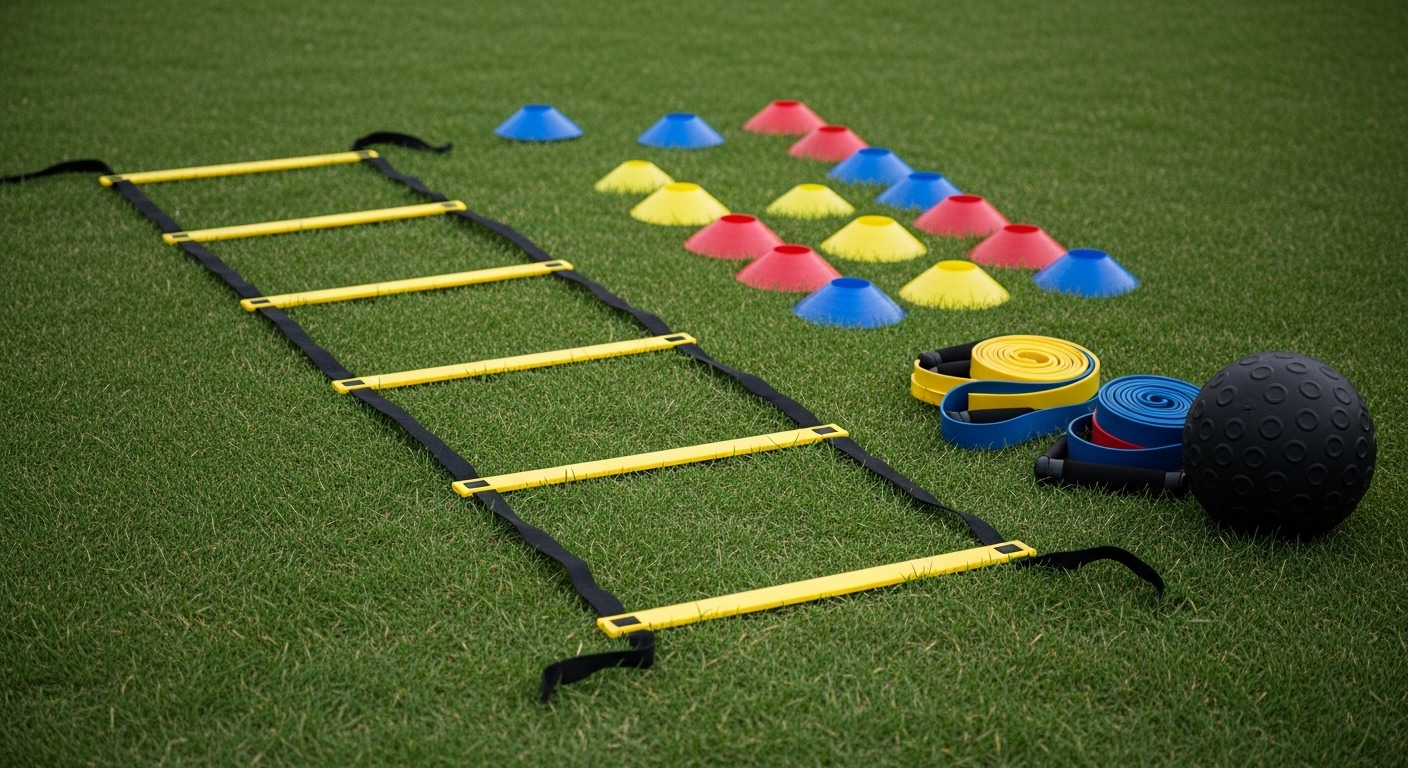
Pair this phase with agility ladder drills for kids — the rapid, low-amplitude foot contacts in ladder work build the same stretch-shortening efficiency you are developing in your jump progressions.
Phase 3 — Sprint Mechanics That Actually Stick
An athlete who has built a real strength base and trained landing mechanics is a completely different learner when sprint cues arrive. The coaching works because the physical capacity is finally there to respond to it.
The mechanics themselves are not complicated:
Acceleration (0-10 yards): Forward lean, pushing back and down into the ground, short and powerful ground contacts. The athlete falls into movement — the force direction is backward and downward, not upward.
Drive phase (10-30 yards): High knee drive, full hip extension at push-off, arms driving in direct opposition to the legs. This is where most sprint cue coaching is aimed, and where it actually pays off with a prepared athlete.
Upright sprint: Relaxed upper body, efficient arm swing from hip to cheek height, continuous powerful push-off. Upper-body tension at this stage actively slows the athlete — the cue “run loose” is often more valuable than any technical correction.
Drills at this phase: A-skips for knee drive rhythm, B-skips for hip extension range, wall march for drive angle and posture, short resisted band sprints for acceleration intent.
This phase also reveals why multi-sport athletes end up being better players. The varied coordination demands, force vectors, and movement patterns from different sports give athletes a richer physical vocabulary that makes them far more receptive to mechanics coaching at this stage. A kid who played basketball and soccer alongside baseball arrives here with movement patterns a baseball-only athlete has to build from scratch.
The Full Development Session
Here is the session structure we use with athletes in Phase 2 who are beginning to move into Phase 3 work:
Readiness Checkpoints and Real Timelines
We are straightforward with athletes and families about what this timeline looks like: speed development is a one-to-two season project, not a camp result. The athletes who try to rush the phases consistently underperform against the ones who build Phase 1 properly and stay patient.
Phase checkpoints we use before advancing:
Phase 1 to Phase 2: Goblet squat at 20% bodyweight for 8 controlled reps; broad jump landing held without foot drift for 3 seconds.
Phase 2 to Phase 3: 5 consecutive broad jumps with no stutter step and quiet contact; landing from a knee-height box controlled and repeatable on demand.
Phase 3 progress: Measured 10-yard dash time. We time athletes — if there is no data, there is no accountability and no feedback loop.
One pattern we see repeatedly: the athletes who develop the most speed over a full season are rarely the ones who came in with the best mechanics or the most natural quickness. They are the ones whose coaches recognized that Phase 1 was the right place for a 9-year-old with a weak foundation — not sprint mechanics camp — and invested in it accordingly.
All of our athletic development resources by training phase and age group are organized at the youth athletic development hub.