I had a 13-year-old shortstop last season who ran a 7.2 in the 60. Scouts would call that decent for his age. But in games, he was consistently late breaking on balls — going right or left — and twice got thrown out stealing when his jump was clean. The raw speed was there. The baseball speed wasn’t.
Speed training for youth baseball players means developing first-step quickness, direction-change athleticism, and reaction time in baseball-specific movements — not just getting faster in a straight line. A 60-yard dash time matters at showcases, but games are won and lost in the first three steps out of a stance or a secondary lead.
Baseball Speed Is Not Track Speed
The fastest plays in baseball happen in 15–30 feet. A stolen base, an outfielder reading a gap, a shortstop driving left on a sharp grounder — none of these are 60-yard efforts. They’re explosive bursts from a standing or moving start, often with a direction read baked in before the first step lands.
This is the distinction most youth speed programs miss. A pure sprint program will make kids faster on the track. A baseball speed program makes them faster in the game — out of a batting stance, from a fielding crouch, reacting off a pitcher’s first move. Those are different athletic skills, and they require different training to develop.
The other piece almost every program skips: deceleration. Fielders who can stop hard after a full sprint, plant, and throw from a balanced position are far more effective than players who brake awkwardly and lose the throw. An outfielder who overshoots a fly ball because they can’t brake isn’t fast — they’re a liability. We train stopping almost as much as we train going. More on that in a moment.
Age Matters: What to Train and When
Before we get into drills, long-term athlete development principles matter here more than almost anywhere else. The right speed training at the wrong age either does nothing or, worse, builds compensations that limit the athlete later.
Under 10: At this age, “speed training” is really coordination and body-awareness work. High knees, skipping, bounds, and tag games do more than structured sprint sessions. The nervous system is learning what fast movement feels like — teaching it patterns before it can stabilize them creates noise, not speed. Keep it playful, keep it short (10–12 minutes), and don’t rush the progressions. If a 7-year-old can’t yet skip rhythmically, they’re not ready for agility ladder drills.
Ages 10–12: Players can start doing directed speed work — cone drills, reactive first-step exercises, and basic agility patterns. This is also the best window to build hip mobility, which directly drives explosive first steps. We pair our speed blocks with hip mobility work for baseball players starting around 10U. The hip load — that weight shift and rotation at the hip before the first stride — is where most first-step power actually originates. Athletes who can’t load their hip cleanly will always be slow out of the box no matter how fast their legs move.
Ages 13 and up: True sprint mechanics work, resisted sprints, and sport-specific speed sessions become appropriate. This is when we start connecting speed training explicitly to game situations — secondary lead reads, gap jumps, dive-and-recover patterns. Players at this age can also handle more volume and benefit from 4–6 week speed cycles timed to the off-season.
One observation from our coaching team worth naming: multi-sport athletes consistently have a two-year head start in reactive speed by the time they’re 12. Kids who play basketball, soccer, or flag football develop lateral quickness and deceleration habits that baseball-only players haven’t encountered. If your athlete plays only baseball, build in cross-training time, even if it’s just open gym basketball in the winter. Lateral explosiveness from basketball and stopping habits from soccer show up directly as fielding range in the summer.
5 Speed Drills We Run Every Week
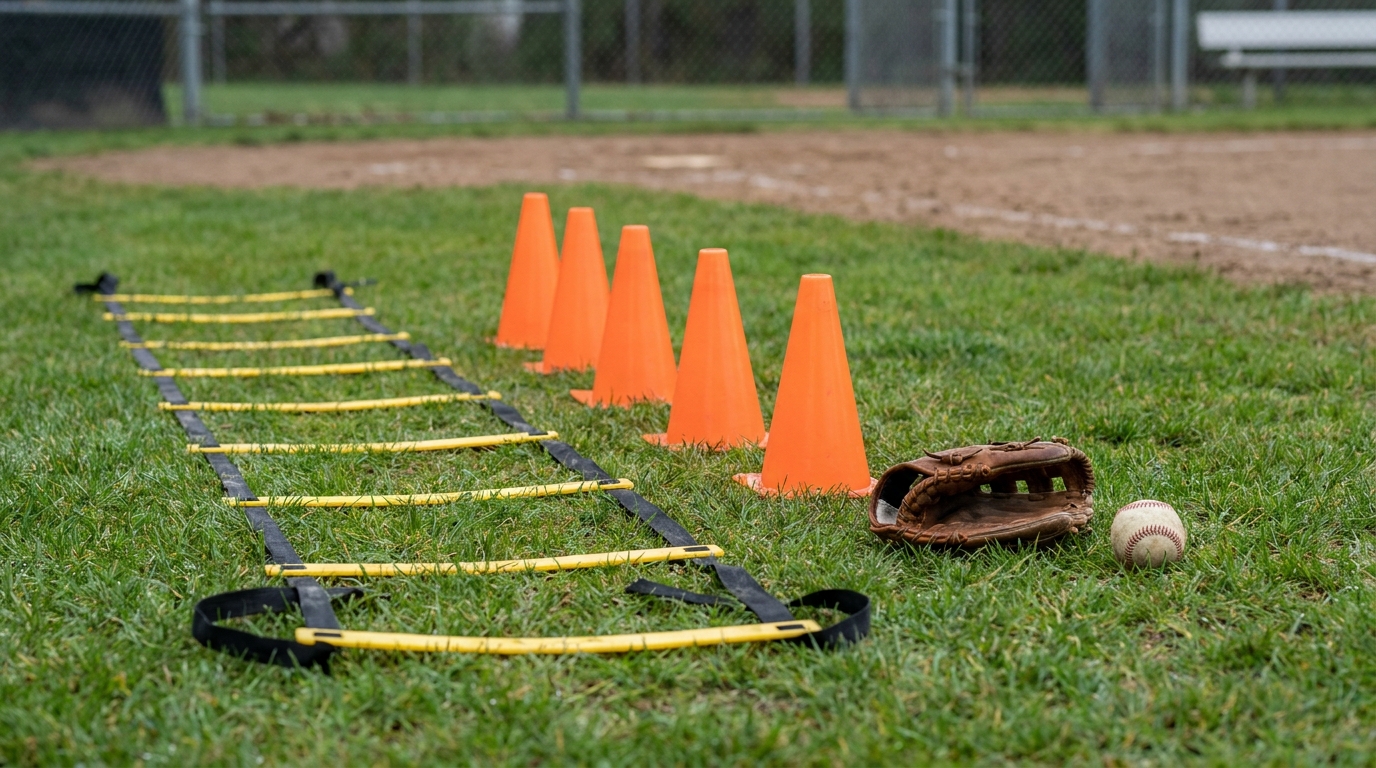
These are the drills our coaching team returns to most consistently across our program, from 10U all the way up to high school. You can run them as a 12–15 minute block before practice or work them into a station rotation. All you need is a set of flat cones and about 20 yards of grass.
The Half of Speed Nobody Talks About
Almost every youth speed program focuses entirely on going. But the plays we lose in baseball are often on the back end of the sprint, not the front.
An outfielder runs full speed toward the warning track, can’t brake, and the ball ticks off the heel of the glove. A shortstop charges a slow roller hard, can’t stop cleanly, and throws from an off-balance stagger. These aren’t effort problems — they’re deceleration problems, and they’re entirely trainable.
Deceleration is also a major injury-prevention lever. Hamstring strains in young baseball players happen disproportionately on the stop, not the go. The eccentric load of braking at full speed is enormous, and athletes who have never been taught to absorb it properly are at risk in ways they don’t know about. Drill 5 above is our entry point. As players advance, we add read-and-reverse patterns: sprint to a cone, brake hard, then immediately explode back in the opposite direction. That full loop — accelerate, stop, re-accelerate — is the athletic pattern that shows up on almost every baserunning and fielding play.
Wiring Speed Into Baseball Situations
Isolated speed work transfers better when you connect it to real game contexts. Three situations we practice explicitly:
Out of the box. Most youth players take a beat after contact before they sprint to first. We drill the swing-to-first transition in practice — the hip pivot out of the box and the angle of the first stride both matter. Getting this cleaner consistently shaves a tenth or two off the first-base time without changing the runner’s raw speed at all.
Secondary lead reads. Baserunning speed isn’t just raw running — it’s reading the pitch to the plate and the ball off the bat. We practice secondary leads with live reads: a coach simulates a pitcher delivering, the runner takes their secondary, then reads a simulated pitch result. On a ball in the dirt the runner retreats; on a ball in the gap they go. This trains the mental timing that makes athletes look faster than their sprint times suggest.
First step in the field. Outfielders benefit enormously from reaction-read drills where a coach holds a bat and swings it left or right. The fielder reads the swing and drop-steps the appropriate direction before any ball is in the air. Most youth outfielders wait to track the ball rather than triggering off the swing, which costs them a full stride before they move.
Our broader speed and agility drills for young athletes framework builds on these same principles across age groups if you want to extend this work beyond the baseball-specific context.
Fitting Speed Work Into Practice
We don’t treat speed training as a separate day or a separate season. It goes into the warm-up block at the start of practice — the first 12–15 minutes — or into a station if we’re running rotations. A weekly structure that works across our program:
- First two practices of the week: Stance-to-Sprint + Reactive Cone Drop during warm-up before throwing programs begin
- Mid-week practice: Agility Ladder + Controlled Brake as one station in rotation
- Game days: Five-minute reactive warm-up only — no heavy speed load the day of a game
The rule we follow: speed work done tired doesn’t build speed, it builds fatigue. Always run the speed block fresh, before throwing programs or batting practice. Players who are competing for breath from sprints can’t throw with the arm mechanics we spent the rest of practice developing.
For players working toward a youth athletic development program with longer-term structure — especially 13U and up approaching showcases or high school programs — a 6-week off-season speed cycle with progressively heavier resisted sprint work and plyometric loading delivers the biggest measurable gains.
Building Speed That Shows Up in Games
Speed is trainable at every age — but what you’re actually training changes depending on where the athlete is developmentally. Under 10, you’re building coordination. Ages 10–12, you’re building reaction patterns and hip-load habits. Ages 13 and up, you’re refining mechanics and connecting everything to game situations.
The athletes who are genuinely fast at 16 aren’t always the ones who looked fast at 10. They’re the ones whose coaches built the right movement foundation at each stage — varied sports in the early years, reactive patterns and hip mobility in the middle years, and structured sprint training when the body can actually absorb and use it.
Build the right patterns at the right time, and the speed follows.