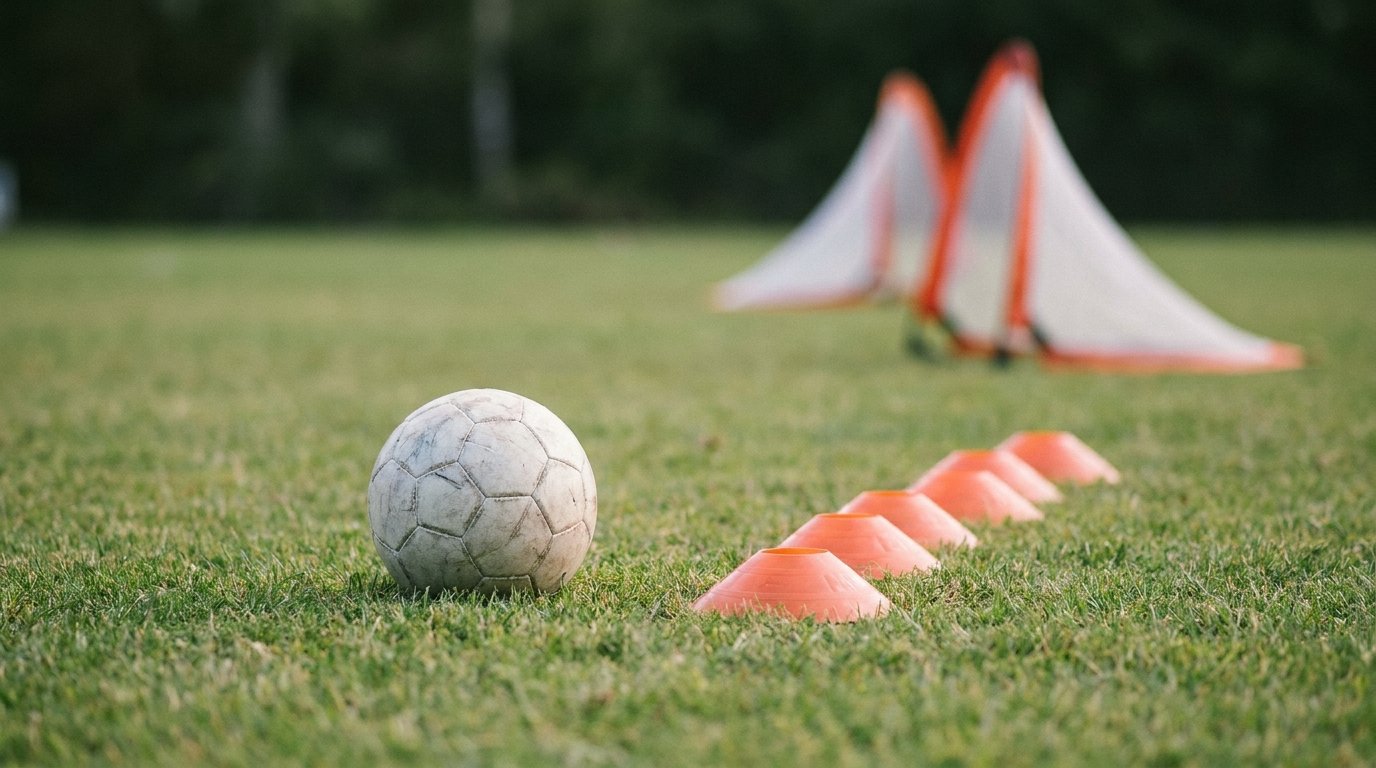
The first time I ran a U6 soccer practice, I spent 20 minutes planning a five-drill progression. The kids spent 20 minutes chasing each other around the field, kicking each other’s shins, and asking when snack was. I learned something that day: a U6 practice plan is not about the drills — it is about the container that holds the chaos long enough for a few good moments to happen.
The short answer: A well-structured U6 soccer practice runs 45–60 minutes and focuses on one technical theme, two or three games that build the same skill, and a small-sided scrimmage at the end. That is it. At this age, teaching is playing — kids learn by doing, not by listening to instructions at a cone.
Below is the plan we use for our U6 fall season players — a true 60-minute session with timed blocks and station rotation. It follows the same format as our U8 soccer practice plan one developmental rung up, so you can ladder players through the program as they grow.
Who This Plan Is For
This plan is built for players ages 5–6 in a recreational or first-year club environment. At U6, we are not running 4v4 formations or teaching corner-kick runs. We are building three things: comfort with the ball at their feet, the habit of keeping their eyes up, and — most importantly — a reason to want to come back next week.
If you are brand new to coaching this age, start with U6 soccer drills for beginners to understand what skills actually land at this stage before you build a full session around them.
The One-Focus Principle
The single biggest mistake we see first-time U6 coaches make is trying to teach too much in one session — passing, dribbling, shooting, and spacing all in 60 minutes.
Here is the rule we follow: pick one technical focus per session, and make every drill in the plan practice that same skill. For this session, the focus is close-contact dribbling — keeping the ball within two feet of their body while moving. Every activity below builds that one skill from a different angle. By the end of practice, kids have touched close dribbling thirty or forty times, in game-like situations, without sitting through a single lecture.
This is the gap most U6 practice plans miss. They list five unrelated drills and call it a plan. A real plan has a through-line.
The 60-Minute U6 Soccer Practice Plan
Session focus: Close-contact dribbling
Players: 8–14 U6 athletes
Equipment: One ball per player, cones, small goals or cone goals, colored pinnies
| Time | Block | Focus |
|---|---|---|
| 0–8 min | Free Ball / Arrival Activity | Ball comfort, no instruction |
| 8–18 min | Sharks and Minnows | Dribbling with pressure awareness |
| 18–32 min | Station Rotation (2 stations) | Skill building |
| 32–42 min | King of the Ring | Competitive dribbling |
| 42–55 min | 3v3 Small-Sided Scrimmage | Applying the skill |
| 55–60 min | Cool-Down and Team Cheer | Transition and closure |
Session Walkthrough
Managing the Chaos Moment
Every U6 practice has one. Usually around minute 25, a kid starts crying, two others are wrestling, and someone has decided to lie down in the middle of the field. This is not failure — it is a predictable attention-span threshold.
Our go-to reset: blow the whistle once, raise your hand, and say “balls on feet, freeze.” Then immediately announce the next activity with high energy. You have about a 10-second window where the novelty of what comes next pulls the group back in. The coaches who succeed at U6 are not the most knowledgeable — they are the most adaptable in that 10-second window.
This same adaptability is what makes small-sided games formats so durable across age groups — our small-sided games guide breaks down the format from U6 through U14 if you want to see how the structure evolves.
Running This With Two Coaches and No Assistants
If it is just you and a helper, collapse the station rotation into a single large-group activity and add an extra round of Sharks and Minnows. The 3v3 scrimmage still works with two coaches managing the sidelines. What does not work is trying to run two simultaneous stations alone. Know your constraints before practice starts, not during.
What U6 Players Actually Take Home
Not technique — at least, not consciously. What a well-run U6 session delivers is one rep of genuine effort, one moment where the game clicked, and one reason to want to come back next week. The plan above is built to produce those moments reliably.
When your U6 players grow into U8 athletes, the structure they have learned here — arrival activity, warm-up game, stations, scrimmage — will feel like second nature. That is the real payoff of a consistent practice format: the plan teaches itself over time, and you get to be the coach instead of the chaos manager. See the U8 soccer practice plan for how the format builds at the next level.
For the full library of soccer coaching resources we publish, visit our soccer coaching hub.
Download this as a free PDF — get the free PDF here
Get "U6 Soccer Practice Plan: 60 Minutes for First-Time Coaches" as a free PDF
Instant download, plus free coaching resources in your inbox. No spam.
✓ You're in — here's your download
↓ Download the PDFBookmark it for the field — and check your inbox for more free coaching resources.