I had a 10-year-old on our team last spring who was one of the hardest-working kids I’ve ever coached. Great attitude, showed up early, stayed late — but he consistently struggled with plays that looked routine: a ground ball that took a bad hop, a quick direction change in the outfield, a throw that came in slightly off-target. After watching him for three weeks, I stopped focusing on his mechanics and started looking deeper. It wasn’t effort. It wasn’t baseball IQ. It was coordination — specifically, the kind of foundational body control that sport-specific practice almost never addresses directly.
We pulled him aside for 15 minutes before regular practice, twice a week, and ran him through a dedicated coordination sequence. By mid-season, the difference was visible everywhere — not just on the field.
The short answer: Coordination drills for youth athletes train the nervous system to link movement patterns — balance, timing, bilateral control, and hand-eye or foot-eye reaction. The most effective drills are mirror exercises, cross-lateral crawls, lateral bounds with a stick landing, cone shuffle patterns, and ball-drop reactions. None require expensive equipment, all transfer across every sport your athletes play, and the 7–12 age window is the most neurologically receptive time to build these skills.
Why Coordination Is the Foundation, Not the Finishing Touch
Most youth coaches treat coordination as something kids either have or they don’t. In our experience coaching athletes from 7U through high school, that’s the wrong frame. Coordination is trainable — and the window between ages 7 and 12 is the most neurologically receptive period for building it. Miss it, and you spend years correcting compensations rather than building skills.
Think of sport-specific skill as something layered on top of foundational coordination. Hitting mechanics, dribbling form, throwing technique — these are all trained patterns. When the foundation is shaky, skill development hits a ceiling. The body can’t execute what the brain is asking for, regardless of how many reps you put in.
This is why we build coordination work into our program for every athlete under 12, regardless of sport. It’s also one of the most compelling arguments for playing multiple sports: each one taxes a different coordination system. The baseball player who also plays soccer in the fall is developing foot-eye coordination and change-of-direction awareness that their single-sport peers simply aren’t. Our full breakdown of why that matters is in our post on why multi-sport athletes are better players.
The Three Coordination Systems Youth Athletes Need
Before you design your drill sequence, it helps to know what you’re actually targeting:
Hand-eye and foot-eye coordination — tracking a moving object through space and timing a response. Batting, catching fly balls, heading a soccer ball, catching a pass — these all live here.
Bilateral coordination — using both sides of the body independently and in sequence. Throwing, pitching, kicking, swimming strokes, even running require the left and right sides to work together without mirroring. This is one of the most undertrained systems in youth sports, and cross-lateral movement is the most direct fix.
Proprioception and balance — knowing where your body is in space without looking at it. A shortstop fielding in motion, a goalkeeper cutting to a near post, a basketball player landing from a jump — all of them are relying on a body that self-organizes without conscious thought. Train this system and you simultaneously reduce soft-tissue injury risk.
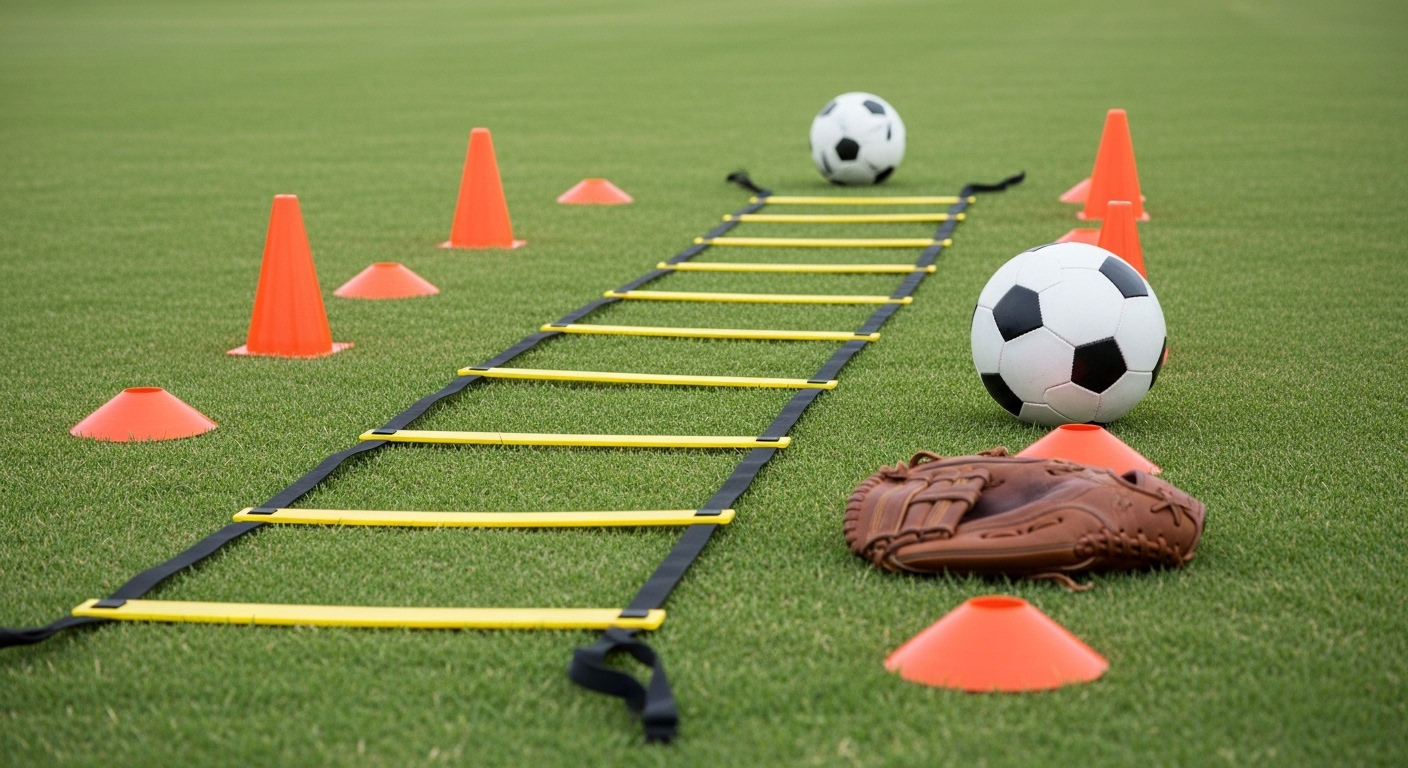
The drills below hit all three. They’re sequenced from controlled to reactive, which mirrors how the nervous system learns and cements new movement patterns. Before you run any pattern drills, grab a set of flat agility cones — they’re the only equipment you need for this whole block.
The Coordination Drill Sequence
This works as a pre-practice warm-up block (12–15 minutes total) or as a standalone training unit two to three times per week.
How to Progress the Drills
The sequence above is your baseline. Once athletes execute each drill cleanly — controlled movement, consistent stick landings, reliable catches — advance them by increasing demand rather than switching to entirely new drills:
- Add fatigue — Run the sequence at the end of practice instead of the beginning. Coordination under fatigue is the real-game test.
- Remove visual anchors — Ball drop drill with the athlete facing away until the coach says go. Mirror drill on grass or uneven turf.
- Increase randomness — In the cone shuffle, call the next direction while the athlete is still moving, before they’ve returned to center.
- Add a sport action immediately after — Following the lateral bound, execute a sport-specific movement: swing a bat, take a shot, field a ground ball. This trains the neurological handoff from athletic movement to skill execution — which is exactly what happens in games.
In our program, athletes spend three to four weeks at the baseline level before we progress, especially those under 10. Neurological adaptation happens in layers. Chasing speed too early builds sloppy motor patterns that have to be unlearned later — and that takes far longer than building them correctly the first time. Our broader framework for that age window is covered in the athletic development for youth athletes ages 6–10 guide.
The Multi-Sport and LTAD Connection
Our coaching team has observed this consistently: athletes who play two or more sports arrive with a coordination head start. A kid playing baseball in the spring and soccer in the fall has already been training hand-eye control, foot-eye tracking, and multi-directional change-of-direction across two completely different contexts. Their nervous systems adapt more readily and retain new patterns faster because the demand variety has been training their adaptability all along.
This is the core of long-term athletic development (LTAD), and it is why we advocate for multi-sport participation through at least age 13 in our program. The coordination drills in this sequence fit naturally into any sport’s off-season or pre-season prep because the underlying systems are universal. Whether your athlete plays baseball, soccer, basketball, or flag football, they are all drawing on the same neurological foundation.
Pairing Coordination Work with Speed and Agility
Coordination and speed work reinforce each other, but they address different systems. An athlete who changes direction explosively but cannot read the play is just fast in the wrong direction. An athlete with sharp pattern recognition but no first-step quickness arrives one count late. Both matter.
We typically pair the drills above with targeted speed and agility progressions as part of our pre-season prep. If you are building a summer training schedule, start with this coordination sequence for two to three weeks to establish the body-control baseline, then layer in our speed and agility drills for young athletes. Six weeks of that combined block — three sessions per week — produces visible, measurable results before the first practice of the season.
Coordination does not show up in stats. It does not generate highlight reels. But it is the difference between an athlete who looks composed under pressure and one who always seems to be one step behind. Build the foundation first. Everything else follows.