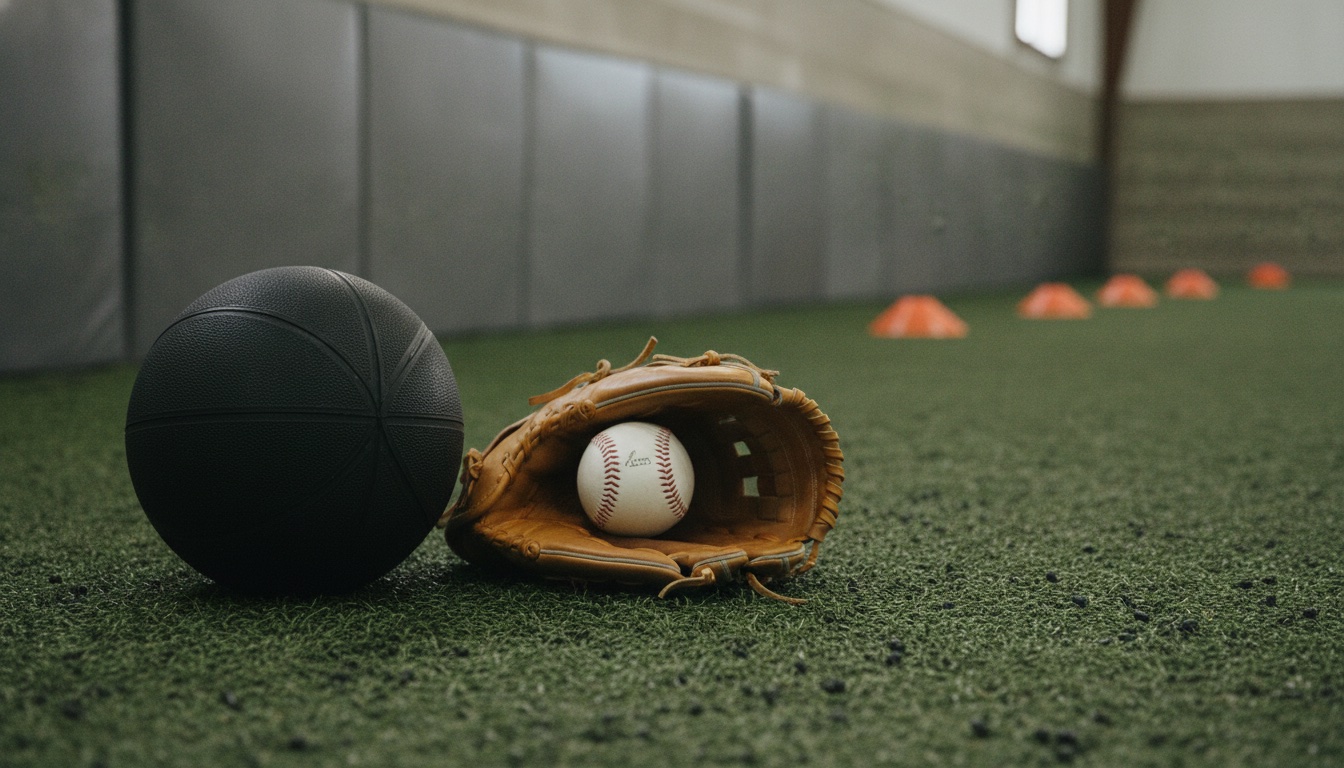
Two winters ago I walked into our facility and found one of our 11-year-olds launching a 10-pound medicine ball into the cinder-block wall. Every throw looked like a kid trying to push a car uphill: arms doing all the work, back foot glued to the floor, a dull thud and a ball that rolled back to him. His dad had bought the ball because “the high school guys use a 10.” Twenty minutes of that taught him one thing — how to throw slowly. We swapped him to a 4-pound ball, and on the first rep his back hip fired, the ball cracked off the wall, and he grinned like he’d just hit one over the fence. That’s the whole lesson of med ball training in a single rep.
The short answer: med ball training builds rotational power for youth baseball players — the hip-to-shoulder sequence that drives bat speed and throwing velocity — as long as the ball is light enough to throw fast. Most kids 8–10 should use a 2–4 lb ball and kids 11–13 a 4–6 lb ball, two sessions a week of 3–5 throws per exercise, stopping any set the moment the throws slow down. Speed of the ball matters more than weight of the ball.
Why a Med Ball Belongs in a Youth Baseball Program
Baseball is a rotational, ballistic sport. The swing and the throw both start from the ground, travel through the hips, get handed off to the trunk, and finish at the hands. Most youth strength work — push-ups, squats, planks — trains straight-line strength. A medicine ball is one of the only tools that lets a young athlete practice releasing rotational force at full speed, the same way they do in the box or on the mound, without the stress of throwing a baseball.
It also tells the truth. You cannot fake a med ball throw. If the hips don’t lead, the ball dies. That makes it a coaching tool, not just a conditioning tool.
Recent work from bat-speed researchers shows why the rotational engine matters so much at the plate: bat speed drives exit velocity at roughly a 6-to-1 ratio over pitch speed — every extra mile per hour of bat speed adds about 1.2 mph of exit velocity, while an extra mile per hour from the pitcher adds about 0.2. “Let the pitcher supply the power” is measurably false. The power is yours to build, and rotational med ball work is one of the cleanest ways to build it. (We go deeper on the swing side in our guide to building bat speed for youth hitters.)
The research on youth specifically is thinner than vendor blogs suggest. Small studies on prepubescent softball players and high school baseball players have looked at med ball programs and bat velocity with encouraging but mixed results. Our honest read: med ball work isn’t a magic velocity program for a 10-year-old. It’s a coordination and power-sequencing tool that pays off over years — exactly what long-term athlete development asks for at this age.
What Weight Medicine Ball Should a Youth Baseball Player Use?
This is the question every parent asks, and the answer is lighter than they expect. The goal is velocity of movement. A ball that’s too heavy turns a power drill into a slow strength grind and teaches the arms to muscle the throw.
| Age | Starting ball weight | Signs to move up |
|---|---|---|
| 8–10 | 2–4 lb | Every throw is crisp and the hips clearly lead for 4+ weeks |
| 11–13 | 4–6 lb | Same — plus they can hold a stable finish on every rep |
| 14–15 | 6–8 lb | Bodyweight, strength base and throw quality all support it |
A training study on youth throwers used exactly this kind of split — a 4-lb ball for 8–10-year-olds and a 6-lb ball for 11–13-year-olds — and that matches what we see. Our rule of thumb: if you can hear the throw slow down, the ball is too heavy. A good rep sounds like a crack off the wall, not a thud.
Two equipment notes most guides skip:
- Get a soft-shell or rubber “bounce” ball for wall work and a non-bounce sand-style ball for slams. Hard rubber balls rebounding off a wall at full speed will catch an 8-year-old in the face eventually.
- Size matters, not just weight. Small hands can’t control a large-diameter ball. If a kid can’t comfortably cradle it with fingers spread, find a smaller one.
Is Med Ball Training Safe for Kids?
Yes — when it’s light, low-volume and coached. Medicine ball throws are low-impact, self-limiting (a kid can only throw what they can move) and don’t load the spine the way a barbell does. If you’ve wondered when kids can start weight training, med ball work is one of the best on-ramps, because it rewards control and speed rather than how much you can lift.
The three rules we hold every athlete to:
- Technique before load. A new movement gets learned with a 2-lb ball or even a basketball.
- Quality over quantity. Sets of 3–5 throws. Power work done tired isn’t power work.
- Throw both ways. Baseball is lopsided — every swing and throw goes one direction. Med ball work is a chance to balance that out, so we throw from both sides, every time.
The 6 Med Ball Throws That Matter Most for Baseball
There are dozens of medicine ball exercises. These six cover what a youth baseball player needs: rotation, hip-to-shoulder separation, overhead extension and full-body power. Run them in this order — the most technical throws go first while athletes are fresh.
Most guides stop at the exercise list. The sixth one is the piece we’d push hardest for younger players. Under 11, the best med ball session is the one that doesn’t feel like a workout. Turning throws into a competitive game — an idea we picked up from a pro development lab that runs it with youth groups — gets far more quality reps out of 9-year-olds, because nobody’s counting sets. They’re trying to win.
The Mistake We See Most: Training Throws Instead of Sequencing
Here’s the gap almost every med ball article misses. Coaches hand a kid a ball, give them “3 x 10 rotational throws,” and walk away. The kid gets through 30 throws by throwing harder with the arms each time, because that’s what’s easiest when you’re tired. Thirty reps of arm-led rotation is thirty reps of the exact pattern we spend all season trying to fix in the swing.
What I tell our coaches: watch the back foot. On a good rotational throw, the back heel lifts and the back knee drives toward the target as the hips open. If the back foot stays flat and the shoulders turn first, the kid is throwing with their arms. Stop the set, drop the ball weight, and cut the reps.
Our in-practice fix is simple. We pair each med ball throw with three dry swings or a pitcher’s dry drill immediately after. Throw, then swing. The body remembers the feeling of the hips leading, and you see it carry straight into the next round of tee work. That transfer is the entire point — med ball work that stays in the weight room is a missed opportunity.
If a kid can’t get the hips to lead even with a light ball, the issue is usually mobility, not strength. Fifteen minutes of hip mobility exercises for youth baseball before the throws often fixes more than any cue.
A Simple Weekly Med Ball Plan
Two short sessions a week is plenty for a youth player. In season, cut it to one session and drop the volume by half. Off-season is when med ball work does the most good — it slots directly into a youth baseball offseason training plan alongside lifting and throwing progressions.
Ages 8–10 (15 minutes, 2x per week)
- Scoop toss: 2 x 4 each side
- Overhead slam: 2 x 5
- Chest pass: 2 x 5
- Med ball volleyball: 5 minutes
Ages 11–13 (20 minutes, 2x per week)
- Scoop toss: 3 x 4 each side
- Step-behind toss: 2 x 3 each side
- Rotational shot put: 3 x 3 each side
- Overhead slam: 3 x 5
- Pair each set of rotational throws with 3 dry swings
Ages 14–15 (20–25 minutes, 2x per week)
- All six throws, 3 sets each
- Add heavier (6–8 lb) scoop tosses only once technique holds for a full block
- Pair with the plyometric progressions on the same day — med ball first, then jumps
Rest 30–60 seconds between sets. This is power work, not conditioning. If kids are breathing hard, you’re going too fast.
How Med Ball Training Fits With Everything Else
Med ball throws work best as the “power” piece of a broader athletic program. Here’s how we place them:
- After the warm-up, before skill work or lifting. Power work needs a fresh nervous system.
- Never on the same day as a heavy pitching outing. Rotational throws still load the trunk and shoulder.
- Alongside other sports. A kid who plays basketball or football in the winter is already getting a lot of explosive work. One med ball session a week may be all they need.
Equipment should support the work you’re doing in the cage too — a properly sized youth bat lets the rotational speed you build with the ball actually show up in the swing. Our store carries youth bats and training gear at 10% off with no sales tax, which is the one plug you’ll get from us here.
The Bottom Line
Med ball training is one of the best tools a youth baseball coach has for building rotational power, and one of the easiest to get wrong. Keep the ball light, keep the reps low, demand that the hips lead every throw, and make it a game for the younger kids. Do that consistently through an off-season and you won’t need a radar gun to see the difference. You’ll hear it — in the crack off the wall, and later, off the bat.
For more on building complete athletes, see our youth athletic development hub.