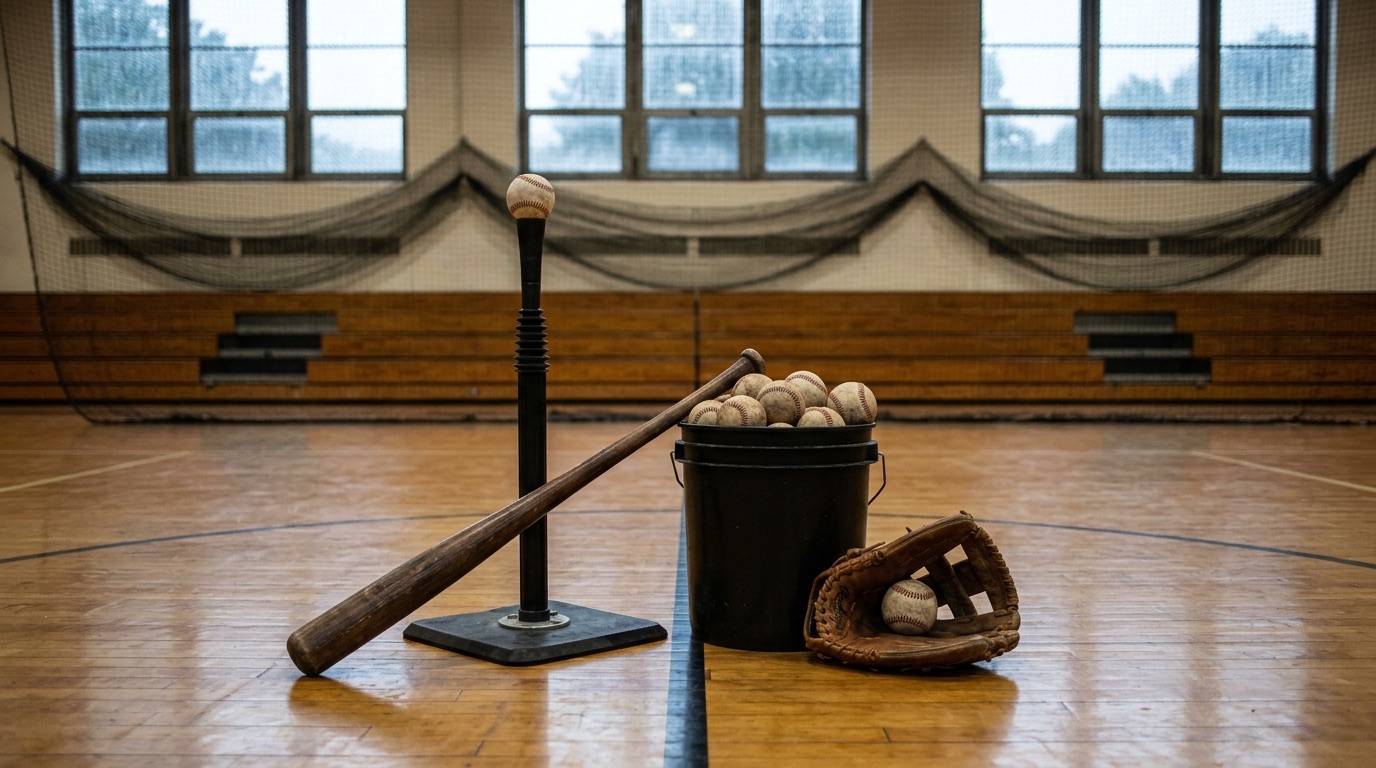
It was last October — our 12U club team had a tournament on Saturday, and Friday was supposed to be our final sharpening session before game day. The rain started at noon and didn’t stop. By 3 PM we were texting parents: “Gym night, not field.” Twenty-two kids, one elementary school cafeteria, no cages, a ceiling that maxed out at about 14 feet, and a freshly-waxed wood floor.
We ran one of the most productive practices of the fall.
The key to a good rainy day gym practice is planning for the space you actually have, not a fantasy facility. Run four simultaneous stations, keep rotations tight with a timer, and fill one of those stations with mental reps and situational review. Athletes can leave a gym day sharper than a field day if the plan is right.
Why Most Gym Days Fail
The mistake I see most coaches make is showing up at the gym and improvising. They grab the bag of balls, set up a tee in one corner, and let athletes drift. Thirty minutes in, half the team is leaning against the wall while two kids take turns on a tee that nobody is coaching. The gym day becomes a throwaway.
The second mistake is trying to recreate a field practice indoors. Some things — live BP, fly balls, full-distance throwing — are not safe in a standard gym regardless of how experienced your athletes are. One errant ball into a bleacher at 12 feet costs you the gym for the season. You need a plan built around gym constraints, not one that ignores them.
Before You Walk In: Know Your Space
Answer three questions before you design a single station:
Ceiling height — Under 12 feet: no live swings, no fly balls, underhand tosses only. Over 14 feet: soft toss is safe. Over 18 feet: you can run light cage work with foam balls.
Floor surface — Waxed wood or polished concrete: use tennis balls or foam balls for any hitting, rubber-soled shoes only (no cleats). Rubber or artificial turf: dimple balls are fine with reduced swing speeds.
Width available — Under 30 feet: one hitting lane maximum. Over 40 feet: two or three side-by-side lanes work.
Once you know those constraints, the plan writes itself. Work into the space, not around it.
The 90-Minute Indoor Baseball Practice Plan
This plan runs four simultaneous stations of five or six athletes each. Works for 10U through high school; simplified versions for 8U are noted below. Rotation: 18 minutes per station, two-minute transition. Use a phone timer with an audible alarm — when it sounds, everyone rotates. No exceptions, no “just a few more swings.”
Station Rotation Without Chaos
Post the rotation schedule before athletes arrive — text it to an assistant coach to put on a whiteboard or tape it to the gym door. The two biggest time wasters on gym days are athletes who do not know where to go next and stations that run long because there is no hard stop.
When the timer sounds, call “Rotate!” clearly and athletes move one station clockwise. Have a designated coach or team leader at each station so no one is waiting for instructions when they arrive. The transition window is two minutes — enough for athletes to grab water and move, not enough to lose the energy.
For younger groups (8U–10U), simplify to two or three stations and replace Station 4 with a “coach chat” circle: athletes sit with a coach and walk through one baserunning rule or game situation verbally. Our 8U baseball practice plan follows a similar low-complexity station format that adapts directly to a gym.
What to Cut on a Gym Day
Every gym plan should include a short list of what NOT to run. We have seen all of these go wrong:
- No overhand throwing at distance in a standard gym with a low ceiling. One errant throw into the bleachers and you lose the gym.
- No live hard-ball batting practice without a full cage, a 20-foot ceiling clearance, and zero athletes in the hitting path. “It will be fine” is not a plan.
- No fly-ball or pop-fly work in a gym — even a 16-foot ceiling makes it unpredictable and dangerous.
- No cleats on waxed wood floors. Turf shoes or socks only, or you are looking at a serious knee injury from a plant-and-slip that should never have happened.
Anything you cannot run safely in the space gets replaced with a mental-rep block or extra time on the tee. Athletes will remember a good film review longer than a chaotic drill that scared parents in the stands.
Athletic Development Add-Ons
Gym days are actually ideal for athletic development work that gets cut when field time is full. Add a five-minute block at the start or end of practice for:
Lateral shuffle pattern — five shuffles each direction, explode off the outside foot. Builds first-step quickness that transfers to every position. No ball, no equipment, just space.
Hip hinge pattern — 10 bodyweight reps, emphasizing the same hip load position used at the plate and in the fielding stance. Most youth athletes do not hinge — they bend at the waist. Five minutes of guided reps in a gym builds the pattern faster than trying to correct it mid-drill.
Reaction drop — a partner holds a tennis ball at shoulder height and drops it without warning; the athlete must catch it before the second bounce. Works reaction time and hand-eye in a space no bigger than six square feet.
These three movements take under five minutes and pay off all spring. If you have an agility ladder in the equipment bag, pair this gym plan with our agility ladder drills for kids — a ladder on a gym floor is one of the best uses of a no-field day.
Making This a Regular Part of Your Fall Season
The teams that stay sharp through fall and arrive at spring tryouts ahead of the field are the ones who treat every gym day as intentional practice time — not a makeshift day off with a batting tee in the corner. The plan above works in any gym, for any age group, with whatever equipment fits in the bag.
When you do have cage access, pair this plan with our batting cage station ideas for youth baseball practice — same four-station rotation logic, different drills. The two plans are designed as complements so athletes experience consistent structure regardless of where they practice that week.
Download this as a free PDF — get the free PDF here
Get "Indoor Baseball Practice Plan: Rainy Day Gym Drills" as a free PDF
Instant download, plus free coaching resources in your inbox. No spam.
✓ You're in — here's your download
↓ Download the PDFBookmark it for the field — and check your inbox for more free coaching resources.