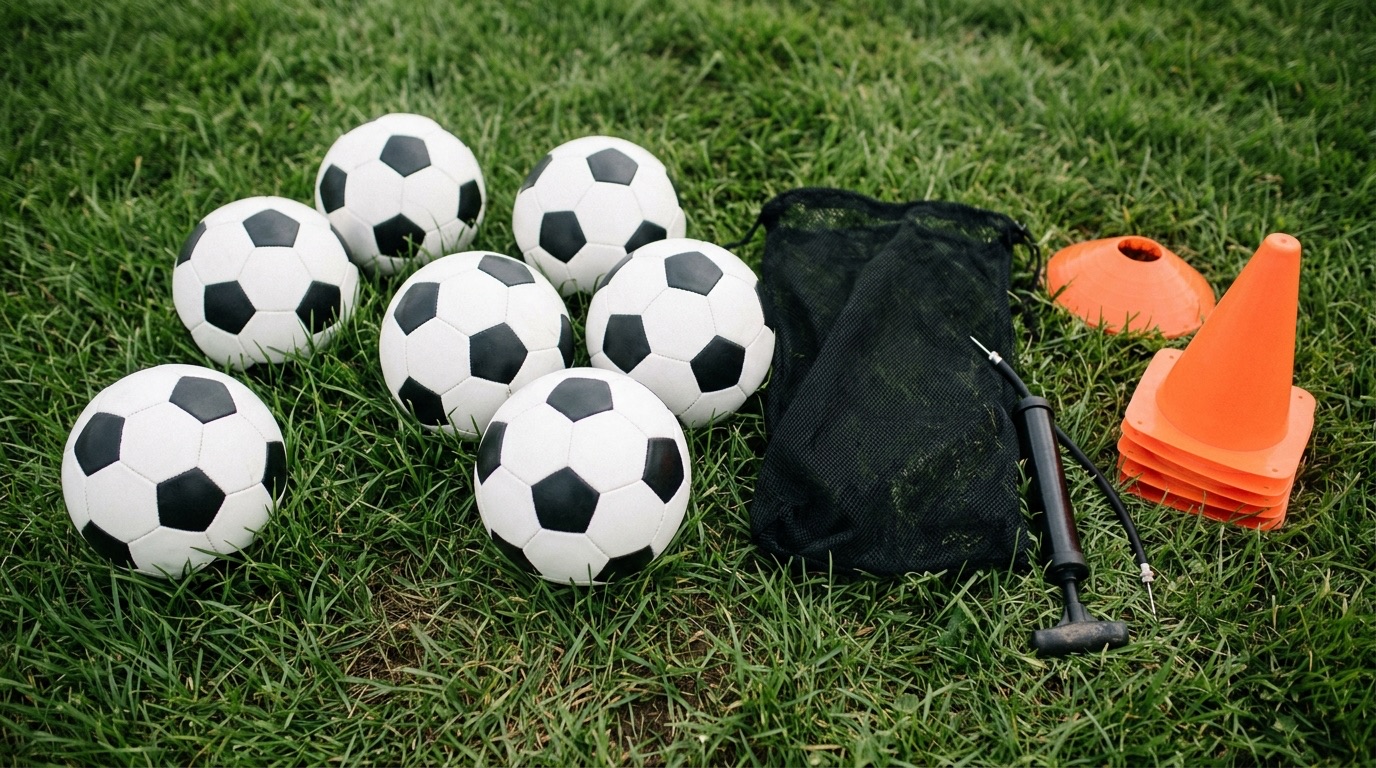
The first week of tryouts, I had 24 kids on the field and eight balls. Half the practice was spent waiting for someone to finish a dribbling rep before the next kid could go. We got through half the planned session and spent the other half on water-break chaos. That is when I learned: you can run a great session with limited goals or cones, but you cannot run a great session without enough balls.
The short answer: A youth team needs one ball per player for individual work — most coaches find 14–18 balls covers a 12-player roster with enough buffer for deflation and field scatter mid-practice. Buy separate practice and match balls: cheaper training balls absorb the daily wear, and you preserve a set of better balls for game day. Budget $8–$14 per practice ball, $18–$28 per match ball, for a typical first-year spend of $280–$350 for a full program.
Here is what we have dialed in over years of running programs from 7U through high school.
How Many Balls Does Your Team Actually Need?
The standard coaching answer is 1:1 — one ball per player. In practice, that is the floor, not the ceiling. At any given moment in a good session, some balls are deflated, some are kicked into a fence line 40 yards away, and some are in a kid’s hands while they tie their cleat.
We run a 12-player U10 team and keep 16 balls in the bag. The extra four cost us less than an hour of a referee’s time and pay for themselves every single practice in lost-time savings.
Rule of thumb by roster size:
- 8–10 players: 12 balls minimum
- 11–14 players: 14–16 balls
- 15–18 players: 18–20 balls
- Club program running multiple teams: buy in lots of 24 — it simplifies storage, and you will fill the bag eventually
Ball Size by Age Group
This is non-negotiable. Sending a 7-year-old into a session with a full-size ball kills their technique before it develops — they cannot strike it cleanly, and every rep reinforces the wrong mechanics.
We go into full detail on what size soccer ball your players need by age, but here is the quick reference for your order form:
- Size 3: U5–U8 (roughly ages 4–8)
- Size 4: U9–U12 (ages 9–12)
- Size 5: U13 and up
If your league organizes by school grade and ages straddle a size boundary, buy for the majority of your roster and keep one or two of the other size on hand. Parents frequently try to hand down a Size 5 from an older sibling — redirect them. It is the right call for their kid’s development.
Practice Balls vs. Match Balls: Do Not Treat Them the Same
This is the single biggest budget mistake first-year coaches make: buying a premium ball, using it every day for rondos and shooting drills, and wondering why it is soft and misshapen by October.
Practice balls take a beating. They hit chain-link fences, sit in wet grass, and get pumped hard and deflated repeatedly. You want durable machine-stitched construction with a butyl bladder — butyl holds air far longer than latex and will not need inflation before every practice. Budget $8–$14 each.
Match balls are a different category. Latex bladders give truer flight and a softer touch, which matters when you are testing what your players actually learned in training. We keep 4–6 match balls per team and treat them as equipment, not consumables. Budget $18–$28 each.
For specific model picks organized by age group and budget, see our best youth soccer balls guide for 2026.
Construction: What You Are Actually Paying For
Ball spec sheets use the same four or five terms, so here is what they mean in a coaching context:
Bladder type: Butyl = holds air longer (your practice ball). Latex = better touch and truer rebound (your match ball). For youth programs on a budget, buy butyl for everything except your game-day set.
Panel count: 32-panel traditional design is the standard. Thermally bonded seamless balls are fine for older competitive players but add cost with no perceivable benefit for U12 and below.
Stitching: Machine-stitched is durable and consistent for daily training. Hand-stitched adds significant cost for a feel difference that players at the recreational and younger club level cannot detect.
Outer casing: PU (polyurethane) over PVC every time. PU holds up in rain, does not absorb mud as readily, and cleans up faster. In a wet fall season on a grass field, this is the difference between balls that last one season and balls that last three.
What to Budget for a Full Season
Honest math for a 12-player recreational or mid-level club team:
| Item | Qty | Per-unit | Total |
|---|---|---|---|
| Practice balls (butyl, machine-stitched) | 14 | $10 | $140 |
| Match balls (latex, PU outer) | 5 | $22 | $110 |
| Ball bag | 1 | $25 | $25 |
| Hand pump + 4 spare needles | 1 | $15 | $15 |
| First-year total | ~$290 |
In subsequent seasons you are replacing 4–6 practice balls that did not survive the year and maybe one match ball — call it $80–$100/year to keep a healthy fleet.
The Pre-Season Ball Order Process
This is the sequence we run every fall and spring before the first practice of the season.
Pump, Bag, and Storage: The Details Coaches Skip
A bag of good balls without a pump becomes a bag of paperweights by week three. Get a dual-action hand pump and buy four or five spare needles at the same time — needles break or disappear constantly. If you are running a large club program with 40+ balls, an electric inflator pays for itself in the first week.
Ball bags: a mesh bag or zip bag sized for 12–18 balls is standard. Mesh lets you see the count at a glance; zip bags keep the outsides cleaner on rainy days. Either works.
Off-season storage: keep balls moderately inflated (not fully pressurized) and off cold concrete. Prolonged contact with hard, cold floors flattens panels over time. A shelf or hanging net bag keeps their shape through a long off-season.
When to Replace
Practice balls last one to three seasons depending on practice frequency and surface. Replace any ball that:
- Will not hold air for more than 24 hours after inflation
- Has cracking or peeling on the outer casing
- Has separated seam panels that create an uneven surface
- Feels noticeably soft or hard in one area compared to the rest of the ball
Match balls, handled properly, can last three to five seasons. Replace a game ball the moment it stops tracking straight or loses its round shape — a misshapen match ball actively teaches bad touch habits.
If you are sorting out the full gear list and program setup for your first season, our guide for first-time youth soccer coaches covers everything from equipment to running a structured first practice.