Three weeks before my first rec softball season, a parent handed me a roster of eleven 9-year-olds and said, “You’re the coach now.” I had spent twenty years around baseball diamonds — coached everything from T-ball to high school varsity — but underhand pitching, the 60-foot base path, and a 12-inch ball all felt like a new game. Within two practices, the girls were making real contact off the tee. By game four, they were turning double plays. Here is the framework that got us there.
The short version: A successful first season comes down to four things — walking onto the field with the right gear, running a tight parent meeting before week one, structuring your first practice around three skill stations, and setting a consistent weekly rhythm. Everything else follows from those four cornerstones.
Before You Step on the Field: Equipment Checklist
You do not need to be a former college softball player to coach well. You do need to show up prepared.
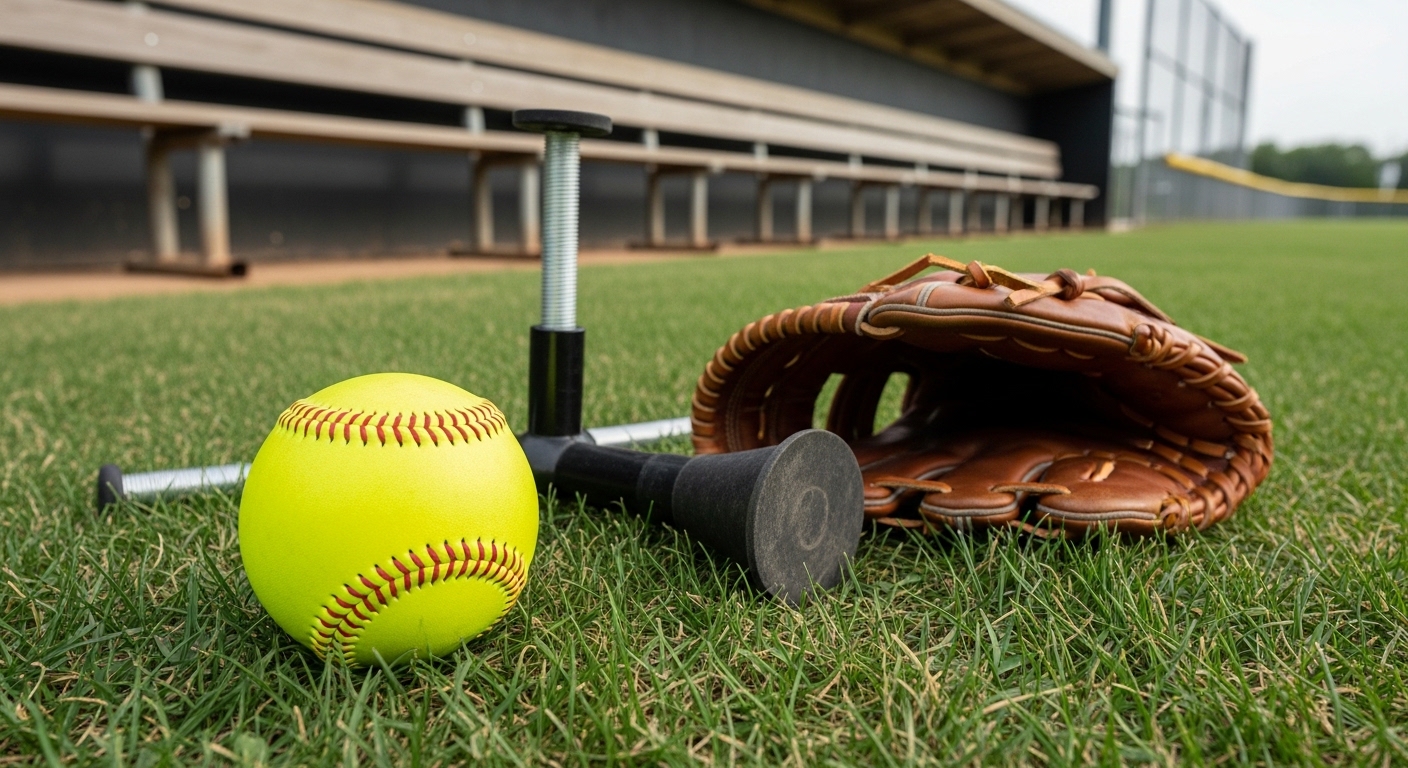
Balls: 11-inch softballs for 8U–12U; 12-inch for 14U and up. Bring at least 12 practice balls. You will lose three in the tall outfield grass by week two.
Batting tee: One good adjustable tee is worth more than a pitching machine at this age group. Players get clean, unlimited contact reps at their own pace without waiting on a machine or a live arm.
Helmets: Every batter needs a helmet with a face guard. Non-negotiable for rec ball. If the league does not supply them, each player needs one.
Catcher’s gear: At least one full set — helmet/mask, chest protector, shin guards. Parents will not invest in personal catcher’s gear for their 9-year-old at rec level. The team needs it.
Cones and agility markers: Eight to ten cones let you run station rotations without anyone standing around watching. Idle players lose focus in about 90 seconds.
For batting tees, helmets, and other youth softball equipment at theranchsports.com — they stock everything on this list and offer 10% off with no sales tax.
Coaching binder: Print your roster, a practice plan, and a blank lineup card. The parent who watches you pull out an actual printed plan on day one remembers it all season.
The Parent Meeting: Run It Before Day One
Most first-year coaches skip this. That is the single biggest structural mistake you can make.
A 30-minute parent meeting — held the week before your first practice, or immediately before it — sets the cultural temperature for the entire season. Parents who understand your coaching philosophy early stay constructive in the stands. Parents who do not fill the gaps themselves.
Five topics to cover:
1. Who you are. Your background, your goal for the season, and why you volunteered. Two minutes. Do not over-explain.
2. Your playing-time approach. Be direct. At rec level, every player plays meaningful innings. If you are rotating positions, say so now. Our playing-time policy template for youth sports coaches has language you can take word-for-word.
3. Your communication channel. Pick one — group text, TeamSnap, or email — and enforce it. Sideline conversations during practice are off the table. Disagreements go through you privately, after games.
4. Sideline behavior. Positive noise only. No coaching from the fence during games. One voice on the field: yours.
5. What you need from them. Ask two or three parents to arrive 10 minutes early each week to help set up stations. You will get more help than you expect if you ask directly rather than hoping someone volunteers.
Parent dynamics are one of the top reasons first-year coaches do not come back for year two. Our full guide on handling difficult sports parents covers the real conversations — late-inning substitutions, playing-time complaints, and the parent who is absolutely certain their kid should be starting every game.
The First Practice: A 75-Minute Script
Your first practice has one job: send every player home wanting to come back. They do not need to know everything. They need to feel like they can do something.
This structure works for 8U through 12U with minor adjustments for age and attention span.
That is 65 minutes of structured content inside a 75-minute window. The extra 10 minutes covers water breaks, equipment sorting, and the player who cannot find their batting glove.
The Season Arc: Weeks 1 Through the Final Game
First-year coaches often run a great first practice and then improvise everything afterward. Here is the framework that prevents that.
Weeks 1–3: Foundation Block
Cover one skill per station per week. Do not layer in pitching mechanics, pop fly reads, and rundown situations at the same time. Build throwing, tee hitting, and ground ball fielding in sequence — confidence first, complexity second.
Keep sessions at 75 minutes maximum for 8U and 10U. Attention windows at those ages are shorter than most adults expect, and a focused 75-minute practice beats a wandering two-hour one every single time.
Weeks 4–6: Combination Reps
Start connecting skills across situations. Live hitting off a soft toss where the batter sprints to first after contact. Ground balls that require a throw to first rather than just a catch and stop. The game-within-the-drill keeps engagement high and starts building real softball instincts.
This is also the window to establish your batting order and defensive rotation. At rec level, move every player through multiple positions during the first half of the season. Athletes will show you what they are drawn to — but only if they get the reps to find it. The kid who looks disengaged at shortstop often comes alive at third base or behind the plate.
Weeks 7 and Beyond: Sharpen What Works
By mid-season you will have a clear picture of your team’s strengths. Now you can build defensive alignments that make sense — without leaving weaker fielders isolated at positions that expose them on every ball in play.
Add a short situation drill to each practice: five minutes walking through “runner on first, ground ball to second — where does the ball go?” Running scenarios at half-speed before they happen in a game dramatically shortens the learning curve. We use this approach across all our programs — our guide to running the first practice of the baseball season covers the same situation-drill format in detail.
The Final Two Practices
Run an internal scrimmage with scrambled lineups — not your regular batting order, mixed groups so players compete alongside people they have not directly worked with. Finish with a short team reflection: “Name one thing you learned this season that surprised you.” You will get specific, honest answers. Write them down. They inform how you open your next season’s parent meeting.
Three Mistakes First-Year Softball Coaches Make
Talking too much. I have coached athletes from 7U through college, and the most consistent error I see from brand-new coaches is filling every available minute with instruction. A 9-year-old at an outdoor practice with no shade has about 45 seconds of active listening available. Give the cue, run the drill, reinforce the cue after the rep. That is the cycle. Cut the lecture in half and double the reps — outcomes improve immediately.
Locking in positions too early. Rec coaches who plant players in fixed spots by week two end up with a frustrated catcher who wanted to pitch, a parent who is furious by game five, and a team that never discovers its actual depth. Rotate deliberately through the first half of the season. Position preferences emerge naturally — let them.
Under-communicating with families. Every parent conflict I have dealt with in twenty years of youth coaching was made worse by a gap in communication. The angry sideline parent almost always felt left in the dark about something. Text the group before each game. Send a two-line practice recap. It takes three minutes. It changes the entire season.
Softball vs. Baseball: What Transfers and What Does Not
If you come from a baseball background like we do, a few mechanical adjustments are necessary.
Receiving: Teach players to keep two hands ready below the waist on incoming pitches. Softballs arrive on a flatter trajectory than overhand deliveries and younger players frequently position their gloves too high, under-catching the ball. Start receiving drills with slow-rolled pitches from 15 feet until the hand position is consistent.
Hitting: The ball comes up into the zone on an underhand delivery. Teach a level, slightly upward path through contact — swinging down produces weak topspin grounders. The strike zone dimensions are the same as baseball, but the ball flight is different enough that hitters who trained exclusively on baseball pitching often swing over the top of rec-level pitching for the first few practices.
Field spacing: The 60-foot base path means infielders need to charge anything hit their direction rather than read and react from depth. Aggressive footwork wins at every age level in rec softball.
These mechanical differences are missing from most general first-time coach guides online — nearly every resource we found was written for baseball coaches stepping into softball and none of them addressed the translation. Our coaching team came from a baseball background and made exactly these mistakes in year one. The adjustment is now part of our standard first-week orientation for any new coach joining our program.
For more softball resources, our 8U softball practice plan gives you a ready-to-run session, and the practice plans hub collects age-group templates across every sport we cover.
Download this as a free PDF — get the free PDF here
Get "First-Time Softball Coach Guide: Your First Season" as a free PDF
Instant download, plus free coaching resources in your inbox. No spam.
✓ You're in — here's your download
↓ Download the PDFBookmark it for the field — and check your inbox for more free coaching resources.