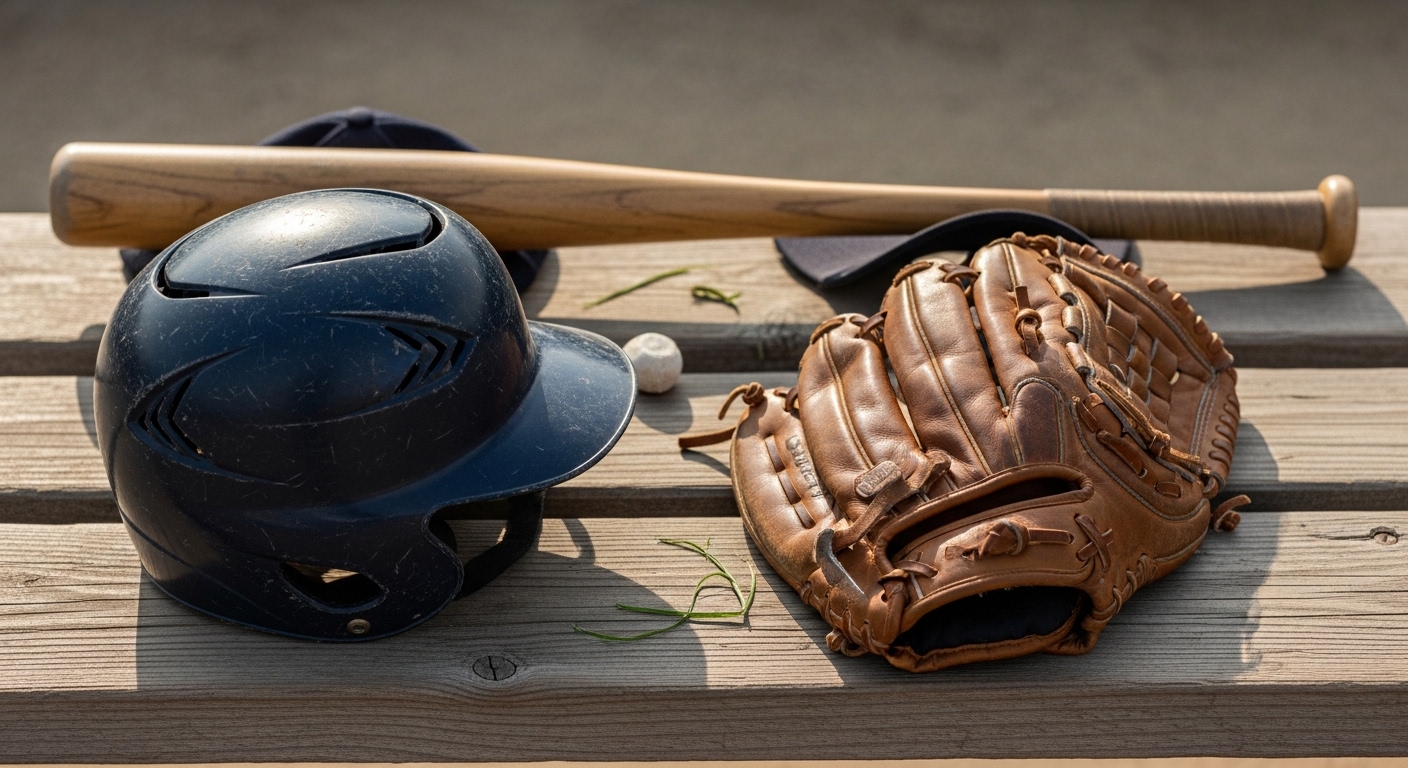
Last spring a dad walked into our first practice carrying a brand-new two-piece composite bat still in the shrink wrap — $350, top of the line, USSSA drop -8. His 9-year-old could barely get the barrel through the zone on a flat toss. We spent the first fifteen minutes watching this kid swing twelve percent harder than usual and make contact at roughly half his normal rate. By round three he was casting his hands out to compensate — a habit that took two months of tee work to undo. The bat was the culprit.
That purchase happens hundreds of thousands of times every spring. Parents see rankings lists, buy the hottest bat of the year, and skip the question that actually matters: does this bat fit this specific kid? It’s the same fit-first principle we hammer in our youth baseball glove size guide — buy for the player in front of you, not the player they might become.
For most players ages 8–12, the right bat is a -10 drop in the correct certification for their league — USA for Little League and recreational play, USSSA for travel and club ball. Composite bats give a larger sweet spot and less hand sting; alloy bats are more durable and need no break-in period. Never buy heavy so a player can “grow into it” — at youth ages, bat speed creates power, and a bat that is too heavy teaches compensatory mechanics before the season even begins.
Our 2026 Youth Bat Tier Lists
Rankings are only useful once the certification is right, so we built two boards: one for USA bats (Little League and most rec leagues) and one for USSSA bats (travel and club ball). A USA bat and a USSSA bat with the same name are different bats.
USA Bats (Little League, Rec)
USSSA Bats (Travel, Club)
C tier means budget picks with a lower ceiling, not bad bats. Every bat on these boards is legal in its certification.
How We Ranked Them
We lined up the independent 2026 rankings — Bat Digest’s USA and USSSA lists, the Baseball Bat Bros picks, and for USSSA, GameChanger’s Bat Lab test data from 10U–13U hitters — and gave the top tiers to the bats that show up near the top of more than one. We did not lab-test these bats ourselves; the testing belongs to those sources. Bat Lab has not published a 2026 USA list, so the USA board rests on two sources instead of three.
The clearest result: the Louisville Slugger Supra is the Bat Bros’ #1 USSSA bat, Bat Digest’s #2, and posted the highest exit velocity (73.2 mph) in Bat Lab’s 10U–13U testing. It is the only youth bat that tops all three. On the USA side the sources split — Bat Digest’s #1 is the Rawlings Icon, the Bat Bros’ #1 is the Supra USA — so both sit in S.
| Bat | Cert. | Bat Digest | Bat Bros | Bat Lab (USSSA test) | Price |
|---|---|---|---|---|---|
| Rawlings Icon USA | USA | #1 (best overall) | Not ranked | No USA list | — |
| Louisville Slugger Supra USA | USA | Not ranked | #1 | No USA list | ~$350 |
| Easton Hype Fire USA | USA | #2 (best -10) | Not ranked | No USA list | — |
| DeMarini Exile USA | USA | Not ranked | #2 | No USA list | ~$200 |
| Easton MAV2 Flash USA | USA | Not ranked | #3 | No USA list | ~$250 |
| Marucci CATX Rckless Hybrid USA | USA | #7 | Not ranked | No USA list | — |
| Warstic Bonesaber USA | USA | #8 (best alloy) | Not ranked | No USA list | — |
| Rawlings Clout AI USA | USA | #6 (best value) | Not ranked | No USA list | — |
| Louisville Slugger Supra | USSSA | #2 | #1 | 73.2 mph (top) | ~$400 |
| Rawlings Icon USSSA | USSSA | Not ranked | #2 | Tested | ~$400 |
| Easton Hype Fire | USSSA | Top-5 drop 10 | #3 | 71.8 mph | ~$400 |
| DeMarini Zen | USSSA | #1 | Not ranked | Tested | ~$400 |
| Easton The Dub | USSSA | #2 drop 5 | Not ranked | 70.6 mph | — |
| Marucci CATX Rckless Composite | USSSA | #5 | Not ranked | Tested | — |
| Louisville Slugger Atlas | USSSA | Not ranked | Not ranked | 70.7 mph | — |
| Warstic Bonesaber | USSSA | Not ranked | Not ranked | 68.4 mph (GC Silver) | — |
| Marucci CAT (alloy) | USSSA | Not ranked | Budget pick | Not tested | ~$80–$220 |
Rankings as of October 2026; prices are typical retail and vary by drop and length. You can check sizing and current availability for youth bats like these at theranchsports.com — they carry a solid range with no sales tax.
Whatever tier you pick from, the drop weight and length still have to fit the player — an S-tier bat two drops too heavy is a worse bat for your kid than a C-tier bat that fits.
USA vs. USSSA: The Certification That Matters Before Anything Else
This is the single most common bat-buying mistake we see, and it can cost a family $200.
USA Baseball certification covers Little League, Babe Ruth, Cal Ripken, and most recreational leagues. These bats carry a USA Baseball stamp and are designed to perform similarly to wood — lower performance ceiling, aligned with youth development goals. USSSA certification is for travel ball and tournament play, operating under a 1.15 BPF standard that allows significantly more trampoline off the barrel. These two standards are not interchangeable. Bring a USSSA bat to a USA league game and your player is hitting with an illegal bat before they step in the box.
Before you spend a dollar, confirm your league’s certification standard. If you are not sure, email your league director and ask directly. The answer changes every purchasing decision you make.
Composite vs. Alloy: A Real-World Look
Gear review sites compare barrel stiffness ratings and vibration dampening statistics. We think about it differently: what does each material teach a kid to do?
Composite bats have a larger sweet spot, which means off-center contact still sends the ball with decent distance. This is great for building confidence in newer hitters. The downside is they require a break-in period — typically 150–200 swings off a tee or soft toss, rotating the barrel a quarter turn every 25 swings. Composites also crack more easily in cold weather (below 60°F) and cost significantly more than alloy at every length.
Alloy bats give instant feedback. Mishits sting and sound hollow; solid contact feels unmistakably different. For a developing hitter, that honest feedback can accelerate swing improvement faster than the forgiving sweet spot of a composite. Alloy bats are lighter at equivalent length, never need break-in, and handle cold weather without issue.
Our coaching team has seen 9-year-olds swinging alloy bats make more consistent contact than teammates in composites that cost twice as much — simply because the alloy fit the player and the composite did not. For players just entering the game, I often recommend starting with alloy for one full season before moving to composite. Let the hitter earn the hot bat.
Drop Weight by Age and Skill Level
Drop weight is the difference between bat length in inches and bat weight in ounces. A 30-inch, 20-ounce bat is a drop -10. Here is how we guide families at every age group we coach:
- 7U–8U (Tee Ball and Coach Pitch): Drop -12 to -13.5. Lightweight construction only — they are learning the swing pattern, not generating power.
- 9U–10U (Little League and Rec): Drop -10 is the standard for USA leagues. Travel players typically use -10 or -8 depending on strength.
- 11U–12U: Drop -10 is most common; stronger USSSA travel players sometimes move to -8.
- 13U: Drop -10 to -8 in USSSA. Begin thinking about BBCOR preparation for the following season.
- 14U: As of January 2026, USSSA national events require BBCOR -3 bats or wood. See the section below — this is a significant rule change.
How to Size a Bat the Right Way
Height and weight charts are a starting point, not the final word. Two 11-year-olds with identical measurements can have very different core strength and bat speed profiles. Here is the three-step field check we run with every new player at the start of our season — it doubles as a quick equipment check when you run youth baseball tryouts:
The 2026 USSSA Rule Change Every Travel Family Needs to Know
As of January 2026, USSSA 14U national events require BBCOR -3 bats or wood — not the drop -5 or drop -8 USSSA bats that were standard in prior seasons. This is the biggest rule change youth travel baseball has seen in years, and we have already seen families show up to early-season events with the wrong bat.
If your player is 13U this season, plan for a BBCOR purchase before next spring. More importantly, get your player some cage time with a BBCOR bat this fall. The weight jump from a -8 USSSA to a -3 BBCOR is significant, and rebuilding bat speed with the heavier stick takes time. Do not wait until the first tournament of 14U season to make the switch.
The Coaching Bottom Line
The best bat on the market is the one your player can swing fast. Every other feature — composite layup, barrel taper, grip texture — is secondary to fit. We have seen players hit .400 with a $60 alloy bat and struggle to make contact with a $400 composite that was two drops too heavy. Spend your research time on fit first, brand second. And remember that reps beat gear every time — a well-fit bat plus the structured swing work in our 10U practice plan will do more for a hitter than any upgrade.
For more on how we develop hitters from tee ball through high school, visit our baseball coaching hub.