It was my third practice with our 8U girls and we were twelve minutes in, running a simple throw-and-catch warm-up across the outfield grass. Half the team was watching a golden retriever trot along the fence. Two players were debating whose glove was prettier. One had sat down to retie her cleats — for the second time.
That’s 8U softball. And if your practice plan doesn’t account for it, you’ll spend forty-five minutes managing chaos instead of coaching.
Here’s the short answer on structuring an 8U softball practice: run a station-rotation format with 6–8 minute blocks, keep each station to 4–5 players, and build every session around the same four pillars — throwing, fielding, hitting, and baserunning. One 60-minute practice can give every player meaningful reps at all four without anyone standing in line for more than sixty seconds.
Why Station Rotation Works at This Age
At 8 years old, focused attention lasts about 5–8 minutes before a kid’s brain starts hunting for the next thing. That’s not a discipline problem — it’s developmental reality. The biggest mistake first-time coaches make is running the whole team through one long drill for fifteen or twenty minutes. The kids in the back of the line disengage within ninety seconds.
Station rotation solves this automatically. Everyone is active, the clock keeps moving, and the “next station” gives restless 8U players something to look forward to every few minutes. We’ve run this format with groups as small as eight and as large as eighteen — it scales cleanly with one parent helper per station.
If you coach baseball too, this structure mirrors our 8U baseball practice plan — same block logic, adapted for softball’s specific fundamentals.
The 60-Minute Practice Template
Here’s how we lay out a full 8U softball practice from first whistle to final huddle:
| Time | Block | Focus |
|---|---|---|
| 0:00–0:08 | Dynamic warm-up | Movement-based activation |
| 0:08–0:16 | Partner throw progression | Short toss, 25–35 feet |
| 0:16–0:37 | Station rotation (3 stations × 7 min) | Throwing, fielding, hitting |
| 0:37–0:52 | Coach-pitch live reps | Small-sided game format |
| 0:52–0:58 | Baserunning game | High energy, end on a win |
| 0:58–1:00 | Team circle | One word from each player |
Station Breakdown and Drill Sequence
Set up all three stations before players arrive. Use cones to define each area clearly — without visual boundaries, 8-year-olds will drift into each other’s space before the first rotation ends.
Station A: The Star Drill (Throwing and Catching)
This is the drill that most 8U coaches skip — and it’s the one that actually builds throwing accuracy at this age. The standard approach is a straight line or a passing circle. We switched to a five-point star formation two seasons ago and haven’t looked back.
Five players form a pentagon and throw across to the non-adjacent player, tracing the star shape rather than passing around the perimeter. The coach stands in the center calling the pace. This setup forces each thrower to locate a target who isn’t directly in front of them, square their feet to a moving receiver, and adjust arm angle with each throw. Coaching circles on TikTok have been running this drill for 8U softball with real results — and we saw the same thing when we introduced it: throwing accuracy tightened up faster than with any standard line drill we’d used before.
Station B: Fielding Ground Balls
Keep the fundamentals simple at 8U — two-handed fielding, glove flat to the ground before the ball arrives (“beat the ball to the spot”), and a throw to a cone target at first base after each catch. A parent helper rolls firm grounders one at a time.
Station C: Batting Tee
One player hits, one shags, two waiting. Reps move fast. At 8U, hitters need volume and confidence more than mechanics lectures — pick one cue per session and stay with it.
Managing Transitions Without Losing the Team
The biggest time loss at 8U isn’t the drills — it’s the two minutes between them when twelve players wander in twelve different directions. We fixed this with two signals: one long whistle blast means “freeze and eyes on me,” two short blasts means “rotate to your next station.” Teach the signals in the first five minutes of the first practice. By week three they’re automatic.
Assign each parent helper a specific job before practice starts — “you’re rolling grounders at Station B, one ball at a time, keep it moving.” A parent with a clear job is a real coaching asset. A parent without one becomes a distraction.
Equipment: What Actually Matters at 8U
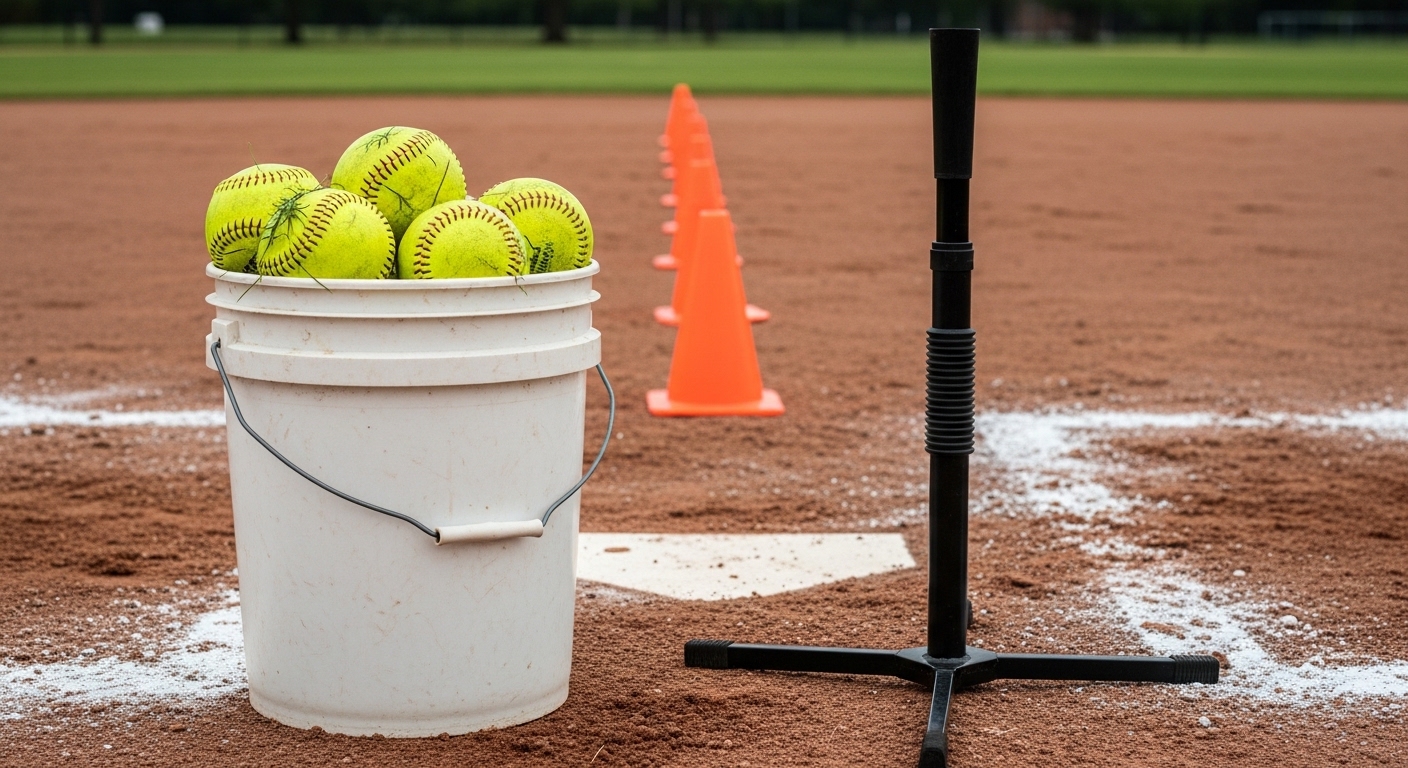
You don’t need much for an 8U practice: a tee, a bucket of practice balls (not the hard rubber ones — they sting young hands on a mis-hit), and properly sized gloves. This matters more than coaches realize. An 8U player needs a 9–10 inch glove that actually closes when she squeezes it. A glove that’s too big means she can’t secure the ball, her confidence craters, and she starts turning her head away from grounders. If you already have a player flinching, work through our progression for teaching a young softball player to catch without fear before you push her harder in drills. Properly fitted youth softball gloves at theranchsports.com run 10% off with no sales tax — worth checking before the season starts.
Building Athletes, Not Just Softball Players
8U is exactly the age where the movement patterns you build become the athletic foundation for everything else. The footwork in the Star Drill — locate, square up, throw — is the same footwork a wide receiver uses running a route. The hip hinge in ground-ball fielding shows up in every sport a kid will ever play.
We deliberately layer coordination drills for youth athletes into our warm-up blocks at this age — lateral shuffles, balance holds, and bear crawls — because these players are building general movement literacy alongside softball skills. If you want to add 5 minutes of multi-directional work before the throw progression, our agility ladder drills for kids pair cleanly with this template.
Adapting the Plan for Your Situation
Smaller roster (8 or fewer players): Drop to two stations instead of three, 10 minutes each. Station A is the Star Drill with whatever players you have; Station B is the tee. Coach-pitch gets 18 minutes.
First practice of the season: Skip live reps entirely. Use that time to teach the station rotation system itself — how to rotate, what the whistle signals mean, where each station is. Your second practice will run twice as fast because the logistics are already learned.
Wide skill gap in your group: Place your most experienced player at Station A to model the Star Drill, and put your parent helper at Station B where struggling fielders need the most individual attention. The tee station is self-correcting enough that any skill level can succeed there without extra coaching.
The 8U window moves fast. These players are still learning that a round ball is supposed to go into a round glove — and they’re doing it while also thinking about snack, their dog, and whether their friend is on the same team. A structured, active practice that keeps everyone moving is what makes them want to be back next week.
Download this as a free PDF — get the free PDF here
Get "8U Softball Practice Plan: A 60-Minute Template" as a free PDF
Instant download, plus free coaching resources in your inbox. No spam.
✓ You're in — here's your download
↓ Download the PDFBookmark it for the field — and check your inbox for more free coaching resources.