- Type
- Drills & skills
- Ages
- All ages
- Read time
- 8 min
- Printable
- Free PDF
Bottom of the last inning, tie game, our fastest 11-year-old on second base. The hitter lines a clean single into right-center. Our runner takes two steps, stops to watch the ball land, then takes off. He was out at the plate by a step. Nothing was wrong with his speed. We had never practiced that read, so he did what untrained runners do: he watched.
The best youth baseball base running drills for team practice are short, full-team drills that put every player in motion at once: run through first, banana turns, first-to-third reads, tag-ups, and a relay to finish. Run them as one 10 to 15 minute block every practice, then put live runners on the bases during batting practice so players learn to read a real ball off a real bat. Twelve minutes every practice beats one long base running day a month.
Base running is the least practiced skill in youth baseball, and it is the cheapest way to score more runs. No extra talent is needed. A team that runs through first, takes the extra base, and reads balls in the dirt will beat a team with better hitters often enough to notice. This page covers the drills we use with our teams from 8U through high school, how we fit them into a normal practice, and what to teach at each age. For everything else in a practice, start at our baseball coaching hub.
Why most base running practice doesn’t work
The standard version looks like this: twelve kids in a line at home plate, one runs, eleven watch. Each player gets four reps in fifteen minutes and the coach calls it conditioning.
Three fixes change everything:
- Use all four bases as starting points. Split the team into four groups, one at each base. Everybody runs on the same “go.” Twelve players get a rep every 20 seconds.
- Teach one decision per drill. Running hard is easy. Deciding is the skill. Every drill below has a read attached to it.
- Coach from where the runner’s eyes should be. Stand in the third base coach’s box for first-to-third work, and in front of first for run-throughs, so players practice looking where they will look in a game.
The 15-minute team base running block
This is the block we run right after our team warm-up routine, while legs are fresh. Do it in order. Cut step 5 or 6 if you only have 10 minutes.
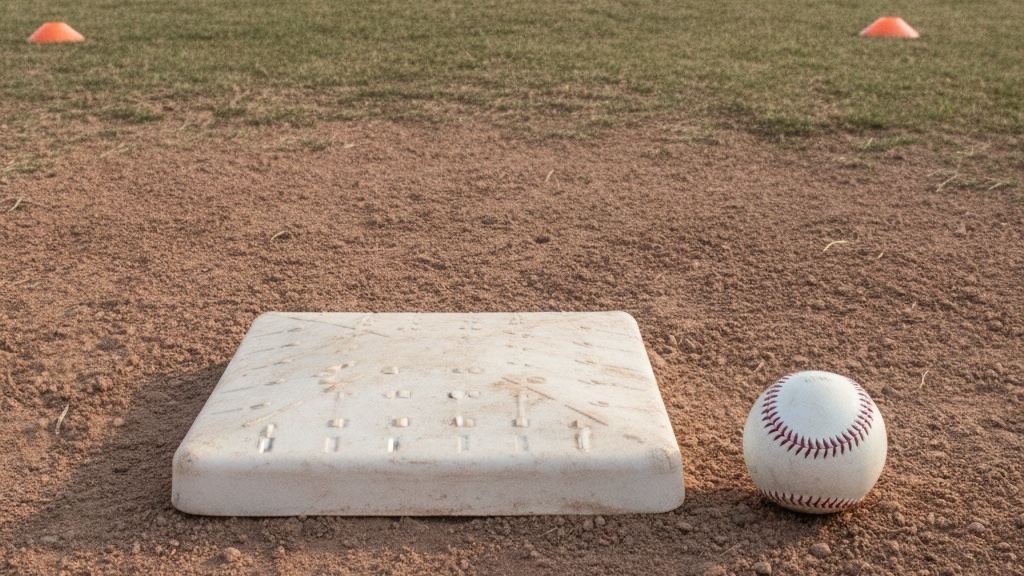
If your field is taken or you are in a gym, a set of throw-down bases and four cones is all the equipment this block needs. Our store at theranchsports.com carries them at a 10% discount with no sales tax.
The drill most teams skip: live runners during batting practice
This is the gap. Every drill above teaches the path and the rule. None of them teaches the read, because a coach yelling “go” is not a baseball coming off a bat. The fix costs zero extra practice time.
During team batting practice, the three players who just finished hitting become base runners. One starts at first, one at second, one at third. On every swing, they react to the ball the way they would in a game:
- Ground ball: runner at first goes hard and rounds second, runner at second reads it (go on a ball hit behind them toward the right side, hold on a ball hit in front of them at short or third), runner at third breaks on contact.
- Line drive: everybody freezes. One step back toward the bag until it gets through.
- Fly ball: runner at third tags, runners at first and second go as far as they can and still get back.
- Swing and miss: shuffle back to the bag every time.
After three or four pitches the runners move up a base, and the one who scores goes to shag. In a 40-minute batting practice, each player gets around 15 to 20 live reads. We run it inside our station-based practice setup, so the field hitting station doubles as the base running station.
I started doing this after the play at the top of this page. By the end of that fall, the same 11-year-old was scoring from second on singles without looking at anyone. His speed did not change. He had simply seen a couple hundred balls off the bat from second base.
What to teach at each age
Rules on leads and steals change by league, so check your rulebook before you teach leads. In many kid-pitch leagues on 60-foot bases, runners cannot leave until the pitch reaches the batter. On bigger fields, leads and pickoffs come into play.
| Age | Focus | Skip for now |
|---|---|---|
| 6U to 8U | Run through first, which way to run, stop on the base, listen to the base coach | Leads, secondary leads, tag-up rules beyond “go back if it’s caught” |
| 9U to 10U | Banana turns, first-to-third, freeze on line drives, tag at third, feet-first slides | Primary leads if your league doesn’t allow them |
| 11U to 12U | Reading the ball off the bat, ball-in-dirt reads, getting a jump when the pitch crosses the plate | Delayed steals and trick plays |
| 13U and up | Primary and secondary leads, reading a pitcher’s first move, first-and-third situations | Nothing. Add it in as they can handle it |
For the youngest groups, turn every drill into a game. Our fun and gamified baseball drills page has more formats that work with 6- to 8-year-olds.
Sliding, safely
Teach feet-first sliding only, and teach it on something soft: wet grass, a slip-and-slide tarp, or a flattened cardboard box on the outfield grass. Shoes off for the first session. Many youth leagues do not allow head-first slides into a base, and young players do not need them.
The cues that matter: start the slide about a body length from the bag, tuck one leg under into a figure four, keep both hands up (holding a batting glove or a handful of dirt in each fist keeps fingers closed), and chin tucked. Five slides each, once a week, in the first month of the season is enough.
Five mistakes we see every season
- Watching the ball instead of the coach. A runner going first to third has the ball behind them. Turning the head costs two steps. Step 4 fixes this.
- Slowing down before first. Kids decelerate into the bag or lunge at it. Put a cone ten feet past first and make that the finish line.
- Turning after the bag. A wide turn that starts at the base adds ten or more feet. The cone in Step 2 moves the turn earlier.
- Running on line drives. Doubled-off runners are almost always untrained runners. Live reads in batting practice are the only real cure.
- Treating base running as punishment. If laps around the bases follow every mistake, players learn to hate the one skill you need them to love. Keep running tied to competing.
Speed helps, but reads come first
Faster athletes are better base runners, and sprint work belongs in a youth program. Short accelerations of 10 to 20 yards with full rest carry over directly to the first three steps out of the box. Our guide to speed training for youth baseball players covers how we build that. Under 12, we would rather kids play tag, race, and play other sports than run timed 60s.
Even so, the slowest player on your roster can be a good base runner by spring. Run the 15-minute block every practice, keep runners live in batting practice, and keep score in the relay.
Download this as a free PDF — get the free PDF here
Get "Youth Baseball Base Running Drills for Team Practice" as a free PDF
Instant download, plus free coaching resources in your inbox. No spam.
✓ You're in — here's your download
↓ Download the PDFBookmark it for the field — and check your inbox for more free coaching resources.