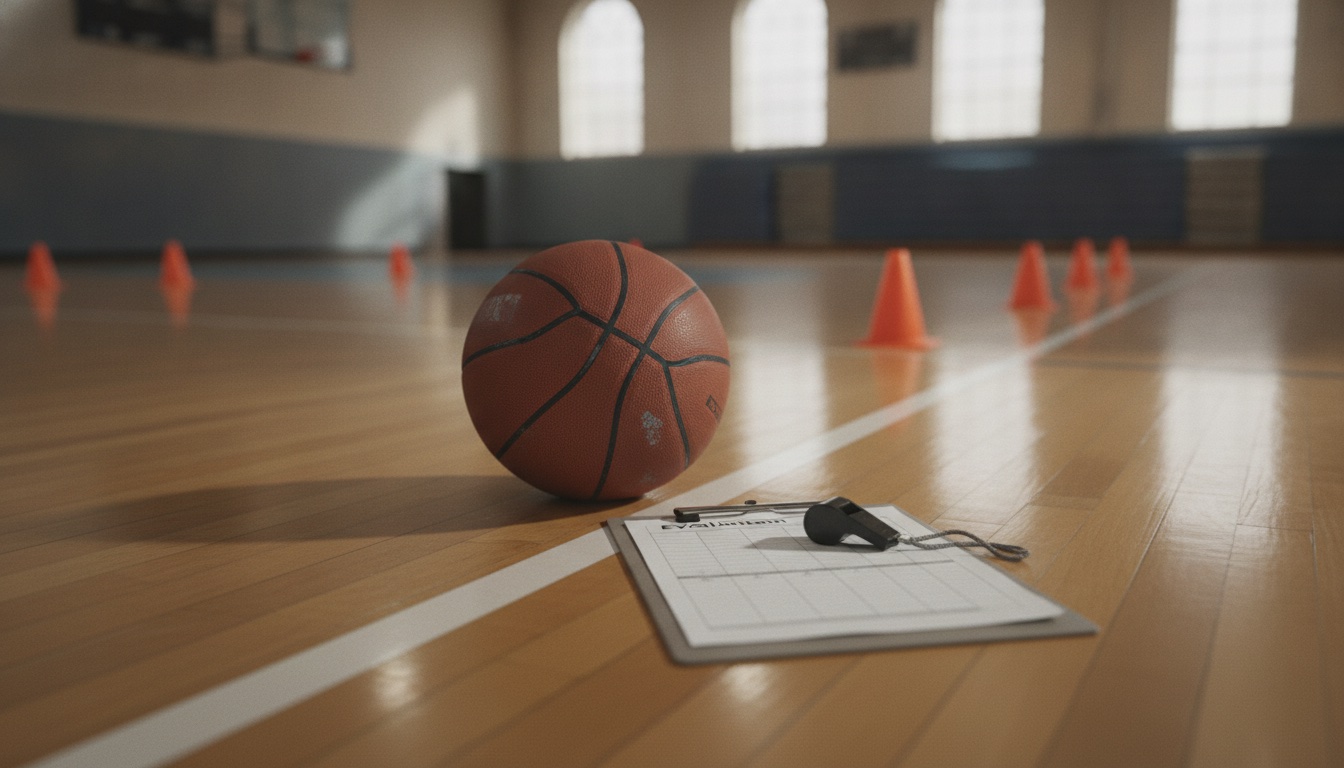
The thirty-two kids lined up along the baseline were trying their hardest to look calm. Some were bouncing on their toes. A couple had clearly been to skills camps. Most were just nervous 10-year-olds hoping they made the team. Our job that afternoon wasn’t to find the best athletes in the gym — it was to build a roster we could coach, a group with enough skill to develop and enough coachability to grow. Those are not always the same thing.
We’ve run youth basketball tryouts at every level from recreational 8U up through competitive 14U, and the biggest mistake most coaches make is evaluating skill in isolation. A tryout that is only a skills test misses the whole point.
The short answer: A well-run 90-minute youth tryout has three phases — individual skill stations (20 min), small-sided 3v3 evaluation games (40 min), and a coachability score woven throughout. Use a 10-category rubric scored 1–5, weight coachability at least as heavily as athleticism, and never deliver cuts in the gym or in earshot of other players.
Before You Run a Single Drill
Set your roster size before anyone walks through the door. If you have 12 spots, commit to that number now — do not let the quality of a strong tryout class pressure you into keeping 15. Know your number. Share it with your assistant coaches. It becomes the frame for every decision you make.
Brief your evaluators. Every coach on the floor should use the same rubric and watch the same things. If one evaluator is tracking effort and another is tracking handles, your post-tryout calibration meeting will run long and still produce arguments. Walk through the rubric together the night before, not in the parking lot at 8:45 a.m.
Issue jersey numbers at check-in, and evaluate by number during the active tryout — not names. It reduces familiarity bias and forces you to defend every score with something you actually observed.
Finally, know your communication plan for cuts before tryouts start. We will cover this in detail at the end, but coaches who arrive at tryouts without a plan for delivering bad news are the ones who post-list on a gym door at 10 p.m. and wonder why parents are angry.
The 90-Minute Tryout Plan
This structure works for ages 8–14. Adjust drill complexity by age group — 8-year-olds need simpler commands, shorter rotations, and more positive framing throughout.
The Evaluation Rubric
Print one sheet per player, numbered rather than named. Score each category 1–5 (1 = not yet ready for this level, 3 = average for this group, 5 = exceptional). The total score gives you a starting point for the calibration conversation — it does not replace that conversation.
| Category | What We Watch |
|---|---|
| Ball Handling | Controls the ball under mild pressure without watching it |
| Passing | Decision-making — does this player see the open teammate? |
| Finishing | Layups with both hands, footwork, ability to finish through contact |
| Shooting Form | Elbow alignment, consistent release point, balanced catch |
| Defensive Positioning | Stance, foot slides, staying between ball and basket |
| Athleticism and Effort | Sprints, transition plays, 50/50 balls — how hard does this player compete? |
| Court Awareness | Does the player know where to be without being told every time? |
| Coachability | Adjusts on rep 2, listens between drills, responds to correction without shutting down |
| Team Behavior | Encourages teammates, does not show up others, stays engaged off the ball |
| Composure Under Pressure | Responds to mistakes and adversity — does not blame, does not quit |
Coachability and Composure are weighted 1.5x. A player who scores 4 on coachability is more valuable to this program than a player who scores 5 on ball handling and 1 on coachability. We will not improve the second player — they will resist every correction we offer, and they will make every practice harder for everyone around them.
In our experience, coachability predicts long-term development better than initial skill level. It is the single most under-weighted category in youth sports tryouts.
Why 3v3 Beats 5v5 for Evaluation
In a 5v5 scrimmage, a weak defender can camouflage behind teammates. A ball-handler who struggles under pressure can dump it off early and stay on the perimeter. The best player on the floor will pull all the decision-making toward them, which tells you a lot about that one player and almost nothing about the other nine.
In 3v3, every player defends with higher frequency, handles the ball in live situations multiple times per possession, and reads the defense without a dominant teammate to bail them out. Decision-making is compressed. Players who can actually play — not just perform isolated drills — reveal themselves.
Set teams using jersey numbers to prevent friend-grouping and ensure random matchups. Run enough rotations that each player faces at least two different groups. Your strongest evaluation data will come from the middle of the block — after kids settle into the competition, before fatigue becomes a factor.
This format is the same approach used in our beginner basketball practice plan, where we use 3v3 games to teach concepts like spacing and ball movement before moving to 5v5. The competitive, small-sided environment accelerates both learning and evaluation.
Running a Clean, Fair Calibration After Tryouts
When tryouts end, send the kids home and sit down with your evaluators before anyone leaves the building. Go player by player in score order. For each player near the roster bubble, the evaluator who scored that player highest goes first — they have to defend the score with specific observations, not impressions.
Any player who evaluators disagree on by 5 or more total points gets discussed until someone changes their score or you reach a consensus. “He was fast” is not a score justification. “He recovered and got back into defensive stance after losing his player on screen — twice” is.
Document your final scores. You will need them when parents call.
Delivering Cuts the Right Way
This is the part of tryouts that coaches prepare for the least, and it causes more lasting damage than almost any other coaching mistake I have seen.
Never announce cuts publicly. A list on a gym door — even if you call it “private” — will be photographed and texted to every player before you get to your car. Call each family individually. Yes, every one.
Keep the call brief and specific. “We had a lot of players this year, and we decided to go a different direction for this roster. What I can tell you is what I saw from your player: [specific skill], and [specific behavior] stood out. If they keep working on [specific area], they will be a stronger candidate next year.” Name real things. Not “keep your head up” or “you will get them next year” — actual, specific, actionable observations from your rubric sheets.
Give parents a moment to ask a question. Most will not. The ones who do are often the most invested in their child’s development — they deserve a real answer, not a deflection. If a parent becomes hostile, close the call calmly: “I understand this is disappointing. I am glad to talk about development steps, but I am not going to revisit the roster decision.”
We have made a lot of cut calls over the years. The ones that go badly are almost always the ones where we did not have a specific, observable reason for the cut before I picked up the phone. Know your reasons before you call.
After Tryouts: Move Fast Into Your First Practice
The best thing you can do for team cohesion after tryouts is run a great first practice. Players who just competed against each other for spots need to feel like teammates immediately — and that feeling is built on the floor, not in a welcome email.
If this is your first time building a youth basketball program from scratch, our complete guide to coaching youth basketball for the first time covers everything from organizing a practice schedule to communicating with parents during the season.
For players who made the team and need to develop defensive fundamentals quickly, our youth basketball defensive drills page walks through the communication and positioning habits that make a team feel like a unit from day one.
For all our basketball coaching guides in one place, visit the basketball coaching hub.
Download this as a free PDF — get the free PDF here
Get "How to Run Youth Basketball Tryouts: A 90-Minute Plan" as a free PDF
Instant download, plus free coaching resources in your inbox. No spam.
✓ You're in — here's your download
↓ Download the PDFBookmark it for the field — and check your inbox for more free coaching resources.