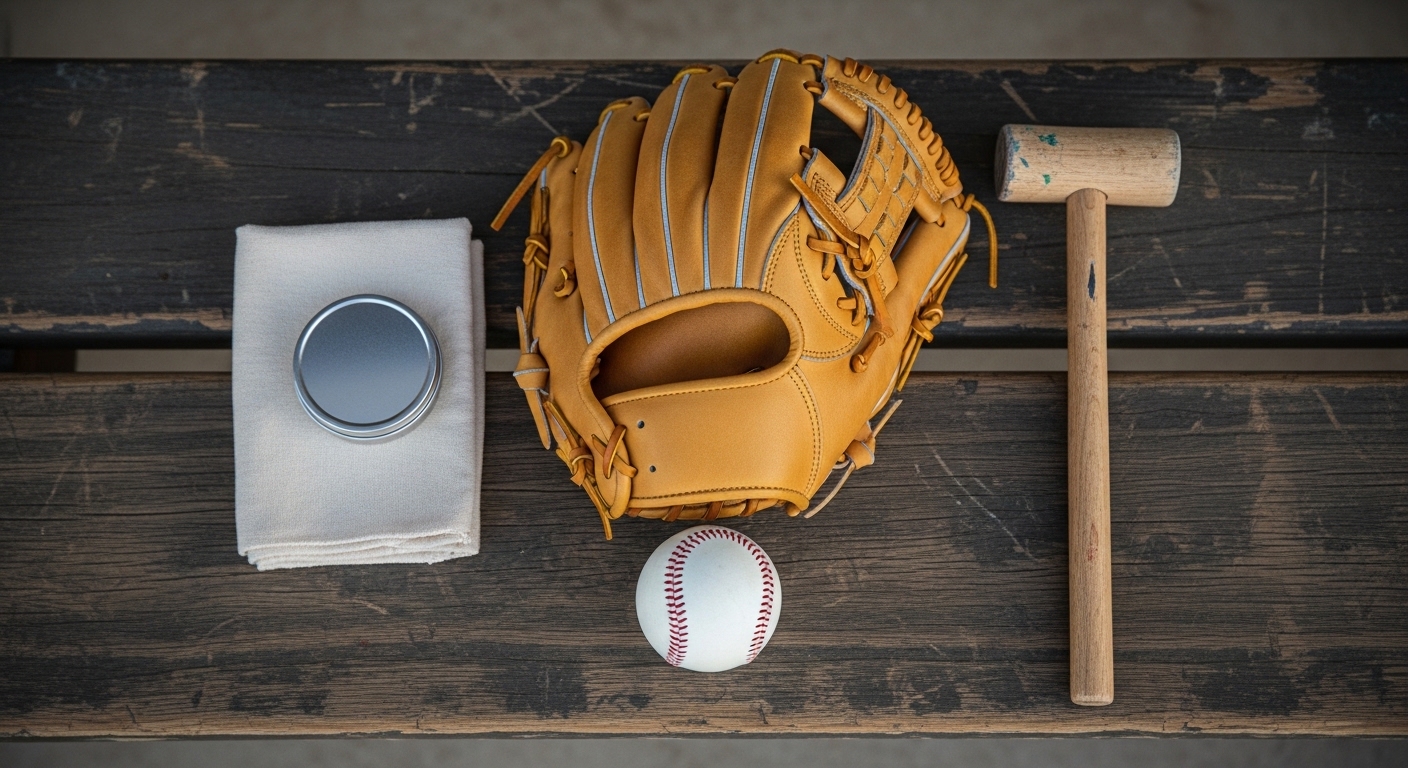
Last spring, one of my 10U infielders showed up to our first game clutching a brand-new first baseman’s mitt his parents had bought the week before. Beautiful glove — stiff as a cereal box. He bobbled three catchable throws in a row, and I could see the frustration building on his face. The glove wasn’t broken in, so the glove was fighting him instead of helping him. We turned it around over the next three weeks, and by game five he was scooping balls in the dirt like he’d had that glove for years.
Breaking in a baseball glove properly takes about two to three weeks of consistent work — hand massage and dry flexing first, then a light coat of conditioner, mallet work while the leather is supple, and finally consistent catch to shape the pocket to your hand. Skip the oven, the microwave, or the hot-water shortcut; those methods destroy the leather fiber and void most manufacturer warranties.
Here’s exactly how we do it.
Why Proper Break-In Actually Matters
A stiff glove doesn’t just feel uncomfortable — it actively costs your kid catches. The pocket hasn’t formed yet, so the ball bounces out instead of nestling in. The hinge points near the heel and along the fingers resist closing, which slows down the snap. For younger players whose hands aren’t yet strong enough to muscle through stiff leather, an unbroken glove can be genuinely demoralizing.
Done right, break-in creates a pocket that fits your player’s hand specifically — the right depth for their position, the right flare on the thumb and pinky for the catches they make most. That’s a performance edge, not just comfort.
What You’ll Need
- Glove conditioner or glove oil (a fingertip-amount per session — less than you think)
- Glove mallet or an old baseball wrapped in a rag
- Rubber bands or a glove wrap to hold the shape overnight
- A baseball for pocket shaping and eventual catch
- Two to three weeks before the season or a key tournament
We pick up glove conditioner and mallets at theranchsports.com — they carry everything on this list, and you get 10% off with no sales tax. The Rawlings Glovolium or Nokona Classic Leather Conditioner are both solid choices; avoid anything petroleum-based like Vaseline, which clogs the leather pores and makes the glove heavy over time.
The Method That Actually Works: Step by Step
Position-Specific Shaping: It’s Not One-Size-Fits-All
This is where most generic guides miss the mark. A shortstop’s pocket and an outfielder’s pocket should look completely different.
Infield (SS, 2B, 3B): Shallow pocket, quick transfer. When you mallet, keep strikes tight and centered. Flare the thumb and pinky slightly outward to create a wider catching face — it helps with in-between hops.
Outfield: Deep pocket to handle fly balls at full stretch. Let the mallet strikes go further back toward the heel. Don’t fight the depth.
First base: The glove needs to fold aggressively from side to side — not cup front-to-back. Pound along the spine and hinge, not just the pocket. We often use our hands as much as the mallet on a first baseman’s mitt because you’re trying to get it to scoop, not clamp.
Pitcher / Catcher: A pitcher’s glove should close tightly to conceal the grip; pound the pocket to close it rather than open it. Catcher’s mitts are built differently and typically need only conditioner plus catch — pounding can misshape the heavy padding.
If you’re still shopping for the right glove for your player’s position, our guide to the best youth baseball gloves in 2026 walks through size, web style, and materials by position and age group.
The Mistakes We See Every Season
Over-oiling is the #1 parent mistake. Parents see a stiff glove and pour oil into it thinking more is better. A waterlogged glove becomes heavy, loses structural integrity, and actually takes longer to break in because the leather is too soft to hold a shape. If the leather is visibly darkened or the glove smells strongly of oil, that’s too much.
Using heat. The oven, microwave, and boiling-water trick all circulate on social media every spring. I’ve personally seen what happens to gloves after parents try these — the leather dries out, cracks along the lace holes, and the padding compresses in ways that can’t be undone. Most manufacturers void their warranty the moment you introduce heat. Just don’t.
Breaking in the wrong pocket shape. If your shortstop pounds his glove closed like a butterfly, he’ll have a slow transfer for the next two years. Shape with intent from day one.
Starting too late. This one hurts to see. A player shows up for the first practice of the season with a glove fresh out of the box. No time to break it in before games start, and they’re playing at a disadvantage for the first few weeks of the season. Start the process the day the glove arrives — ideally a full month before opening day.
How Long Does It Really Take?
Most quality leather gloves are game-ready in two to three weeks of consistent work: nightly ball-and-band, daily catch, and a second conditioner coat around day 10. Cheaper gloves with synthetic leather panels break in faster but wear out faster too.
A professional break-in service (like the one Ball Glove King offers) can compress that timeline to about three weeks from shipping, but you lose the hands-on process. I actually encourage doing it yourself with your kid — the time spent throwing to shape the glove is time spent with your athlete, and they develop a real relationship with their equipment. Kids who break in their own gloves take better care of them.
How to Know When It’s Done
The glove is ready when:
- It closes fully with one hand squeeze (no second hand needed to press it shut)
- The pocket holds the ball without you gripping it
- The hinge doesn’t resist — it snaps closed and springs open cleanly
Once it’s there, maintain it with a very light conditioner coat once or twice a season. Don’t over-condition a broken-in glove; you’ll soften it past the point where it holds shape.
Pair It With Practice
A properly broken-in glove makes every drill more effective. If your infielder is working ground balls, pair this gear investment with solid youth baseball infield drills so the glove gets shaped by real defensive reps, not just catch. Pocket depth forms around the specific catches your player makes most — so the drill work and the break-in work together.
Breaking in a glove is one of the most concrete things a parent can do to help their young player succeed. Two or three weeks of consistent work, done the right way, turns a stiff piece of equipment into a fielding tool that fits their hand perfectly. It’s worth the time — and worth doing right.
For more baseball coaching resources — practice plans, drills, and fundamentals guides — head to our baseball coaching hub.