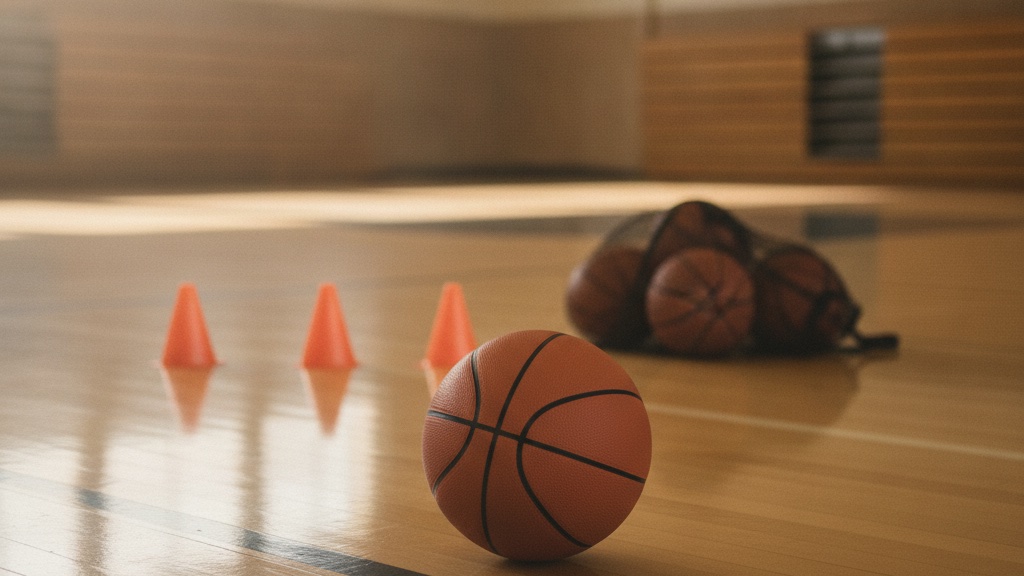
The gym door opens at 6:00. The team before you is still running a scrimmage, there are eleven kids and four parents bunched up by the bleachers, and you have exactly one hour of court time, half of a bag of balls, and a printed roster with two names you can’t pronounce yet. That’s the real first practice of a rec or school basketball season. It’s rarely the clean scenario the sample plans picture.
Here’s the short answer: run a 60-minute first practice that is roughly 70% moving with a ball and 30% talking. Open with a ball in every kid’s hands, teach three things only (the triple-threat stance, a jump stop, and basic player-to-player defense), and finish with a small-sided game so every player touches the ball dozens of times. Skip plays, zones, and long lectures. Your job on day one is to learn names, see who can do what, and send every kid home wanting to come back.
Below is the exact plan we run, the age adjustments, the parent message we send before day one, and the one thing nobody else’s first-practice plan tells you to do.
What the First Practice Actually Needs to Accomplish
Most first-practice advice boils down to “set the tone” and “teach the basics.” True, but vague. We give the first session four specific jobs:
- Learn every name. Use each kid’s name at least three times before they leave.
- Quietly sort the roster. By minute 45 you should know who can dribble with their weak hand, who can catch a pass on the move, and who flinches when someone gets close. That shapes the next six practices.
- Install your two non-negotiables. Ours are “ball on the floor when the coach talks” and “sprint to the huddle.” Two rules, said once, enforced kindly all season.
- Get a win. Every player should do something successful that they can tell their parents about in the car.
If you’re new to coaching the sport entirely, read our guide on how to coach youth basketball for the first time first. It covers the league-rules homework and parent meeting that sit underneath this plan.
Before Day One: The Parent Message
Send this two to three days before the first practice. It heads off the “where do we park, what does she wear, does he need his own ball” texts you’d otherwise field while kids run wild.
Subject: First practice — [Team name], [Day/Date]
Hi families! I’m [Coach name], and I’m excited to coach your kids this season.
First practice: [Day, date, time] at [gym name and which court/door]. Please arrive 10 minutes early. We start on time because our gym slot is short. Bring: basketball shoes (non-marking, worn only indoors if possible), a full water bottle, and a ball if you have one — size [27.5 / 28.5 / 29.5]. Pickup: please be at the door at [end time]. The next team needs the court.
At this first practice we’ll learn names, work on basics, and play a lot. There’s no evaluation and no pressure. If your player has any medical needs I should know about, please reply to this message.
See you on the court!
Not sure which ball size to list? Our youth basketball size by age guide has the chart.
The 60-Minute First Practice Plan
This plan assumes one coach (two is better), one half or full court, and 8 to 12 players. Times are written as minutes from the start of your slot.
Adjusting the Plan by Age
The structure above stays the same; what changes is the content inside each block.
- 8U and younger: Cut the passing block to 5 minutes and add a dribble-tag game. Use a lowered rim (8 feet) and a size 27.5 ball if your gym allows. Keep huddles under 2 minutes. Our 8U basketball practice plan explains why the 10-foot rim backfires at this age.
- 10U: Run the plan as written. You can add one rule from the game during the small-sided block, like traveling, called gently.
- 12U–14U: Add a 5-minute layup line (right side, then left side) after the warm-up and shorten the mirror drill. Older players can handle a short “team identity” conversation in the opening huddle. For what comes after week one, our 12U basketball practice plan picks up from here.
What to Skip on Day One
The fastest way to wreck a first practice is trying to install the whole season in an hour. Leave these out:
- Plays and set offenses. Kids who can’t jump stop yet can’t run a give-and-go reliably. Teach spacing and passing first; plays come weeks later.
- Zone defense. USA Basketball’s youth guidelines recommend player-to-player defense for younger age groups, with zone introduced around 12U, and many rec leagues ban zones outright below that. Check your league rules, but even where zone is legal, a day-one zone hides the kids who need defensive reps most.
- Laps and suicides as conditioning. You get better conditioning from 12 minutes of 3-on-3 than from 12 minutes of running, and kids actually want to come back.
- Long lines. If more than three kids are waiting for one ball, split the drill or add a station.
The Step Most First-Practice Plans Miss: The Clipboard Notes
Here’s the gap we see in almost every first-practice plan we’ve read: it tells you what to run but not what to watch. The first session is the only time you’ll see every kid before they’ve learned your drills, which makes it your most honest evaluation of the season.
I keep three columns on my clipboard during that first hour:
- Weak hand: Can they dribble 5 times with their non-dominant hand without looking? (Yes / sort of / no)
- Catch on the move: In the passing lines, do they catch with hands out and fingers spread, or trap it against their chest?
- Contact comfort: In the mirror drill and 3-on-3, do they step toward the action or drift to the corner?
Last season this exact list told me that more than half our 10U team couldn’t catch a bounce pass cleanly. I had planned to spend week two on shooting. We spent it on catching instead, and by our first game the turnovers on simple passes had mostly disappeared. Without the notes, I’d have blamed the shooting for the losses and drilled the wrong thing.
Fold those three columns into the next three practices. The weak-hand kids get extra reps from our youth basketball ball-handling drills, and the corner-drifters get small-sided games where they’re forced to touch the ball.
After the First Practice
Within 24 hours, send parents a two-line follow-up: one thing the team did well and the next practice time. It takes two minutes and it sets the tone for how you communicate all season. If you want a full season-opening letter, our parent communication letter template is ready to copy.
From there, move into a repeatable weekly structure. Our beginner basketball practice plan gives you the 90-minute version once the season settles in, and you’ll find age-specific plans and drills on our basketball coaching hub.
Download this as a free PDF — get the free PDF here
Get "First Youth Basketball Practice: A Minute-by-Minute Plan" as a free PDF
Instant download, plus free coaching resources in your inbox. No spam.
✓ You're in — here's your download
↓ Download the PDFBookmark it for the field — and check your inbox for more free coaching resources.