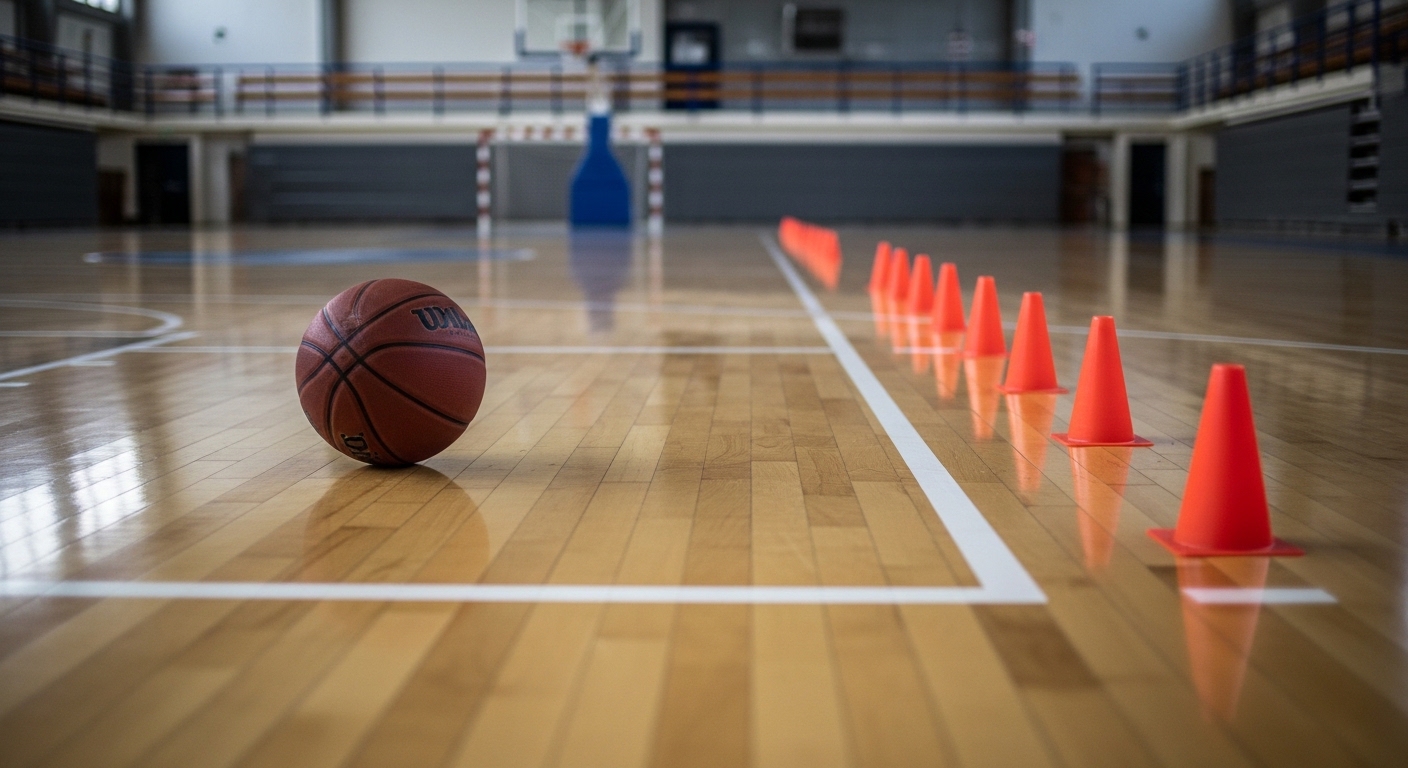
A first-grader walks into your gym, basketball tucked under one arm, sneakers untied, completely unaware there is a practice plan on your clipboard. You call everyone to the center circle and within 45 seconds, three kids are spinning on the floor, one is trying to dribble on another player’s head, and the rest are staring at the gym lights.
Welcome to 6-8U basketball. We love it.
The short answer: the best basketball drills for kids this age are movement games first, skill drills second. At 6-8, players’ bodies are still building the coordination and balance they need to execute basketball skills. Drills that look like games — where they are running, reacting, and competing — teach the neurological wiring that makes real skill stick. Keep each activity under five minutes. Keep it loud. Keep it moving.
Here are six drills we use every season with our youngest players. Each one has a movement-development purpose underneath the basketball skill.
Why 6-8 Year Olds Need Different Drills
Most youth basketball content treats 6-year-olds like smaller 12-year-olds. It does not work. At this age, players are still developing body literacy — the ability to know where their limbs are in space without looking. That is why a first-grader cannot look up while dribbling: their brain is genuinely busy processing both tasks at once.
Research from ProSkills Basketball on youth shooting development makes this point well: deliberate reps work, but only when the player is engaged enough to execute with intent. Lose their attention, lose the learning. The drills below are designed around that reality. We build coordination through basketball, not around it.
If you are still figuring out how to structure the overall session, our youth basketball practice plan for beginners gives you the full 60-minute framework to slot these drills into.
Drill 1: Dribble Tag (Warm-Up + Ball Control)
Time: 5 minutes
This is the first drill we run at every practice. It doubles as warm-up and ball-handling work — and the kids ask for it by name after the first week.
Drill 2: Stationary Pound Dribble (Ball Handling Form)
Time: 3 minutes
After Dribble Tag, we slow down for a focused form block. This is the only drill in the session that is not a game — keep it tight.
Drill 3: Partner Chest Pass Relay (Passing)
Time: 4 minutes
Passing is the most-neglected skill at 6-8U because it requires two kids cooperating at the same time — harder than it sounds. We make it a competition.
I had a 7-year-old named Brennan last fall who could not throw a catchable pass for the first three practices — launching it at the ceiling every time, classic overaim. What worked: we had him step directly toward his partner before releasing. One practice of that single cue, and it clicked. He finished the season as one of our more reliable passers.
Drill 4: Two-Line Layup Walk-Through (Finishing)
Time: 5 minutes
Layups are frustrating at this age because the footwork is genuinely complex. We slow it all the way down.
Drill 5: 1-on-1 Keep Away (Defense + Agility)
Time: 4 minutes
This one is a favorite because it builds defensive footwork and coordination simultaneously — and the kids think it is just a fun game. If you do any athletic development work with your players outside of practice, pairing these defensive footwork habits with agility ladder progressions builds lateral quickness that carries across everything they do on the court.
Drill 6: Around the World Shooting Game (Shooting + Fun)
Time: 5 minutes
We always end with a game that lets players score and feel success. Move the spots in close — 8 feet from the basket for 6-7 year olds, 10 feet for 8-year-olds.
Putting These Together in a Practice
Here is how we sequence this block at the start of a session:
- Dribble Tag — 5 min
- Pound Dribble — 3 min
- Chest Pass Relay — 4 min
- Layup Walk-Through — 5 min
- Keep Away — 4 min
- Around the World — 5 min
That is 26 minutes of focused skill work. For 6-8U, that is close to the maximum before quality drops. Follow it with a small-sided scrimmage and you have a complete 50-minute session. Breakthrough Basketball’s sample practice framework reinforces what we have found in our own gym: capping individual activities at 5-10 minutes and using a skill-then-game format keeps this age group fully engaged through the whole practice. Our youth basketball practice plan for beginners builds out the full session structure including the scrimmage segment and cooldown.
If this is your first season coaching 6-8U, our guide on how to coach youth basketball for the first time covers the mindset and expectation-setting that makes these drills actually land.
The One Thing to Remember
At 6-8 years old, success means kids walking out of practice with a smile and asking when the next one is. Skill development at this age is a byproduct of engagement. When they are having fun, they are building coordination, body awareness, and sport literacy without knowing it. The six drills above are designed to deliver both.
Download this as a free PDF — get the free PDF here
Get "Basketball Drills for Kids 6-8 Years Old: 6 Fun Games" as a free PDF
Instant download, plus free coaching resources in your inbox. No spam.
✓ You're in — here's your download
↓ Download the PDFBookmark it for the field — and check your inbox for more free coaching resources.